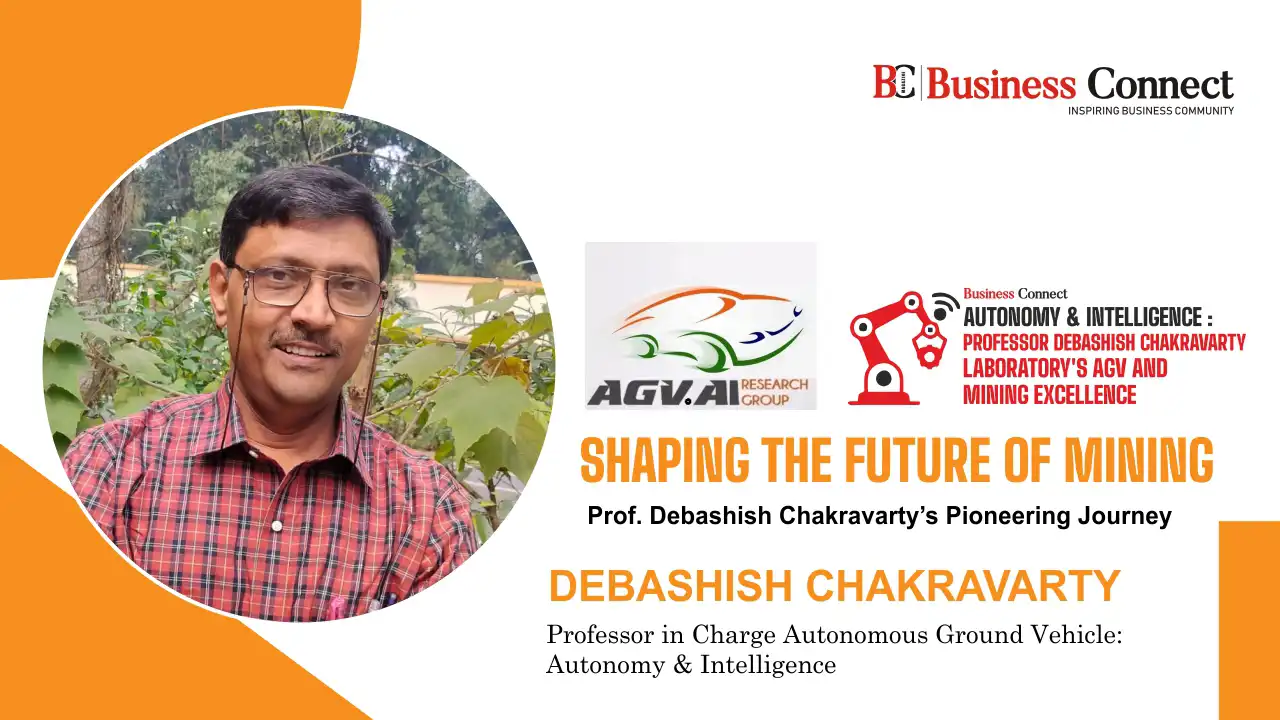
Prof. Debashish Chakravarty is a distinguished leader in mining technologies, renowned for his brilliance and intellectual versatility. With expertise in mining engineering, he has made significant contributions to advance fields like Mine Mapping and Locational Surveillance, Mine Automation, Robotics & Intelligence, Sustainable and Green mining, and Geo Informatics.
Prof. Chakravarty’s academic research focuses on innovative mining technologies, including applied AI, ML, DL techniques, rescue robotics, drones-based applications, SLAM-based robotic surveying/mapping, and extended reality applications that enhance slope stability, situational awareness, production, safety, energy utilization, eco-friendliness with autonomous navigation and efficiency across all phases of mining operations. As the Principal Investigator for the Geo Environmental Parameters Study and developer of the Autonomous Ground Vehicle, he has demonstrated a deep commitment to driving notable change through technologies.
As a Professor in the department of Mining Engineering at IIT, Kharagpur, Prof. Chakravarty has played an instrumental role in shaping the next generation of mining engineers and research. His areas of research include remote sensing, rock mechanics, numerical modelling, and geo-informatics, making him a leading authority in this field. Recently, Prof. Chakravarty had been appointed as the Dean of Alumni Affairs at IIT Kharagpur, followed by the Dean of International Relations at IIT Kharagpur further solidifying his leadership role within the institution.
From Passion to Leadership: The Inspiring Journey
Prof. Chakravarty’s professional journey began during his undergraduate days, driven by a desire to help industrial officials improve workplace awareness and safety through technological setups and interventions. He focused on integrating sensing devices to enhance human capabilities, exploring 3D perception, localization, mapping and navigation.
Over time, his passion for research and execution of highend scientific and advanced technological concepts led him to autonomous and intelligent systems. This interest eventually guided him to spearhead the Autonomous Ground Vehicle: Autonomy & Intelligence Research Laboratory at IIT Kharagpur.
Interdisciplinary Innovations in Mining Engineering
Prof. Chakravarty’s specialisation in mining engineering was inspired by the field’s complexity and the need for interdisciplinary knowledge for the Mines of Future which would be High Performing Mining typically adhering to higher environmental and productivity norms. He found the 3D representation of the mineralised zone, rock- machines, and ventilation planning fascinating. As his research progressed, he recognised the importance of integrating digitally aligned sensory systems to acquire a priori knowledge about mineralised zones and ensure efficient operations in the form of Digital Twins of the mining areas.
This has led to an interdisciplinary approach, incorporating autonomy and intelligence to improve mining operations and meet regulatory needs. Prof. Chakravarty’s work now combines mining engineering with advanced technologies to drive innovation and sustainability towards zero-waste usages of all natural resources.
Shaping the Future of Mining Engineering
Prof. Chakravarty’s career at IIT Kharagpur has been marked by defining moments that have impacted his vision as an educator and innovator. His early work in numerical modelling using numerical techniques, like finite element, FE-DE approaches etc for stability analyses of large geo-structures to micro-mechanical modelling of these, highlighted the need for more realistic characterisation of geo-objects. Discussions with his PhD supervisor and Doctoral Scrutiny Committee members sparked his interest in integrating additional information into numerical models using sensors. The use of digital cameras to record observations during experiments provided valuable insights, leading him to explore penetrative image technologies for better understanding.
Mentoring the Next Generation Leaders
Prof. Chakravarty’s approach to mentoring emphasises the development of value and skills beyond technical expertise. He strives to instil curiosity, resilience and ethical responsibility in his students, encouraging them to think critically, resolve problems efficiently and communicate their ideas clearly. By fostering collaboration, integrity, and adaptability, he prepares his students to work well in diverse teams and overcome new challenges. A key aspect of his mentorship is promoting lifelong learning, ensuring that his students develop critical thinking and problemsolving skills, but also to communicate their ideas clearly, collaborate effectively, and maintain integrity in their research.
Collaboration Ecosystem: Partnering with MSMEs, Startups, and NGOs
Collaboration is not just a part of the ethos; it is the lifeblood of everything Prof. Chakravarty and his team do. Their approach to collaboration is multifaceted, engaging industries, MSMEs, startups and NGOs in a dynamic ecosystem.
Industries: The Problem Solver
Real-world problem-solving: AGV.AI partners with large industries to tackle persistent problems, offering rapid academic prototyping and out-of-thebox thinking. Talent pipeline: Industries gain access to a highly trained talent pool that understands their core challenges.
Mutual benefits: AGV.AI gains invaluable problem statements, industrial-scale data, and testing opportunities.
MSMEs & Startups: Agile Innovators
Symbiotic Growth: AGV.AI collaborates with startups and MSMEs on speed, agility, and symbiotic growth.
R&D support: AGV.AI acts as an outsourced R&D wing, providing access to students for internships and specialised lab equipment. Real-world education: Students gain practical experience building something from the ground up.
NGOs: The Purpose Drivers
Mission-focused: AGV.AI partners with NGOs on a shared sense of purpose, leveraging technology for societal good. Technical Expertise: AGV.AI applies its technical skills to address NGO challenges, such as environmental monitoring and search-and-rescue operations.
By creating a cycle of collaboration, AGV.AI fuels research, inspires students and drives positive impact on society. It’s about breaking down the walls and creating a truly collaborative ecosystem.
Inspiring the Next Generation of Innovators: Creating a Delicate Balance
Prof. Chakravarty balances his roles as a teacher, mentor, and researcher by embracing the interconnectedness of each role. His research keeps his teaching current and relevant, while teaching grounds him and reminds him of the fundamentals, and mentoring allows him to witness the growth of ideas and people. He creates an environment where students feel encouraged to ask questions, explore, and learn from failures. By sharing his own research journey, he models curiosity, humility, and persistence, encouraging students to forge their own paths.
Prof. Chakravarty sees his roles as complementary, with research fueling his teaching, teaching sparking new ideas, and mentoring bringing it all together. He believes that by demonstrating a lifelong commitment to learning, he empowers students to take ownership of their own educational journey towards professional excellence benefitting the country and the society globally.
Navigating Challenges with Curiosity and Collaboration
Prof. Chakravarty’s academic and professional journey has been marked by hurdles, including navigating uncertainty, adapting to evolving technologies and balancing academic responsibilities with institutional roles. There were times when resources were limited, or projects did not go as planned, or ideas were ahead of their time. He was greatly inspired by his parents, family members, his brilliant students including those of the AGV.AI research group and excellent professor, like Professor Partha Pratim Chakrabati of Computer Science and Engineering, IIT Kharagpur and some others, for taking up these challenging tasks of academic field research in these areas of high utility and societal impact.
Despite these obstacles, Prof. Chakravarty has learned to stay curious, committed, and open to learning, often stepping outside his comfort zone. Collaboration with brilliant students and colleagues has been instrumental in overcoming challenges, bringing fresh perspectives and energy to his work. Prof. Chakravarty sees challenges as an integral part of the path instead of roadblocks. Each hurdle has taught him something new, whether about the science, the system, or himself.
Motivated by Curiosity and Impact
Prof. Chakravarty’s motivation stems from a mix of curiosity, purpose, and the excitement of the unknown. The rapid evolution of autonomy and intelligence fields keeps him energised, with new challenges and opportunities emerging constantly. However, what truly motivates him is the potential for impact, seeing how research can improve lives through safer mining systems, smarter mobility, and accessible technology.
Working with students who ask fearless academically challenging questions and think in bold new ways keeps Prof. Chakravarty motivated. Their energy and ideas are often the spark that pushes him and his team into new frontiers they might not have imagined on their own.
Remarkable Milestones and Future Outlook
Prof. Chakravarty has achieved significant milestones, particularly in developing autonomous ground vehicle technology. Some notable accomplishments include:
- Developing the First Autonomous Ground Vehicle Prototype: Successfully created and tested a prototype in the IITKGP campus, overcoming challenges like restricted environments
- Spin-off Success: The company’s spin-offs, Aurobotics and PreImage, demonstrate the lab’s ability to translate research into practical applications and innovative solutions.
Looking ahead, Prof. Chakravarty aims to nurture the next generation of students with fresh ideas for innovation and research, contributing to India’s leadership in intelligent and autonomous and geo-spatial technologies.
Inspiring the Next Generation Leaders
As a role model, Prof. Chakravarty has a message for students and young professionals about perseverance and building impactful careers. With advanced tools and technologies readily available, the current generation has a unique opportunity to make a significant impact.
By staying passionate about high-end scientific and technological research applications, students can harness these tools to drive progress and benefit both themselves and society. Prof. Chakravarty hopes the next generation will seize this opportunity and become the future torchbearers of innovation and leadership, shaping a brighter future for the nation and world.
Shaping the Future: Autonomous Systems and Intelligent Technologies
Human society is constantly evolving, and autonomous systems have become an integral part of daily life. The future of India and the world depends on these technologies, which not only make life comfortable but also help comply with the SDG goals in various fields.
These autonomous systems and intelligent technologies will have a major impact on society, enhancing efficiency, improving decision-making and transforming industries. India can also play a primary role in this journey by investing in research and development, developing a skilled workforce, and implementing autonomous systems in diverse fields.