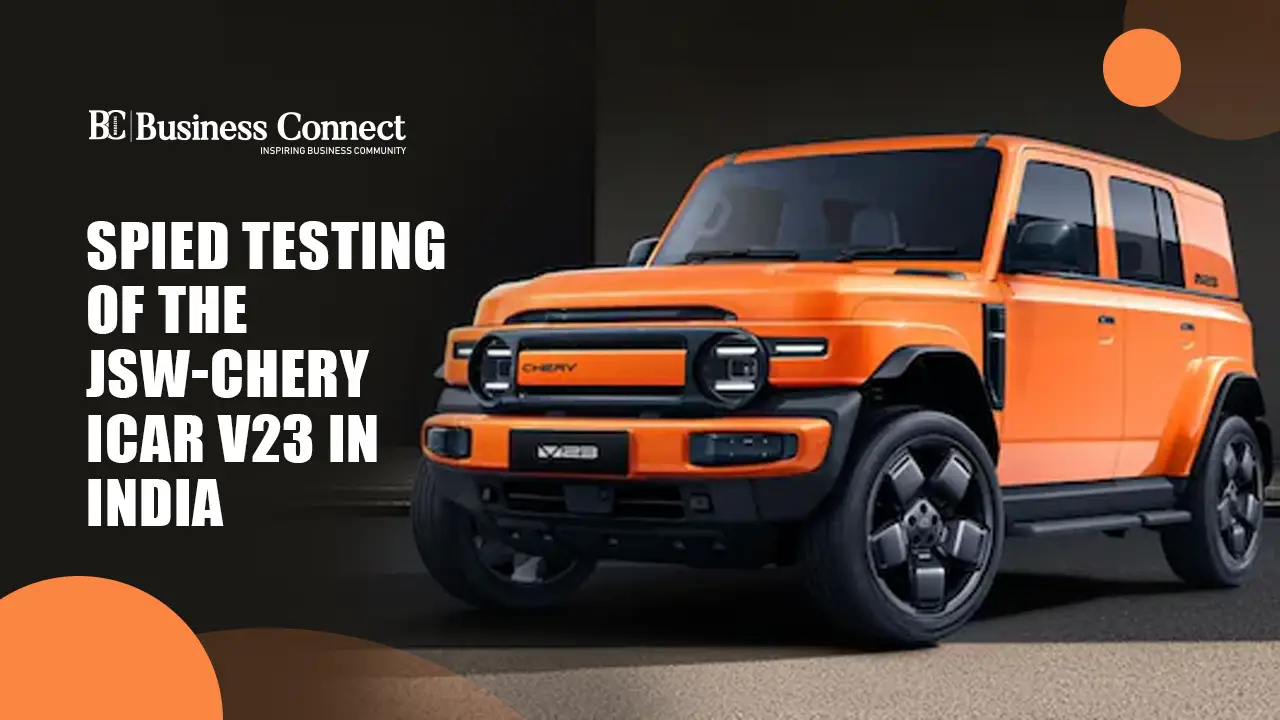
Chery iCar V23–Based Electric SUV Spotted Testing in India Ahead of JSW Launch
A camouflaged electric SUV believed to be based on the Chery iCar V23 has been spotted undergoing road tests in India, hinting at progress in the collaboration between JSW Group and Chery Automobile. The upcoming model is expected to be introduced under JSW’s new automotive brand, which will operate alongside MG Motor India in the company’s expanding mobility portfolio.
Globally, the SUV is sold as the iCar V23, but the India-spec version is expected to arrive with a new name and branding as part of JSW’s strategy to introduce Chery-derived vehicles customised for the Indian market.
This approach mirrors the earlier rebadging of the MG Windsor EV, which is derived from the Wuling Cloud EV and has gained notable traction in the Indian EV market. Encouraged by that success, the conglomerate appears to be expanding the rebadging strategy to more electric models.
Design and Dimensions
The iCar V23 is a compact electric SUV developed under Chery’s iCar sub-brand and was first introduced in China in 2024. The model targets lifestyle-oriented EV buyers and features a rugged, off-road-inspired design.
Spy images from India reveal a boxy silhouette, upright stance, and short overhangs, giving it a mini off-roader character reminiscent of classic utility SUVs. Design highlights include:
-
Round LED headlamps
-
Squared-off wheel arches
-
Chunky body cladding
-
High ground clearance
Globally, the V23 measures 4,220 mm in length, 1,915 mm in width, and 1,845 mm in height, with a 2,730 mm wheelbase, placing it firmly in the compact SUV segment.
Powertrain and Battery Options
Internationally, the iCar V23 is offered with multiple battery and drivetrain configurations.
Entry-level variants feature a single rear-mounted electric motor producing around 100 kW (136 PS) and 180 Nm of torque. These versions are paired with battery packs ranging from approximately 47 kWh to 59.9 kWh.
Higher-end variants offer a dual-motor all-wheel-drive setup delivering up to 214 PS and 292 Nm of torque. These models can be equipped with a larger 81.7 kWh battery pack, offering a claimed driving range of up to 501 km (CLTC cycle).
The SUV also supports DC fast charging of up to 85 kW, allowing quicker charging during long journeys.
However, the exact specifications of the India-bound version are yet to be confirmed and may differ depending on localisation and pricing strategies.
Expected Positioning in India
Once launched in India, the V23-based model is expected to be positioned as a compact lifestyle electric SUV.
Its rugged styling and compact footprint could attract buyers looking for an electric alternative to lifestyle SUVs and compact off-roaders that are expected to enter the market in the coming years.
Industry estimates suggest a potential price range between ₹16 lakh and ₹20 lakh, depending on localisation levels, battery options, and feature packages.
Local Manufacturing Plans
Unlike several early EV models that were imported, the India-spec SUV is expected to be locally manufactured.
Production will likely take place at JSW’s upcoming New Energy Vehicle facility in Chhatrapati Sambhaji Nagar (formerly Aurangabad), Maharashtra. The plant is currently under development and is a key part of JSW’s strategy to enter the passenger vehicle segment.
Manufacturing operations are expected to begin in the second half of 2026. Initially, the company may rely on imported kits or components sourced from China, but localisation levels are expected to increase gradually over time.
JSW’s Expanding EV Strategy
The V23-based SUV is likely to be among the first models under JSW’s upcoming automotive brand, which will operate alongside MG Motor within the group’s growing EV ecosystem.
With India’s electric vehicle market expanding rapidly, the partnership with Chery allows JSW to leverage global EV technology and platforms while adapting products to suit Indian roads, regulations, and consumer preferences.
More information about the India-specific name, features, and launch timeline is expected to emerge as road testing continues in the coming months.