
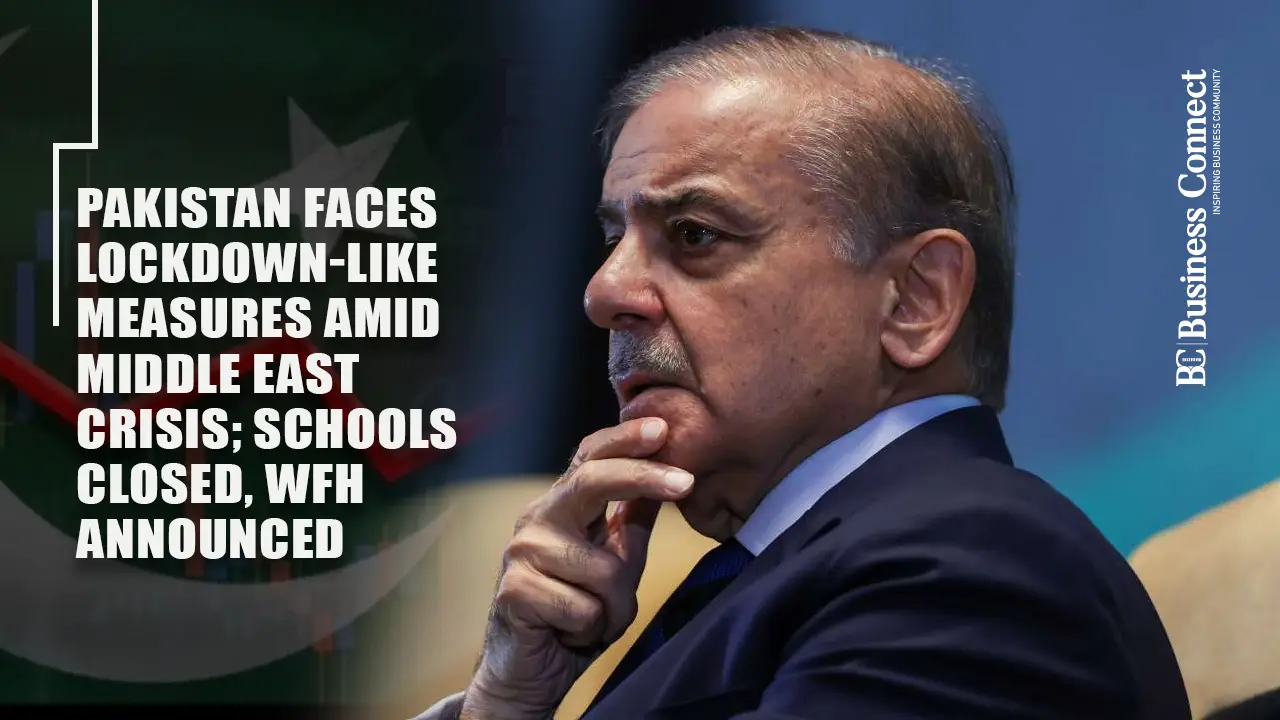
New Delhi Following a spike in oil prices above $100 per barrel due to the Middle East conflict, the Shehbaz Sharif government announced a number of fuel-saving measures on Monday. According to the Pakistani government, government offices would only be open four days a week and schools will be shuttered for two weeks. Prime Minister Shehbaz Sharif informed the media on Monday, “Government offices—aside from banks—will remain open only four days a week to save fuel,” according to the Reuters story. All schools will be closed for two weeks following the end of this week. Higher education classes will be held online in order to save fuel.
He went on to say, “Apart from essential services, 50 percent of staff in government departments will work from home to save fuel.” Additionally, the prime minister declared that government departments will receive 50% less fuel over the course of the next two months.
Here are some of the key measures announced by PM Shehbaz Sharif:
- Fuel allowances for government vehicles will be cut by 50 percent for the next two months
- Operational vehicles such as ambulances and public buses will be exempted.
- For the next two months, 60 percent of government vehicles at all federal and provincial offices will remain grounded.
- Federal and provincial cabinet members will not take their salaries and allowances for the next two months.
- Salaries of members of federal and provincial legislatures will be reduced by 25 percent for two months.
- BS-20 government officers in federal and provincial offices earning Rs 300,000 or more will forgo two days’ salary
- Health and education sector officials will be exempted.
- Non-employee related expenses at all federal and provincial offices will be reduced by 20 percent for the fourth quarter.
- 50 percent of public sector staff will work from home, except those providing essential services.
- Public sector workplaces will operate four days a week, with essential services and the banking sector exempted.
- All higher educational institutions will conduct online classes from March 16 to March 31, while schools will remain closed for two weeks during this period.
- Purchases of vehicles, furniture, air conditioners, and other items for government departments will remain banned until June 2026.
- Foreign visits by ministers, advisers, and government officials will be restricted unless deemed necessary in the national interest.
- Teleconferencing and online meetings will be prioritized to save fuel.
- Official dinners and iftar parties will be banned.
- Seminars and conferences will be held at government venues instead of hotels.
Why was this choice made?
Pakistan has experienced a severe fuel scarcity as a result of the ongoing situation in the Strait of Hormuz, which is the outcome of the war among the United States, Israel, and Iran. It is noteworthy that a large amount of Pakistan’s oil supply passes via the Strait of Hormuz, and the country was compelled to announce a rise in gas prices on Saturday as a result of recent limitations.
At a late-night news conference, the Pakistani government announced the biggest increase in fuel prices in the nation’s history—55 PKR, or almost 18 Indian rupees. Finance Minister Muhammad Aurangzeb, Deputy Prime Minister and Foreign Minister Ishaq Dar, and Petroleum Minister Ali Pervaiz Malik also attended the news conference.
Gas prices are skyrocketing.
Additionally, the cost of high-speed diesel has significantly increased. The studies state that the rates have gone up by twenty percent. For the upcoming week, the price of diesel, which was previously PKR 280.86 per litre, has been set at PKR 335.86.
Pakistan’s Petroleum Minister Ali Pervaiz Malik stated, “The fire that started in a neighboring country has spread across the entire region,” in reference to the price increase. There is no set schedule for when this crisis will end, and we have no idea how long it will persist.”