
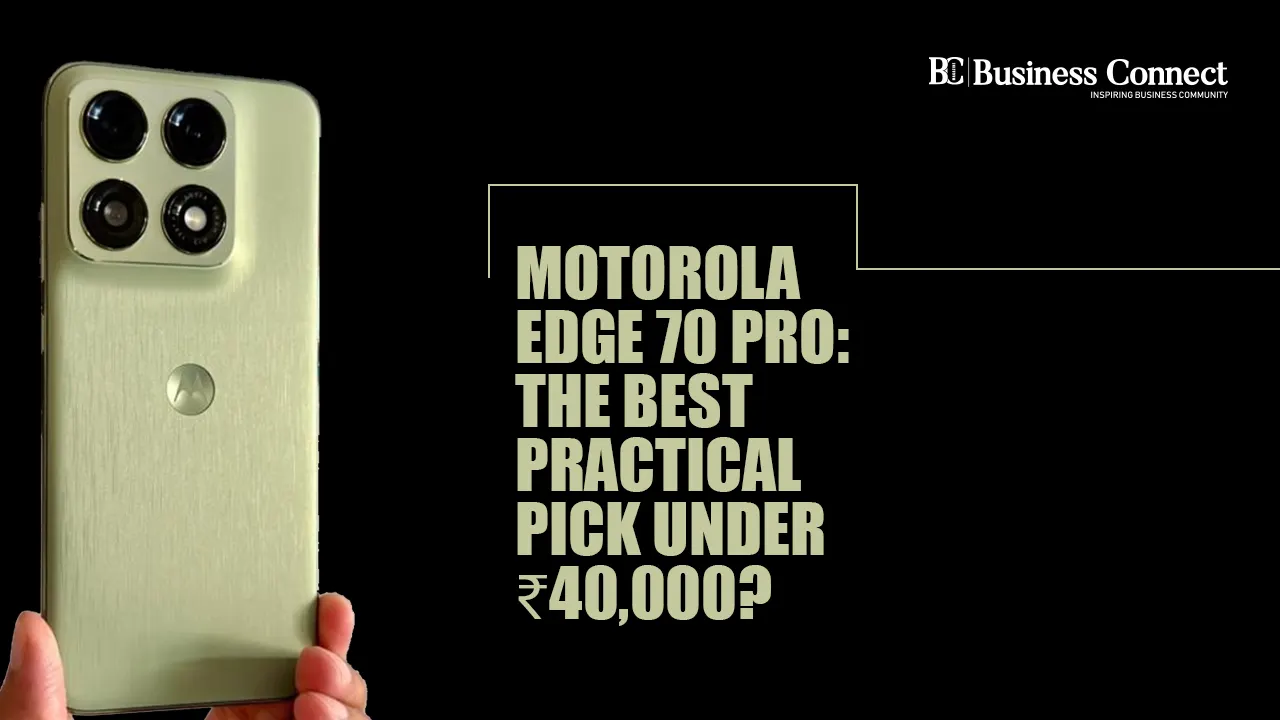
The Motorola Edge 70, which was released towards the end of last year, is undoubtedly a very amazing smartphone. Impressive core components include the ultra-slim design, the Pantone-optimized camera, and a display that matches professional-grade panels.
The newest model in that lineup, the Motorola Edge 70 Pro, is working hard to live up to the “pro” designation. Above all, I would say that this is yet another excellent chapter of phones around ₹40,000 that are excellent enough to be referred to as “flagship alternatives,” even though the term seems out of style these days.
With prices beginning at ₹36,999, it also raises the stakes in terms of pricing. This places the Samsung Galaxy A57, the OnePlus Nord 6, and the Nothing Phone (4a) Pro in direct competition with the Motorola Edge 70 Pro.
Because this troika has greatly improved the generational game, highlighted by superior technology and software, it is crucial to note the trajectory here. A layer of inspiration from the extremely remarkable flagship Motorola Signature becomes more apparent the more the Edge 70 Pro is used, and that should add value overall.
With further enhancements, the three essential components of the foundation that I previously discussed continue here as well. A larger 6,500mAh battery is paired with an incredibly thin design (albeit the “Pro” requirements imply it’s 6.99mm instead of 6mm like the Edge 70).
A similarly competent 6.8-inch AMOLED display that can match the camera’s optimizations complements the Pantone-verified camera image processing for colors and skin tone. The Mediatek Dimensity 8500 Extreme chip’s 4-nanometer design and a sizable 6,500mAh battery combine to provide performance and battery longevity that, in my opinion, is more than sufficient for the future.
When compared to the Samsung Exynos 1680 and the Qualcomm Snapdragon 7 Gen 4, the MediaTek Dimensity 8500 Extreme, which offers 8GB and 12GB memory options (the latter is recommended), performs more than adequately.
However, the OnePlus Nord 6 may have noticeably more performance headroom with the Snapdragon 8s Gen 4. Generally speaking, real-world usage won’t show much of a difference in general snappiness and fluidity unless you’re planning to compare with synthetic benchmarks (software optimization must also be taken into account), but extended multitasking will.
The OnePlus Nord 6 may be the only phone that can equal the Motorola Edge 70 Pro in terms of future-proofness.
When the Motorola Edge 70 Pro is under stress, there is some obvious heating on the back panel (the North Indian summer afternoons made their presence felt after some extended camera usage). The key to this discovery is that, although this phone features a vapor cooling chamber, it is somewhat smaller than certain competitors.
Thermals won’t be difficult on either side of a heatwave, and this has also been observed on flagships in prior years during the busiest summer months. Unless, of course, you play games on a regular basis. The Motorola Edge 70 Pro will function flawlessly for average users.
When compared to its predecessor, the Edge 60 Pro, Motorola made an odd decision regarding the cameras. The Edge 70 Pro maintains its 50-megapixel wide and 50-megapixel ultra-wide sensors, but the third troika sensor is a light sensor rather than a telephoto (the Edge 60 Pro featured a 10-megapixel telephoto, a little more versatile for photography).
The 50-megapixel selfie camera is also fantastic for video calls with loved ones. Apart from that sensor selection, the camera’s general optimization and placement produce highly appealing images. Personal tastes will also play a role, as will the colors and general tone.
For daylight shots, this would be, in my opinion, significantly superior to the Nothing Phone (4a) Pro and comparable to the OnePlus Nord 6. However, the Motorola Edge 70 Pro has an edge with stronger contrast, which makes everything in the frame appear better, richer, and more lively.
The Motorola Edge 70 Pro outperforms its competitors in low-light photography, and this advantage must be due to the light sensor; images are sharper, there is less background noise, and staring at a light source doesn’t cause a flare that ruins a picture.
The Motorola Edge 70 Pro’s 6,500mAh battery isn’t the largest in this price range (the Nord 6 has a 9,000mAh battery), but it’s still more than the others due to its thin design. For Motorola’s engineers and designers, that is no small accomplishment. Nearly 6 hours and 15 minutes of active screen time before you have to plug this in is rather stable and adequate real-world stamina. This 90-watt charging speed is sufficient for a quick splash and dash before leaving for the next meeting.
There have always been benefits to the clean Android experience, even before Motorola’s most recent spec stack with the Edge 70 and now the Edge 70 Pro took center stage (most other phone makers can only come this close since income streams take center stage later). Due to the additional costs associated with memory and storage, the Motorola Edge 70 Pro has had to endure the test of time. As a result, it does not include wireless charging or a light sensor in place of a telephoto.
Nevertheless, nothing is left up to chance thanks to the core experience built on top of a highly powerful Dimensity 8500 Extreme chip, a reliable 6,500mAh battery, and an optimized display. You’ll occasionally find useful Moto AI capabilities, some intriguing editing tools, and precisely the appropriate amount of AI processing for images and movies.
It’s hard to choose a favorite amongst the Pantone Lily White, Pantone Tea, and Pantone Titan color options (the Pantone badge of honor is absent on the back panel, for some reason). And that, in a sense, sums up the Motorola Edge 70 Pro the best—this phone has many positive aspects.