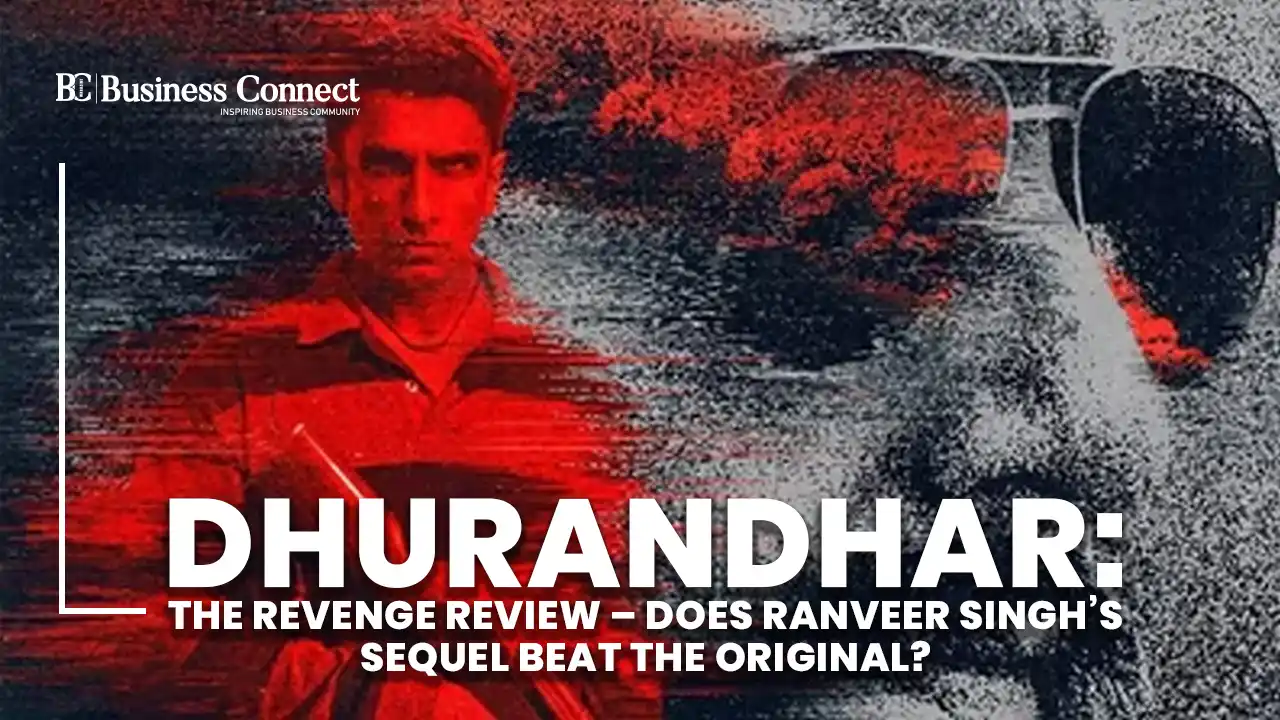
Review of Dhurandhar: The Revenge: Like Ranveer Singh from the first frame, Dhurandhar: The Revenge finally made a big splash in theaters after a protracted wait.
Without giving away too much, Aditya Dhar’s second film takes a more profound and poignant tone. It centers on Jaskirat Singh Rangi’s past and ultimately reveals the trauma that molded him.
Ranveer Singh explains the meaning of the movie’s tagline, “Hosla, Eendhan, Badla,” right from the first scene. The tone for what comes next is established in the opening fight scene, which is enhanced by a strong background score. It draws you right into the film’s intense, high-stakes universe and is undoubtedly one of its most compelling and powerful scenes.
The IC-814 hijacking, the 2001 Parliament attack, and the 26/11 Mumbai terror strikes are just a few of the real-life events that serve as inspiration for the first half of the novel. However, the second half advances the plot with more action, twists, and turns.
How Was the Performance by the Cast?
The ensemble in Dhurandhar: The Revenge gives a strong and convincing performance overall, much like in the first section.
Ranveer Singh gives it his all, entering an even more powerful “beast mode” than previously. His ability to strike a balance between violence and restraint is what makes Jaskirat Singh Rangi feel both strong and emotionally damaged.
This time, Arjun Rampal’s portrayal of Major Iqbal has a more nuanced and significant storyline. He has complete control over the antagonist’s area. You truly hate his character at the end, which is always a victory for an actor playing a bad part.
Ajay Sanyal, played by R. Madhavan, keeps things modest and authentic. His nuanced and serene portrayal gives a character based on actual events more nuance, making it convincing and captivating.
As S.P. Choudhary Aslam, Sanjay Dutt remains threatening. His powerful on-screen persona demands attention in every scene.
Rakesh Bedi stands out on the lighter side. Every time he appears on screen, his comedic timing guarantees that his scenes leave an impression and provides momentary but effective respite.
Despite having little screen time in this film, actors like Gaurav Gera as Mohammad Aalam, Danish Pandor as Uzair Baloch, and Sara Arjun as Yalina are believable and make significant contributions to the story.
Furthermore, although having shorter arcs, Manav Gohil and Mustafa Ahmed have a powerful on-screen presence.
From Salim Siddiqui as Atif Ahmed to Mashhoor Amrohi as Nawab Shafiq, the casting of characters based on real-life individuals is likewise excellent.
What Stands Out?
In Indian cinema, Aditya Dhar’s Dhurandhar universe still feels really unique. The picture stands tall not only for its size but also for how firmly it captures your attention thanks to Vikash Nowlakha’s astute directing and powerful photography.
With its many twists and turns, the story keeps you on the edge of your seat from the outset. With each chapter, it gets more intense, creating suspense and leaving you wondering what will happen next. The film’s smooth transitions between the past and present give the narrative more depth and emotional appeal. Even the violent action scenes feel realistic and never rely too much on visual effects.
The interval hook is yet another important feature. It delivers powerfully and sets up the second half with greater stakes at the ideal moment. The movie easily falls into the category of a classic mass entertainer thanks to its emotionally charged and patriotic rhetoric, heart-pounding scenes, and heroic moments.
What Doesn’t Work?
Despite its strengths, Dhurandhar: The Revenge is not without its flaws.
While the music is impactful, the background score does not quite match the intensity or memorability of the first installment. The film’s length is another concern. Certain portions feel stretched, with a few sequences leaning towards a slower pace.
The violence is also dialed up significantly this time. While it adds to the film’s gritty tone, some scenes are extremely graphic and may feel uncomfortable, especially for those sensitive to gore.
The dialogues, though powerful and mass-appealing, occasionally lean heavily into hyper-masculine themes. Lines like “hum mard hain, humara dharam hai ladna” aim to evoke intensity and heroism but can also come across as reinforcing a more traditional, one-dimensional idea of masculinity.
Is Dhurandhar 2 Better Than the First Part?
In their own unique ways, both sections are equally captivating. After the first film, audiences went into theaters with high hopes, and the sequel mostly lives up to those expectations.
On closer inspection, though, the first section still has a small advantage. It had a stronger and more memorable antagonist presence, such as Rehman Dakiat, a more powerful background score, and a more acute feeling of realism. The story was made more authentic by Aditya Dhar’s skillful integration of real-life audio and visual components. The first movie rarely seemed to be losing steam despite its length.
Even though it is a little less tight than the first, the second part manages to move the plot along in a significant way. In addition to offering unexpected appearances and twists, it expands Jaskirat’s journey, gives his story a fitting and respectful conclusion, and addresses a number of unanswered concerns.
All things considered, both movies continue to be incredibly captivating and compelling, providing an experience that audiences would undoubtedly want to participate in.