
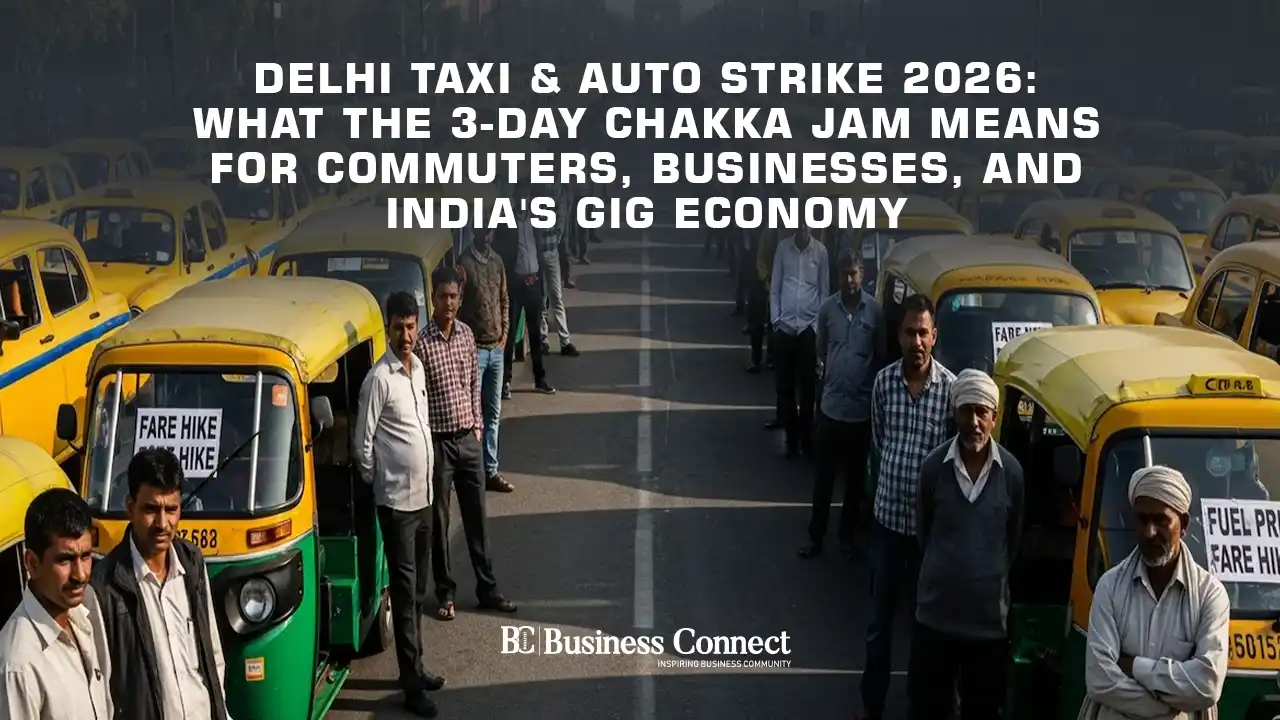
If you are in Delhi-NCR today and wondering why you cannot find a cab or auto — here is everything you need to know.
Starting May 21, 2026, commercial transport unions across Delhi and its surrounding cities have launched a three-day “Chakka Jam” — a full-scale transport strike that is expected to run until May 23. The protest, one of the largest coordinated transport actions in recent Delhi history, has been called by more than 68 transport unions operating under the banner of the All India Motor Transport Congress (AIMTC) and the United Front of All Transport Associations (UFTA).
What Is Happening — The Strike at a Glance
The All India Motor Transport Congress commenced its three-day strike in Delhi-NCR from May 21, 2026. This statewide protest is expected to end on May 23. The reason behind the protest is the latest fuel price hike, the Delhi government’s hike on environment compensation cess on commercial vehicles, and taxi fares which have not increased in the last 15 years.
At least 68 transport associations and unions are carrying out state-wide protests across regions of Delhi-NCR. The United Front of All Transport Associations has announced their support for the protests. Around 4 lakh taxi operators are joining the strike.
The Chaalak Shakti Union has coordinated with multiple groups to call a citywide Chakka Jam on all three days. Anuj Kumar Rathore, Vice President of the union, has said drivers have been urged not to operate their vehicles during this period.
Why Are Drivers Striking? The 3 Core Demands
1. Fare Hike — 15 Years Without a Revision
This is the central grievance. Taxi and auto fares in Delhi have not been revised in 15 years — while the cost of fuel, maintenance, and daily operations has risen dramatically. Drivers argue that operating at current fares is simply not viable.
According to the unions, spiralling prices of CNG, petrol, and diesel have pushed middle-income drivers into severe financial distress.
2. Environment Compensation Charge Rollback
The Delhi government recently hiked the Environment Compensation Charge levied on commercial vehicles entering Delhi. Transport unions — particularly truck and goods vehicle operators — have demanded a rollback of this increase, which they say adds significant cost burden on operators.
3. Regulation of App-Based Platforms
Unions have named app-based cab companies such as Ola, Uber, and Rapido in their objections to current pricing practices. Traditional drivers argue that app-based platforms operate at pricing structures that are not level with the costs traditional operators face — creating an uneven competitive environment.
The unions have formally submitted a representation to Delhi Lieutenant Governor Taranjit Singh Sandhu and Chief Minister Rekha Gupta on May 19, 2026, ahead of the strike.
DELHI LIVE NEWS: What Is Affected Today — May 21, 2026
Likely Disrupted:
- App-based cab services (Uber, Ola, Rapido) — reduced availability
- Auto-rickshaw services across Delhi-NCR
- Commercial taxi operations
- Peak-hour local transport connectivity
- Truck and goods vehicle movement in and around Delhi
Operating Normally:
- Delhi Metro — all lines running as usual
- DTC bus services — operational
- Essential services — unaffected
Important update: Other transport unions in Delhi-NCR have stated that the proposed strike for auto and taxi services has been put on hold for some unions. They clarified that the planned Chakka Jam from May 21 to 23, 2026, applies primarily to truck and goods vehicle operators. A joint protest by the Delhi Auto Rickshaw Union and the Delhi Pradesh Taxi Union is separately scheduled at the Delhi Secretariat on May 23, 2026.
Commuter advisory: Use Delhi Metro for all essential travel today. Book cabs early if needed — surge pricing is likely on app-based platforms due to reduced driver availability.
The Bigger Business Story — What This Strike Really Represents
At Business Connect India, we cover business and entrepreneurship — and this strike is fundamentally a business story. Here is what it means beyond the headlines.
India’s Gig Economy Is at an Inflection Point
The Delhi transport strike is a symptom of a much larger national tension: the collision between India’s traditional service economy and the platform-based gig economy.
On one side — 4 lakh traditional taxi and auto operators who have built their livelihoods around a regulated, government-controlled transport system. Their costs are rising, their fares are frozen, and their customer base is steadily moving to app-based alternatives.
On the other side — companies like Uber, Ola, and Rapido, which have brought convenience, price transparency, and safety features to millions of Indian commuters, while simultaneously disrupting the economics of traditional transport.
Neither side is entirely wrong. And that is what makes this one of India’s most complex ongoing business policy debates.
The Fare Revision Problem — A Government Failure
At the heart of this strike is a simple governance failure: taxi and auto fares in Delhi have not been revised in 15 years. In a city where CNG prices have more than doubled in the last decade, where vehicle maintenance costs have risen sharply, and where the cost of living has transformed — expecting drivers to operate on 2009-era fares is neither sustainable nor fair.
The unions have warned clearly: if the Delhi government does not issue a notification increasing taxi fares within the next two weeks, the agitation will be intensified into a large-scale protest.
For businesses and policymakers, this is a straightforward lesson in regulatory lag — when government policy fails to keep pace with economic reality, the result is always a crisis.
What It Means for Platform Companies
For Uber, Ola, and Rapido — today’s strike is both a short-term challenge and a long-term signal. In the short term, reduced traditional driver supply may actually drive more commuters to app-based platforms, temporarily boosting platform demand.
But in the long term, the demands being raised by traditional unions — fare regulation, platform accountability, level-playing-field pricing — are likely to shape the regulatory environment that governs how app-based platforms operate in India’s largest cities.
Our Take — Business Connect India
This is not just a transport story. It is a story about what happens when 4 lakh livelihoods get squeezed between rising costs and frozen revenues — with no regulatory relief in sight for 15 years.
We have enormous respect for the entrepreneurial spirit of India’s traditional transport operators. Every taxi owner is a small business owner. Every auto driver is an entrepreneur managing their own capital, their own risk, and their own operations.
When small business owners reach breaking point — they strike. And governments that ignore them for 15 years should not be surprised when they do.
The Delhi government must act — not just on fare revision, but on a comprehensive framework that acknowledges the changed economics of urban transport in 2026. A framework that is fair to traditional operators, accountable for app-based platforms, and sustainable for commuters.
Until then, Delhi will keep seeing Chakka Jams.
What Should Commuters and Businesses Do?
For commuters today:
- Use Delhi Metro as your primary mode of transport
- Book app-based cabs well in advance — expect surge pricing
- Allow extra travel time — 30 to 45 minutes additional buffer
- Work from home if possible for the next 3 days
For businesses in Delhi-NCR:
- Alert employees about the strike and offer flexible timing
- Postpone non-essential deliveries and logistics movement
- Communicate proactively with clients about potential delays
What Happens Next?
The unions have issued a clear warning: if fare revision notification is not issued within one to two weeks, the agitation will be intensified into a large-scale protest — for which the unions say the Delhi government will be solely responsible.
A joint protest by the Delhi Auto Rickshaw Union and the Delhi Pradesh Taxi Union is scheduled at the Delhi Secretariat on May 23, 2026 — the final day of the current Chakka Jam.
Business Connect India will continue to track this story as it develops.
Are you affected by the Delhi transport strike today? Share your experience in the comments below.
— Business Connect India Team.
Editor’s Note: Anurag Tiwari from Business Connect Magazine, I believe every protest is also an economic story. Today’s Delhi taxi and auto strike is not just about commuter inconvenience — it is a flashpoint for one of India’s most important and unresolved business debates: how do you balance the livelihoods of 4 lakh traditional transport workers against the rise of app-based platforms?