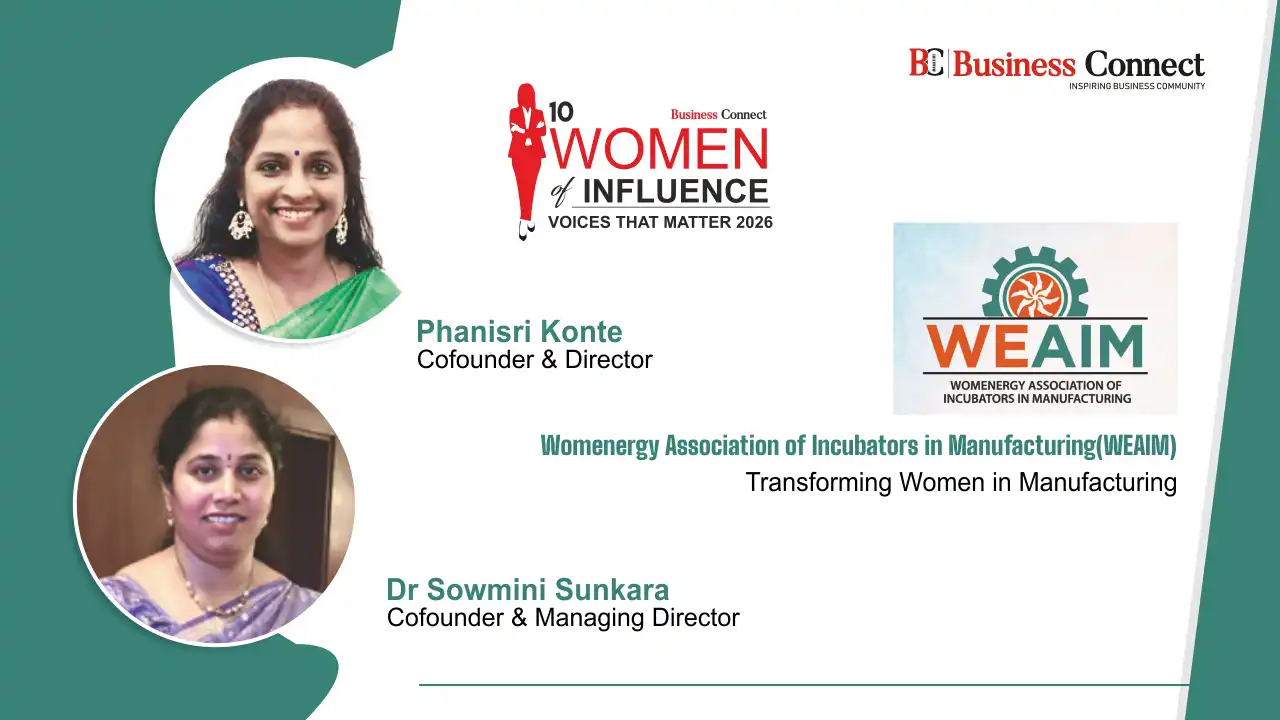
There’s something quietly shifting in the air this March. Not loud, not performative, but steady. Almost like a recalibration of what empowerment actually means, beyond panel discussions and social media captions. Because for a long time, we’ve spoken about women empowerment as a sentiment. Today, it is beginning to look more like structure, access, and long-term economic participation. And somewhere within this shift, organizations like Womenergy Association of Incubators in Manufacturing (WEAIM) are not just participating in the conversation , but changing the course of direction.
The Space No One Was Really Building For
For years, the narrative around women entrepreneurship in India largely revolved around small businesses, homegrown brands, or serviceled ventures. While important, there was a visible gap, one that rarely made it to mainstream conversations. Manufacturing. It is, by design, a demanding sector. Capital-intensive, compliance-heavy, deeply networkdriven. And for many women, especially first-generation entrepreneurs, it remained a distant possibility rather than an accessible pathway.
WEAIM steps into this exact gap. Not as a surface-level support system, but as a structured ecosystem built with a clear understanding of the challenges women face when entering industrial spaces. Founded by first-generation women entrepreneurs themselves, WEAIM doesn’t operate from theory. It operates from lived experience.
A System That Actually Holds
At the heart of WEAIM lies its START IT – SCALE IT Cell, which, in many ways, redefines what incubation should look like. Because for most women stepping into manufacturing, the challenge is not just starting, its navigating everything that comes after. Registrations, compliance, funding, market validation, production scaling… each step layered with complexity.
Instead of fragmented guidance, WEAIM offers something far more cohesive. A stage-based model that supports women from idea validation all the way to industrial growth. Not in isolated bursts of mentorship, but through continuous, execution-driven support. And that distinction matters. Because inspiration, while important, does not build enterprises, but systems do.
When Empowerment Moves From Idea to Income
Perhaps the most telling measure of any initiative like this is not in its framework, but in its outcomes. And here, the impact becomes tangible. Women who once operated within informal, home-based setups have transitioned into registered MSME manufacturers. What began as limited, often inconsistent income streams have evolved into stable businesses with formal market access.
In some cases, entrepreneurs have moved from small-scale food production to establishing certified units with approvals and institutional orders. In others, women dependent on seasonal earnings have expanded their manufacturing capacity, supported by machinery access and financial linkages. But beyond the numbers, the real shift is quieter, and deeper.
Now, there is financial independence, decision-making power and a visible change in how women see themselves within their families and communities. Because when a woman begins to earn not just income, but authority, the ripple effect is rarely limited to her alone.
Building Markets Not Just Businesses
One of the more nuanced challenges in women-led enterprises is not just production, but it is visibility. Creating a product is one part of the journey. Ensuring it reaches the right markets is another. Through WEMART Global, WEAIM extends its support beyond incubation into market access. The initiative brings women-led products into retail and digital ecosystems, making them visible, accessible, and scalable. But what stands out is the approach to technology here.
Rather than positioning tech as a barrier, it is introduced as an enabler. Many of whom are first-time digital users, are guided through ecommerce onboarding, product cataloguing, and digital transactions in a way that feels practical, not overwhelming. It’s a small but significant shift. Because inclusivity is not about introducing tools, but about making them usable.
A Culture That Doesn’t Romanticize the Journey
There is often a tendency to romanticize entrepreneurship, especially when it intersects with empowerment narratives. WEAIM, however, takes a more grounded approach. Its internal culture leans heavily on mentorship over hierarchy, and execution over rhetoric. There is empathy, yes, but paired with accountability. Support, but not without structure.
A community mindset that values shared growth, without diluting individual responsibility. This balance is what allows the ecosystem to remain both human and effective. Because real empowerment is rarely built on motivation alone. It is sustained by clarity, consistency, and measurable outcomes.
Innovation That Listens Before It Builds
In a rapidly shifting economic landscape, staying relevant requires more than agility, it requires awareness. WEAIM’s approach to innovation is less about chasing trends and more about responding to real-time needs. Whether it is integrating digital retail through WEMART Global or creating platforms like EmpowHer 2026, the focus remains on building bridges, between industries, policymakers, and entrepreneurs.
These intersections matter. Because the future of manufacturing, especially for women, will not be built in isolation. It will be built through collaboration, access, and exposure to evolving market realities.
Redefining Sustainability Quietly
There is a certain overuse of the word sustainability today. But within WEAIM’s framework, it takes on a more grounded meaning. Not as a branding layer, but as long-term economic stability. By enabling women to build compliant, scalable enterprises, the organization contributes to something far more enduring than short-term success, livelihoods that sustain families, create employment, and strengthen local economies.
Through responsible production practices and alignment with broader development goals, the impact extends beyond individual businesses into community-level transformation. And that, perhaps, is where real sustainability begins.
With Intent Not Just Ambition
The vision set by co-founders Dr. Sowmini Sunkara and Phanisri Konte are both ambitious and precise. To nurture one lakh women manufacturers by 2030 is not just a number. It is a structural shift waiting to happen. It speaks of industrial clusters led by women, export-ready enterprises, and a future where women are not just participants in manufacturing, but decision-makers, innovators, and leaders within it. There is clarity in this vision. But more importantly, there is a roadmap. Because scale, without structure, rarely sustains.
A Thought That Stays With You
As per co-founders of this stellar organization, empowerment is not a moment, if there is one concept that subtly guides this whole journey. It is a process that starts with having the guts to think for oneself, but it is maintained by having access to markets, resources, knowledge, and appropriate ecosystems. Most significantly, it is strengthened by the conviction that personal life and ambition are not mutually exclusive.
They should and can coexist. Because the result is more than just personal achievement when women are able to build with clarity, earn with confidence, and lead without hesitation. It is a society that is more resilient, progressive, and balanced. Perhaps this new stage of empowerment is deeper rather than louder.