
Most businesses do not fail because of weak strategy
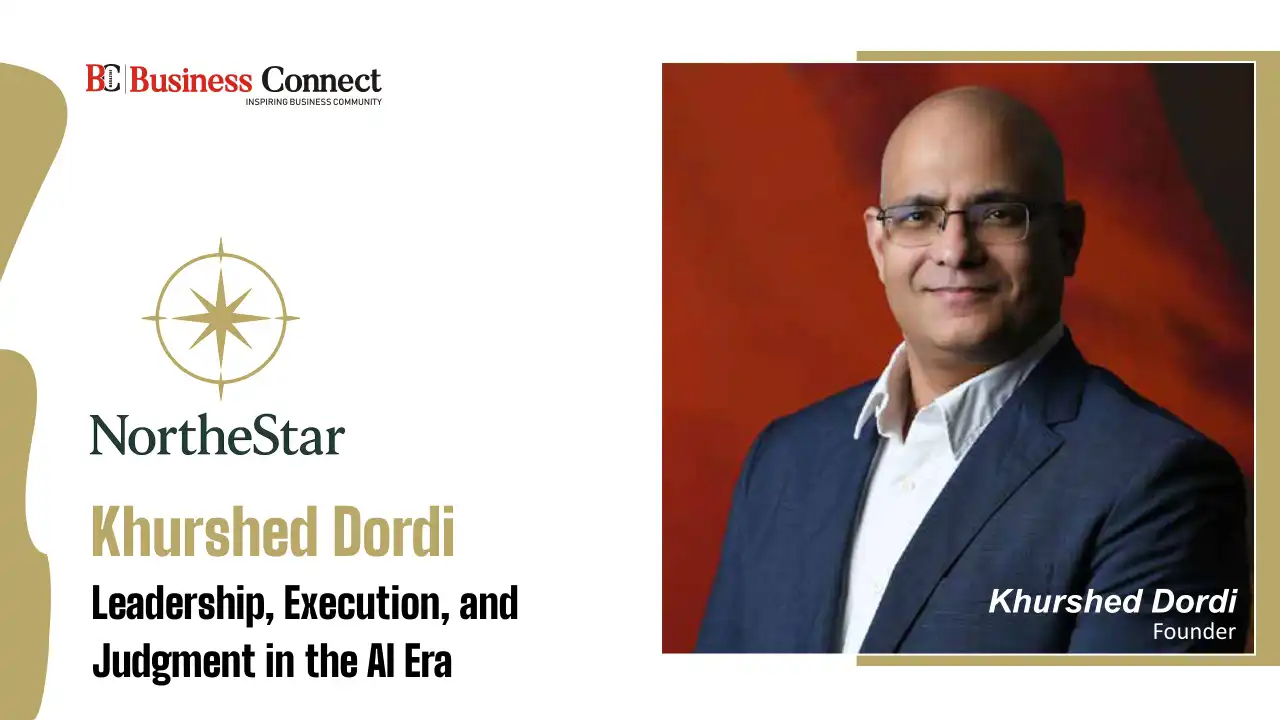
They struggle because execution becomes inconsistent. And leadership transitions rarely break down because of capability alone. They break down when judgment does not evolve with the role. That is the space Khurshed Dordi has worked in across his career. With more than three decades of experience across global financial services and enterprise leadership, Khurshed has seen this pattern from the inside.
He has worked within complex institutions, led through scale, and built businesses himself. That combination gives him a practical view of what it really takes to help founders, CEOs, and leadership teams move from momentum to disciplined performance. He works with a small number of leadership teams at a time, usually over several months. The focus is not on activity for its own sake.
It is on clarity, alignment, execution discipline, and better decision-making in environments where growth, complexity, and technology are all moving at once. His work is built as a partnership, with progress measured by outcomes.
A Career Built Around Complexity
Khurshed’s career in financial services gave him a close view of how large institutions actually function: where decisions slow down, where accountability diffuses, and where execution begins to drift. His experience also showed him something else. Strategy is rarely the main issue. In many organisations, the real constraint is leadership. Priorities are not clear enough.
Ownership is not strong enough. Decisions are not consistent enough. Over time, execution suffers. That is the gap he now helps leaders close He works with founders, CEOs, and senior leadership teams to build businesses that can scale and institutions that can perform with greater consistency. His belief is simple: organisations do not transform by themselves. Leaders do.
When Early Speed Turns Into Friction
In the early stages of a business, proximity creates momentum. The founder is close to the work, decisions are fast, and execution is direct. As the organisation grows, that same model begins to strain. Decisions slow down. Teams become dependent. Priorities multiply.
Execution becomes uneven. The same dynamic appears in large organisations as well. Strong functional leaders step into broader enterprise roles, but success in one domain does not automatically translate into enterprise judgment. These are different transitions, but they often reveal the same gap.
Founders must move from running the business to leading an organisation that can operate without constant intervention. Functional leaders must move from optimising a unit to thinking across the whole institution.
Both shifts demand more than expertise. They require judgment across competing priorities: growth and risk, innovation and governance, short-term performance and long-term institutional health.
Why Most Leadership Development Falls Short
Many leadership programmes create insight. Fewer create change. That is because leadership behaviour is shaped less by what happens in a workshop and more by the pressure of real decisions, institutional incentives, and organisational culture. Development becomes meaningful only when it is connected to the realities leaders are dealing with in real time. Khurshed’s work is grounded in that reality.
He works close to decisions, close to leadership teams, and close to execution. The conversations are not theoretical. They are tied to the actual choices leaders are making and the consequences those choices create.
The SCOPE Framework
Khurshed’s SCOPE framework brings together five elements that shape performance:
• Strategy defines direction
• Culture shapes behaviour
• Operations determine how work gets done
• Profit engine creates economic clarity
• Execution connects the whole system
Many organisations work on these elements in isolation. That is where misalignment begins. A strategy may be clear, but culture may not support it. Operations may be strong, but incentives may send teams in the wrong direction. Profit may be tracked carefully, but execution may still remain inconsistent. Performance improves when these elements reinforce one another. When they do not, effort rises but outcomes stay unpredictable.
Execution Is a Design Problem
When execution weakens, most organisations respond with more pressure. More meetings. More reviews. More tracking. That usually treats the symptom, not the cause. In one case, the issue was not effort or capability. It was design. There were too many priorities, ownership was unclear, and decision-making had become slow and fragmented.
The intervention was disciplined but simple: narrow the priorities, assign clear ownership, and create a consistent operating rhythm. Over time, decisions sped up. Teams aligned more effectively. Execution became more stable. The CEO no longer sat at the centre of every issue. The business had not fundamentally changed. The way it was being led had. That is the point. Execution is rarely just an effort problem. More often, it is a design problem.
From Business Performance to Institutional Strength
Strong institutions are not built by optimising one part of the business at a time. They are built when leaders begin to ask a broader question: Does this decision strengthen the institution as a whole? That shift changes how leaders think about risk, capital allocation, incentives, collaboration, and long-term resilience.
Khurshed works with leadership teams to build this mindset through sustained engagement, not one-off intervention. His work often begins with the CEO or founder, but it extends into the next layer of leadership where execution actually happens. Strategy may be set at the top. Performance depends on how leadership thinking travels through the organisation.
AI Does Not Replace Leadership
Organisations today have more data, more tools, and faster access to insight than ever before. Yet better information has not automatically created better outcomes. In many cases, AI simply exposes the quality of leadership already in place. If priorities are unclear, AI adds noise. If alignment is weak, AI scales inconsistency. If decisions are fragmented, technology accelerates confusion rather than improving results. That is why AI cannot be treated as a substitute for leadership. It can strengthen analysis. It can support better decisions. But it cannot provide judgment, ownership, or accountability. Those still belong to leaders.
The Questions That Matter
Khurshed often begins with a small set of questions:
• Can the business operate without the founder’s constant involvement?
• Are priorities clear across the leadership team?
• Do incentives drive the right outcomes?
• Are decisions consistent across the organisation?
• Is execution predictable?
These questions may seem simple, but they reveal a great deal. They expose whether a business can scale. They show whether a leadership team is aligned. And they often bring the same issues to the surface: too many priorities, too much founder dependence, too little delegation, and too much activity without enough clarity. These are rarely capability problems. More often, they are leadership design problems. And in complex organisations, solving them requires more than experience. It requires judgment that can hold under pressure, across functions, and over time.