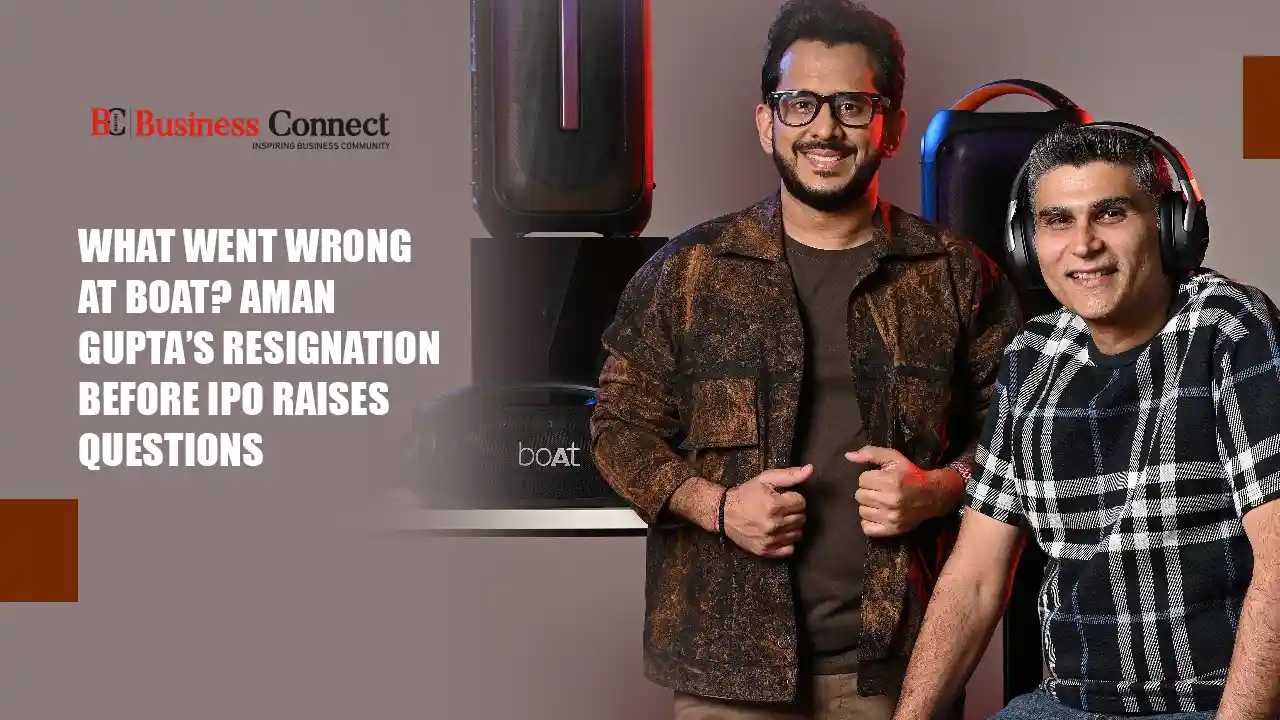
The story starts with a charging cable. In 2016, two people founded a company—Aman Gupta and Sameer Mehta. Aman was from Delhi. He studied at DPS R.K. Puram, then completed his B.Com (Hons) from Delhi University, and later became a Chartered Accountant.
Not only that, Aman is also an MBA graduate from the Indian School of Business (ISB). His academic journey didn’t stop there; he also completed an exchange program at Northwestern University’s Kellogg School of Management.
Initially, Aman worked as an Assistant Manager at Citibank, then as a Senior Consultant at KPMG, and later became a Sales Director at Harman International, the parent company of JBL. This gave him deep exposure to the audio industry from within. During this time, Aman realized one key thing—Indian consumers love bass. Whether it is tabla, dhol, or EDM, India prefers punchy sound.
So BOAT tuned its products accordingly and priced them between ₹350 and ₹550—a range where no strong branded player existed.
And then BOAT got what every startup needs—timing. In 2016, Reliance Jio launched. Mobile data, which earlier cost ₹200–₹300 per GB, became almost free with unlimited data. After Jio’s arrival, millions of people bought smartphones, and with smartphones came the need for earphones, chargers, and cables. BOAT was in the right place at the right time.
In the first two years itself, BOAT crossed ₹100 crore in sales. In 2018, the company received its first funding from Fireside Ventures—₹ crore. After that, BOAT entered speakers, soundbars, and TWS earbuds.
Then BOAT did something unusual for an Indian electronics brand—it focused on celebrities, but not in a traditional way. It chose young, rising faces like Hardik Pandya, KL Rahul, and Jacqueline Fernandez. As their popularity grew, BOAT also benefited.
BOAT positioned itself not just as an electronics brand but as a lifestyle brand. Aman Gupta once said in an interview, “We don’t sell electronics, we sell lifestyle accessories.” This positioning worked. BOAT customers started calling themselves “BOAT heads,” forming a community.
In 2019, during Lakmé Fashion Week, models walked the ramp wearing BOAT products. This was a bold move for an earphone company and helped BOAT become a premium lifestyle brand among youth.
Then the money started flowing in.
Revenue figures:
- FY 2020: ₹701 crore
- FY 2021: ₹1,531 crore
- FY 2022: ₹2,873 crore
- FY 2023: ₹3,377 crore
In just three years, revenue grew almost five times. As sales increased, profits and investors followed.
In January 2021, US-based private equity firm Warburg Pincus invested $100 million (~₹730 crore), valuing the company at around ₹2,200 crore. Then in October 2022, in a Series C round, Warburg Pincus and Malabar Investments invested more, pushing BOAT’s valuation to $1.32 billion (~₹8,800 crore). BOAT had officially become a unicorn.
In May 2022, SEBI approved BOAT’s ₹2,000 crore IPO. Everything was ready. India’s own audio brand was about to enter the stock market.
And this is where the story takes a turn.
Up until now, everything looked perfect—revenue was growing, funding was coming in, and the company had become a unicorn. But what wasn’t visible outside was that things were breaking inside.
The first crack came from quality issues. BOAT’s model relied heavily on design and branding in India, but manufacturing was done in China. Cheap audio devices were produced in Chinese factories, branded as BOAT, and sold in India. This model is known as white labeling.
As long as competition was low and customers wanted cheap products, it worked well. But as users started using the products, complaints increased. Earbuds stopped working within 3 months, charging cases failed, sound quality remained average, and most importantly, customer service was poor. People raised tickets but received no response for weeks. Complaints started flooding Reddit, Twitter, and YouTube reviews.
The second issue was the “Made in India” claim. BOAT positioned itself as a proud Indian brand aligned with the “Atmanirbhar Bharat” movement. But the reality was different.
In 2022, BOAT formed a joint venture with Dixon Technologies called Calfionix Tech. Around 70–80% of BOAT products came from this JV. However, trade records showed that Calfionix imported goods worth $44 million (~₹376 crore) from China and Taiwan in one year. Around 90–95% of its raw materials were imported.
So the question arose—was it truly “Made in India” or just “Assembled in India”? Components were coming from China, assembly was happening in India, and branding was being done as “Made in India.” This gray area affected BOAT’s credibility.
And then came another major blow.
In April 2024, reports surfaced that data of over 75 lakh BOAT customers had been leaked. Names, phone numbers, emails, home addresses, and order details were all exposed. A hacker known as “Shopify Guy” uploaded the data on the dark web. Shockingly, the entire database was reportedly sold for just ₹216.
For a company holding millions of users’ personal data, this raised serious concerns—not just about BOAT, but about the Indian startup ecosystem itself, where growth is often prioritized over data security.
At this point, BOAT was facing three major problems…
In May 2022, SEBI approved BOAT’s ₹2,000 crore IPO. Everything was ready. India’s homegrown audio brand was about to enter the stock market.
But this is where things started to change.
Behind the strong numbers, cracks began to appear.
The first issue was quality. BOAT relied heavily on a white-label model—products designed in India but manufactured in China, then branded and sold in India. This worked initially, but over time customers began complaining: earbuds stopped working in months, charging cases failed, sound quality remained average, and customer support was slow and unresponsive. Complaints increased on Reddit, Twitter, and YouTube.
The second issue was the “Made in India” narrative. While BOAT promoted itself as an Atmanirbhar Bharat success story, investigations revealed that a large portion of components came from China and Taiwan, and products were mostly assembled in India rather than fully manufactured there. This raised credibility concerns.
Then came a major blow in April 2024, when data of over 75 lakh BOAT customers was leaked. Names, phone numbers, emails, addresses, and order details were exposed on the dark web by a hacker. Shockingly, the data was reportedly sold for just ₹216. This raised serious concerns about data security practices not just at BOAT, but across the Indian startup ecosystem.
At this point, BOAT was dealing with three major problems: quality issues, questions over its “Made in India” claim, and a major data breach.
But the biggest setback came from the market.
BOAT entered the smartwatch segment in 2020, and initially it worked. The Indian smartwatch market grew rapidly. However, BOAT repeated the same strategy—rebranded Chinese products with limited innovation. Competitors like Noise and Fire-Boltt moved faster, introducing better features like health sensors, improved software, and more innovation.
As a result, BOAT’s market share declined:
- 2022: 18.8%
- 2023: 17% (third position)
- 2025: 14.1%
Meanwhile, competitors overtook it. Fire-Boltt became number one, followed by Noise.
The smartwatch category itself also started shrinking due to lack of innovation and similar products across brands.
Financially, BOAT saw its revenue drop in wearables and overall growth slowed. After being profitable until 2022, the company posted a loss of ₹129.5 crore in 2023, followed by another loss in 2024.
Despite SEBI approval in 2022, the IPO was postponed due to weak market conditions and losses.
In FY 2025, BOAT showed a small profit again (~₹60 crore), but this came mainly from cost-cutting rather than sales growth.
Later, the IPO process resumed, targeting ₹1,500 crore, but just 29 days before filing official IPO documents (DRHP), both founders stepped down from executive roles—Aman Gupta as CMO and Sameer Mehta as CEO. The market viewed this as a major red flag.
Audit reports also flagged mismatches in financial reporting and concerns over fund usage, raising governance questions.
Employee attrition also increased sharply, with over 30% of employees leaving annually in recent years.
Eventually, BOAT paused its IPO again in 2026.
However, the company is not “finished.” It still remains one of India’s biggest audio brands, with millions of customers and strong market presence.
Aman Gupta, meanwhile, has diversified heavily—investing in multiple startups through Shark Tank India and launching his own AI-focused venture “OFF/BEAT” with ₹100 crore funding.
The BOAT story ultimately shows one thing clearly:
A brand can grow rapidly with marketing, timing, and pricing—but long-term success depends on product quality, innovation, trust, and consistency.
Because in the end, no matter how strong the advertising is, customers only remember the product experience.