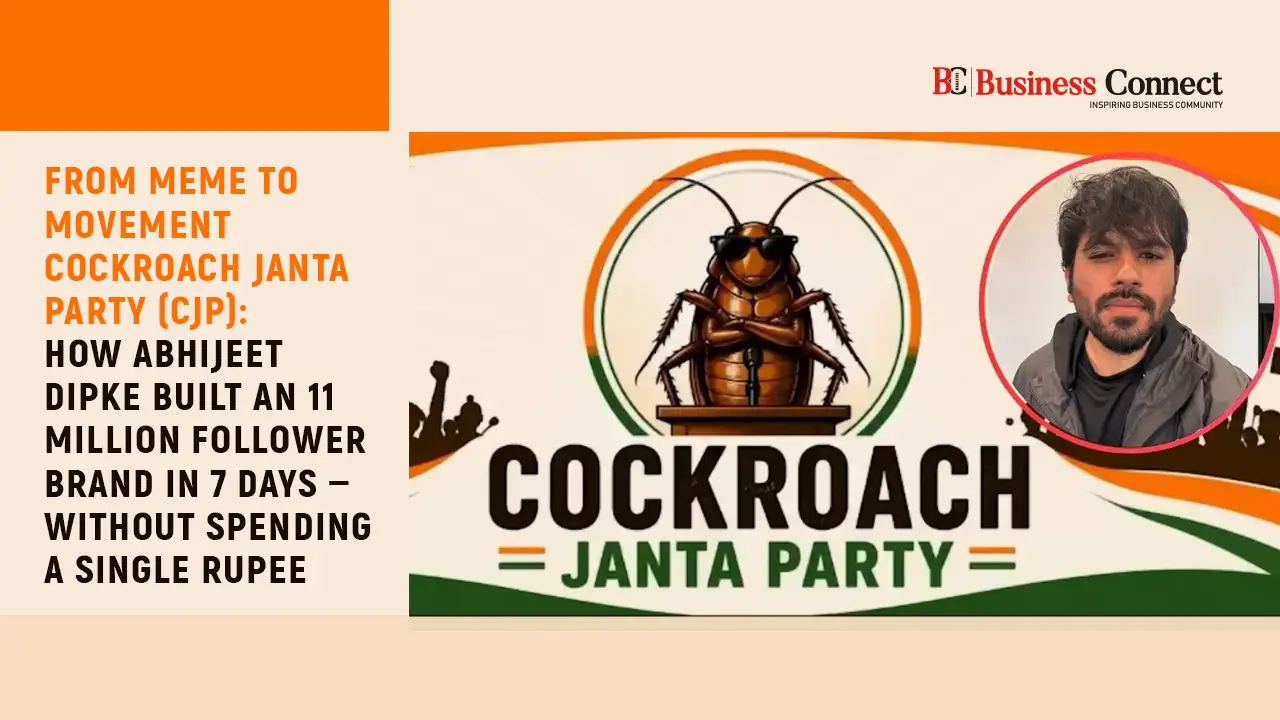
In mid-May 2026, something unprecedented happened in India’s digital landscape. A brand-new entity surpassed the ruling Bharatiya Janata Party — one of the world’s largest political organizations — in Instagram followers. It did this within days. With just a handful of posts. And with a marketing budget of essentially zero.
The entity is the Cockroach Janta Party (CJP).
And the man behind it — Abhijeet Dipke, a 30-year-old digital strategist from Chhatrapati Sambhajinagar, Maharashtra — has just delivered what may be the most remarkable brand-building case study of 2026.
The Numbers First — Because They Are Extraordinary
- 11 million+ Instagram followers — surpassing BJP — in a matter of days
- 350,000+ official sign-ups on the CJP website
- A viral party anthem already circulating across platforms
- Senior political figures including Mahua Moitra, Kirti Azad, and Prashant Bhushan publicly engaging with the movement
- Supporters reportedly considering fielding a candidate for the upcoming Bankipur Assembly by-election in Bihar
These are not the numbers of an internet joke. These are the numbers of a serious brand moment.
The Origin Story — How a Supreme Court Remark Became a Brand
Every great brand has an origin story. CJP’s is more dramatic than most.
On May 15, 2026, during a Supreme Court hearing regarding the designation of senior advocates, Chief Justice of India Surya Kant allegedly compared unemployed youth trying to find a footing in the profession to “cockroaches” and “parasites of society.” The CJI later clarified that his comments were aimed at individuals using fake degrees and were misquoted — but in the digital space, the damage was already done.
Abhijeet Dipke, who was celebrating his graduation in Boston at the time, saw the remark trending.
“I think it was more triggering because it came from the Chief Justice of India, who is the custodian of the Constitution,” Dipke told media outlets. “Someone who is there to safeguard our freedom of expression is comparing us to cockroaches.”
Instead of just posting an angry tweet and moving on — Dipke did what a seasoned brand strategist would do. He identified a gap. He identified an emotion. And he built a brand around it.
On May 16, 2026 — just one day after the remark — the Cockroach Janta Party was born.
The Brand Strategy — Deconstructed
What Abhijeet Dipke pulled off in 7 days is a masterclass in modern brand building. Let us break it down:
1. He Flipped the Insult — The Most Powerful Branding Move
The single most brilliant strategic decision Dipke made was not to fight the “cockroach” label — but to own it.
This is a classic technique in brand strategy called “reclamation branding” — taking a negative label imposed by opponents and wearing it as a badge of identity.
History is full of examples. Harley-Davidson riders reclaimed the “outlaw” label. “Nerd” became Silicon Valley’s proudest identity. And now — “cockroach” has become the rallying cry of India’s frustrated, unemployed, chronically online Gen Z.
When you own the insult, you defuse it completely. And you create an in-group identity that is extraordinarily powerful.
Business lesson: If the market or competition defines you negatively — consider owning that narrative instead of fighting it. Reclaimed identities create fierce brand loyalty.
2. He Identified the Exact Audience — and Spoke Directly to Them
The CJP’s website lists its membership criteria with brutal honesty: you must be “unemployed, chronically online, professionally frustrated, and lazy.”
This is not accidental. This is precision targeting.
Dipke did not try to build a brand for everyone. He built it for a very specific, very large, very underserved audience: India’s Gen Z — a generation dealing with rampant unemployment, paper leaks in competitive examinations like NEET and CBSE, growing wealth inequality, and a deep distrust of institutions.
These are not fringe concerns. These are the lived reality of hundreds of millions of young Indians who feel the system has forgotten to count them. CJP’s tagline says exactly that: “A political party for the people the system forgot to count.”
Business lesson: The narrower and more honest your audience definition, the stronger your brand connection. Trying to appeal to everyone means resonating with no one.
3. He Combined Humor with Substance — The Perfect Content Formula
Here is what separates CJP from a thousand other viral internet jokes that fade in 48 hours: beneath the meme-heavy surface lies a serious policy agenda.
The CJP’s mock 5-point manifesto demands absolute judicial independence, zero post-retirement political appointments for retiring judges, radical transparency in public spending, and accountability for paper leaks in competitive examinations.
These are not joke demands. These are real, resonant, structural grievances that millions of Indians share.
The format is comedy. The content is critique. That combination — what media theorists call “infotainment with teeth” — is the most shareable content formula on the internet today.
Business lesson: Your content needs both entertainment and substance. Entertainment gets the first click. Substance creates the loyal audience that comes back.
4. He Moved at Internet Speed — Launch in 24 Hours
From viral remark on May 15 to party launch on May 16. Less than 24 hours.
In brand building, speed of response to cultural moments is everything. Dipke did not spend weeks in committee meetings, brand workshops, and agency briefings. He saw the moment, understood it immediately, and acted.
This is the difference between a brand that is built by strategists who understand culture — and a brand that is built by committees that analyze culture.
Business lesson: Cultural moments have a window of hours, not weeks. If you cannot move fast, you cannot capitalize on them.
5. His Background Made This Inevitable
None of this happened by accident. Dipke’s background reads like a training program specifically designed to produce this moment.
He studied journalism in Pune. He went to Boston University for a Master’s in Public Relations. Between 2019 and 2024, he was deeply embedded in the Aam Aadmi Party’s digital machinery — serving as a communications fellow in the Delhi Chief Minister’s Office and as an advisor to the Delhi Education Department under Manish Sisodia and Atishi. During the 2020 Delhi Assembly elections, he specialized in meme-driven digital campaigns for youth outreach.
This is a man who has spent years studying exactly how digital movements are built — and then built one in 7 days when the moment arrived.
Business lesson: Overnight success is almost always years of preparation meeting one perfect moment. Build your skills before the moment arrives.
The Cross-Party Validation — Why It Matters for the Brand
When Manish Sisodia posted a viral reel declaring that if there is a war between a crocodile and cockroaches, he stands with the Cockroach Janta Party — he gave CJP something that money cannot buy: third-party credibility.
Senior figures like Mahua Moitra, Kirti Azad, and Prashant Bhushan publicly engaging with the movement signaled that this is not a fringe internet phenomenon. It is a genuine cultural moment that mainstream political figures feel compelled to respond to.
In brand terms, this is called “influencer validation at scale” — and it happened organically, without a single paid partnership.
What This Means for India’s Digital Democracy — and Its Businesses
The Cockroach Janta Party story carries implications far beyond politics.
It demonstrates that in 2026, brand authority is no longer the exclusive domain of organizations with large budgets, established infrastructure, and decades of history. A single individual — with the right skills, the right timing, and the right message — can build a brand that outpaces institutions built over decades.
For Indian entrepreneurs and business builders, this is simultaneously inspiring and challenging. It is inspiring because it proves that ideas, strategy, and execution matter more than capital. It is challenging because it means your competition can now emerge from anywhere — overnight.
The rules of brand building have fundamentally changed. And Abhijeet Dipke just wrote the new playbook.
Our Take — Business Connect India
We have covered hundreds of brand stories. But we cannot recall the last time we saw 11 million followers, 350,000 sign-ups, and cross-party political engagement — built in 7 days, by one person, with no advertising spend.
Whether the Cockroach Janta Party becomes a lasting political force or remains a powerful cultural moment, its brand story is already complete. And it is one of the most instructive brand-building case studies India has produced in years.
Abhijeet Dipke did not just build a viral page. He identified an underserved audience, gave them an identity, spoke their language, and moved faster than any institution could respond.
That is not luck. That is strategy.
And in a country of 1.4 billion people — 350 million of whom are chronically online and professionally frustrated — that strategy found exactly the audience it deserved.
3 Things Every Indian Entrepreneur Should Take Away
1. Look for the insult your market is absorbing — and reclaim it What label is your audience being given that they resent? Build your brand around owning that label. Reclaimed identities create the strongest communities.
2. Speed is a brand strategy The window for cultural moments is hours. Build a team and a process that can identify and act on cultural moments faster than your competition.
3. Humor is the most shareable content format — but substance is what creates loyalty Make people laugh to get the first share. Give them something real to believe in to make them stay.
What do you think — is the Cockroach Janta Party a flash-in-the-pan moment or the beginning of something bigger? Tell us in the comments.
— Business Connect India Team
Editor’s Note: At Business Connect India, we cover brands, businesses, and the strategies behind them. This week, the most extraordinary brand-building story did not come from a startup or a corporation. It came from a 30-year-old digital strategist who turned a Supreme Court insult into India’s fastest-growing political movement — in 7 days, with zero ad spend. This is that story.