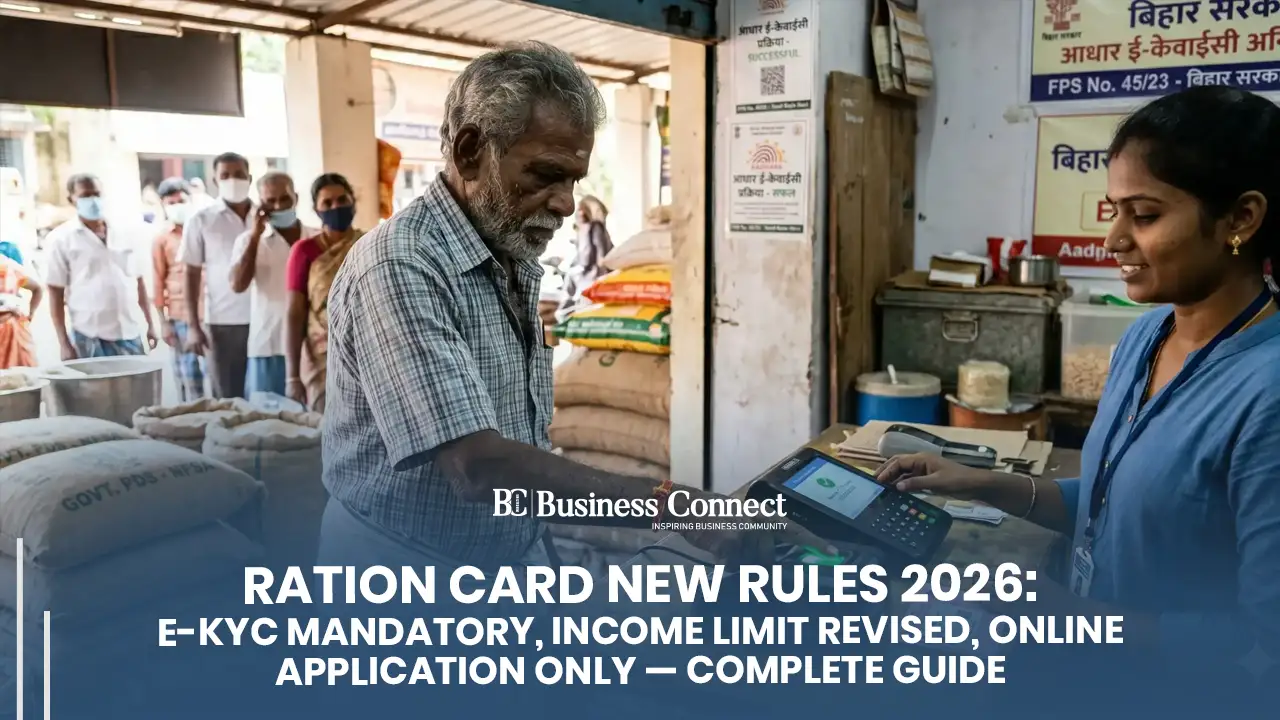
India’s Public Distribution System is undergoing its most significant overhaul in years. Every ration card holder — across all 36 states and union territories — needs to understand what has changed, what the new deadlines are, and exactly what to do right now to keep their benefits running without interruption.
Who must act: Every existing ration card holder in India — every family member listed must complete Aadhaar-based e-KYC before their state’s deadline.
What happens if you don’t: Subsidised food grain benefits may be temporarily suspended until verification is complete. Your card is not cancelled — just frozen until you comply.
How to complete e-KYC: Visit your nearest Fair Price Shop with your Aadhaar card, OR use the Mera Ration App with face authentication, OR use the state’s home-verification app (available in select states).
New applications: Physical forms are being phased out. Apply online only via your state’s PDS portal or the Mera Ration App.
For the over 81 crore Indians who depend on subsidised food grains through the Public Distribution System, 2026 marks the most consequential set of rule changes in recent memory. The government — at both central and state levels — is overhauling how ration cards are verified, who qualifies for them, how they are applied for, and how benefits are delivered. The reforms are designed to plug leakages, eliminate ghost beneficiaries, and ensure that subsidies reach the truly deserving. But for genuine beneficiaries, navigating these changes without disrupting their monthly ration requires immediate, informed action.
The most urgent change is the one with a hard deadline: Aadhaar-based e-KYC (electronic Know Your Customer) is now mandatory for every member of every household listed on the ration card. This is not a suggestion or a recommendation — it is a compliance requirement, and cards not linked to Aadhaar within the state-set deadline face temporary suspension of benefits.
“The objective is to ensure genuine beneficiaries continue to receive entitlements without leakages in the system.”
Change 1: e-KYC Mandatory for Every Family Member
This is the biggest change of 2026 and the one that requires the most immediate action. Aadhaar-based e-KYC is now compulsory for every individual listed on the ration card — not just the head of household, but every single member: spouse, children, elderly parents, and any other household member enrolled as a beneficiary.
The e-KYC process works through biometric authentication — either fingerprint scanning, iris scanning, or OTP-based face authentication — linked directly to the Aadhaar database. When you complete e-KYC at a Fair Price Shop or through the Mera Ration App, the system confirms that the person claiming the benefit is who they say they are, and that their Aadhaar is active and correctly linked to the ration card record.
Method 1 — At your Fair Price Shop (FPS): Visit your local ration dealer with your Aadhaar card. The POS (Point of Sale) biometric device at the shop will scan your fingerprint or iris. Free of cost.
Method 2 — Mera Ration App (Home): Download the Mera Ration App (available on Android and iOS). Use the face authentication feature powered by the AadhaarFaceRD system. No travel required.
Method 3 — Home Verification App (Select states): Several states including Uttarakhand have launched mobile applications that allow e-KYC from home via iris scanning — particularly useful for the elderly, disabled, or anyone unable to travel to an FPS.
There is no single national deadline for ration card e-KYC — each state sets its own. For example, some states required completion by April 1, 2026; others have extended to later in the year. Check your state’s Food Department website or visit your Fair Price Shop immediately to find the specific deadline for your state. Do not wait — if the deadline passes without completion, benefits stop automatically.
Change 2: Revised Income Eligibility Limits
Income thresholds for ration card eligibility have been recalibrated across India in 2026 to better reflect current economic realities. The previous income benchmarks — in many cases fixed years ago — had not kept pace with inflation or changing wage patterns, meaning some households that no longer needed subsidised food support were still receiving it, while others that genuinely needed it fell into unclear eligibility gaps.
Under the 2026 reforms, urban and rural income limits are being assessed separately, recognising that the cost of living in a metro city is substantially different from a rural district. Key points:
- •Families whose income exceeds the newly prescribed ceiling may no longer qualify under certain ration card categories
- •Authorities are integrating data with income tax filings and welfare databases to detect discrepancies automatically
- •Households filing income tax returns, owning large properties, or holding government jobs may be automatically flagged for review
- •If a household’s income has increased beyond the threshold, they are legally required to inform the District Supply Officer (DSO)
- •In Uttarakhand specifically, the Yellow Card (State Food Scheme) income limit has been set at ₹5 lakh annual family income
The central government has not published a single, uniform national income threshold update — the income limit revisions are largely being implemented at the state level. The revised amounts vary significantly by state, card type, and rural/urban classification. Always check your specific state’s Food Department notification rather than relying on generic figures circulating on social media.
Change 3: Digital-Only Applications — Physical Forms Out
If you need to apply for a new ration card in 2026, physical application forms are being phased out across most states. The process is now digital-only in most regions, requiring applicants to:
Each state has its own food and civil supplies portal. For national-level services, the Mera Ration App and the Annavitran portal (nfsa.gov.in) are the primary gateways.
Identity proof (Aadhaar), income certificate, residence proof (electricity bill, rent agreement, or domicile certificate), and family details. Documents must be clearly scanned or photographed.
Before final approval is granted, every applicant and household member must complete e-KYC. Applications without verified Aadhaar cannot proceed to approval.
Once submitted, track via your state’s PDS portal. SMS alerts are being introduced to notify families about application status, ration allocation, and collection dates.
The primary record is now digital — accessible via DigiLocker and government apps. Some states still issue a physical card after approval, but the digital version is the official document.
Change 4: One Nation One Ration Card (ONORC) — Upgraded in 2026
The One Nation One Ration Card scheme, which allows beneficiaries to purchase their subsidised quota from any Fair Price Shop anywhere in India, has received a significant technological upgrade in 2026. This is especially important for migrant workers who move between states for employment and previously faced the impossibility of using a UP ration card while working in Karnataka.
| Feature | Before 2026 | After 2026 Upgrade |
|---|---|---|
| Authentication | State-level Aadhaar verification | Real-time national Aadhaar sync, instant authentication |
| Portability | Available but sometimes delayed | Seamless — any FPS, any state, same day |
| Migrant access | Paperwork sometimes required | Zero paperwork — Aadhaar + biometric = access |
| Data sync speed | Periodic batch updates | Real-time continuous syncing |
| Fraud detection | Manual checks | Automated analytics — bulk withdrawal alerts, pattern detection |
Change 5: Ration Card Types — What Each Gets
Grain entitlement: 35 kg/month (wheat at ₹2/kg, rice at ₹3/kg)
2026 change: e-KYC mandatory for all members
Grain entitlement: 5 kg per person per month
2026 change: Income re-verification required; e-KYC compulsory
Example (Uttarakhand): 7.5 kg rice/month at ₹11/kg
Income limit: Annual family income up to ₹5 lakh
Change 6: Smart Monitoring — AI-Driven Fraud Detection
Authorities have implemented advanced automated monitoring systems that track food grain distribution in real time. These systems use analytics to detect unusual patterns — bulk withdrawals, repeated failed biometric authentications, irregular shop-level transactions, or discrepancies between reported family size and actual collection patterns. Officials can intervene instantly when anomalies are flagged.
Additionally, the systems are now cross-referencing ration card databases with income tax, property ownership, and government employment records. If your household’s data triggers a flag — for example, a family member who filed an ITR, or a recently registered vehicle above a certain value — you may receive a verification notice. Ignoring such notices can lead to temporary card suspension.
Change 7: LPG and Cash Benefit Linkages
In a notable expansion of what the ration card ecosystem delivers, 2026 sees the ration card being used as a gateway for additional benefits beyond food grains:
LPG cylinder subsidy: Eligible ration card holders may receive LPG subsidies or refunds directly in their bank accounts after purchase — replacing the old physical cylinder delivery model. Ration card must be linked to the LPG connection to receive this.
Ayushman Bharat linkage: In several states including Uttarakhand, failure to complete ration card e-KYC results in exclusion from Ayushman Bharat health scheme benefits as well — the two systems are being co-linked.
₹1,000 monthly cash support (proposed/pilot): Some states are exploring direct cash transfers of approximately ₹1,000 per month to eligible ration card households — in addition to, not instead of, food grain delivery. This is a pilot concept in select states; not yet a confirmed national scheme.
Change 8: Periodic Data Audits — Ongoing
The 2026 reforms establish e-KYC not as a one-time event but as a continuous compliance requirement. Periodic data audits will be conducted throughout the year to identify duplicate entries, deceased beneficiaries still listed on active cards, and households whose circumstances have changed beyond eligibility thresholds. Households that receive a verification notice but do not respond within the stipulated time frame face temporary benefit suspension under the new rules.
What to Do Right Now — Action Checklist
- ✓Check if e-KYC is completed for every family member on your card — visit your FPS or check status on the Mera Ration App
- ✓Find your state’s deadline for e-KYC completion — check your state’s food department website
- ✓Complete e-KYC immediately if pending — FPS visit, Mera Ration App, or state’s home-verification app
- ✓Verify Aadhaar linkage for every household member — check at your FPS or aadhaar.uidai.gov.in
- ✓Update bank account linked to Aadhaar if it has changed — required for any DBT cash benefit
- ✓Declare income changes to your District Supply Officer if your household income has risen above state thresholds
- ✓Apply online for new cards — do not visit offices with paper forms, use the state PDS portal
- ✓Migrant workers — update your Aadhaar address and activate ONORC through the Mera Ration App
Frequently Asked Questions
- Ration Card New Rules 2026
- e-KYC Ration Card
- PDS Reform India
- One Nation One Ration Card
- Mera Ration App
- Aadhaar Ration Card Link
- Ration Card Online Apply
- Antyodaya AAY Card
- NFSA Beneficiaries
Sources & Verification: Dr. Deepika Singh (Ration Card New Rules 2026, March 3, 2026); India Herald (Ration Card Rule Changes 2026, February 14, 2026); Square Capital (Ration Card New Rules 2026, February 9, 2026); RationCardPortal.com — Uttarakhand Ration Card Update 2026 (March 22, 2026); Swastik College (Ration Card Rules 2026 Big Update, February 28, 2026); Sasaka Academy (Ration Card New Rules 2026 — 8 Major Changes, February 12, 2026); Global Kidz (Ration Card New Rules 2026, December 31, 2025). Important note: Ration card rules in India are implemented at the state level with state-specific deadlines and income thresholds. This article covers the broad national framework of 2026 reforms. Always verify the specific rules, deadlines, and income limits applicable in your state on your state’s official food and civil supplies department website or at your nearest Fair Price Shop. This article is for informational purposes only and does not constitute official government advice. Last reviewed: July 6, 2026.
Add Business Connect magazine to your Google News feed
Read Also:
- Best business magazine in India
- Business Magazine in India
- Top Best business magazine in India
- New Ration Card Online Apply 2026: Easy Step-by-Step Process Explained
- Update Mobile Number in Ration Card Online – Step-by-Step Guide
- Benefits and Status of the Different Categories of Ration Cards
- Ration Card e-KYC: Status Check & Online Verification
- Ration Card Apply in Maharashtra: Step-by-Step Guide
- AAY Ration Card Benefits: Everything You Need to Know