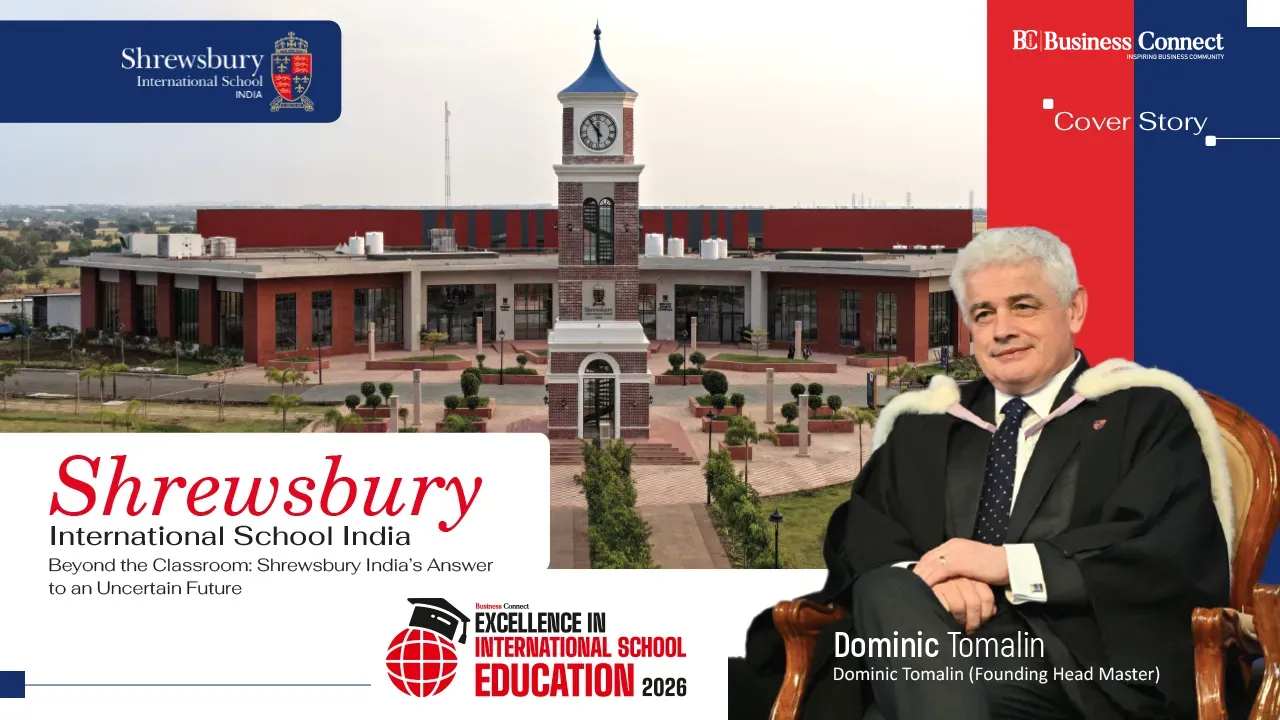
As artificial intelligence reshapes industries and traditional career paths continue to evolve, the question facing educators today is no longer simply what students should learn, but who they should become. At Shrewsbury International School India, Founding Head Master Dominic Tomalin believes the answer lies in an educational philosophy that is nearly five centuries old, yet remarkably relevant to the future. From embracing Floreat to living the Salopian Way, Shrewsbury for Life reflects a lifelong connection built on shared values, ambition,
Conversation About Education That Quickly Becomes a Conversation About Life
Spend a few minutes speaking with Dominic Tomalin and it becomes evident that he does not view education through the narrow lens of examinations, rankings, or university admissions. While all of these things matter, they are not the starting point of his thinking. Instead, he repeatedly returns to a much bigger question: what is the purpose of education in a world that is changing faster than any generation has experienced before?
Artificial intelligence is transforming the workplace, industries are being disrupted at an unprecedented pace, and students entering school now may eventually work in professions that do not yet exist. Amidst all this uncertainty, schools across the world are attempting to determine what future readiness really means. For Tomalin, however, the answer is not found in chasing every new trend or technological development. Rather, it lies in helping young people understand themselves, develop strong values, cultivate meaningful relationships, and become lifelong learners.
That philosophy forms the foundation of what Shrewsbury calls “Shrewsbury for Life,” an approach shaped by the Floreat framework and the Salopian Way, ensuring education extends far beyond academic achievement. While the school brings with it the heritage and educational framework of Shrewsbury School in the United Kingdom, its vision extends far beyond importing a British education model into India. Instead, it seeks to create an environment where academic excellence exists alongside character development, personal growth, creativity, leadership, and community engagement.
In many ways, the institution’s story is inseparable from the philosophy of the man entrusted with leading it.
A Legacy That Continues to Evolve
Shrewsbury School in the United Kingdom is one of the oldest and most respected educational institutions in the world. Established nearly 474 years ago under a Royal Charter, it has built a reputation that spans generations. However, what Dominic finds most remarkable about the institution is not simply its age but its ability to remain relevant through centuries of social, cultural, and technological change.
Many organisations possess history. Far fewer manage to evolve without losing their identity. According to Tomalin, Shrewsbury’s enduring success stems from its willingness to honour tradition while remaining firmly focused on the future. Legacy, in this context, is not something that limits innovation; it is something that provides confidence while embracing change.
That mindset has shaped the institution’s international expansion. Before arriving in India, Shrewsbury had established successful campuses across Asia. The Indian campus represents the fifth international chapter in this journey and perhaps one of its most ambitious trajectories. Unlike several international schools that primarily focus on academics or brand recognition, Shrewsbury International School India has been built around a comprehensive educational philosophy that seeks to nurture every dimension of a young person’s development.
At the heart of this philosophy lies the concept of the Floreat, which focuses on four interconnected dimensions of growth: intellectual, active, expressive, and reflective. The objective is not merely to nurture students who perform well in examinations, but individuals who are capable of understanding themselves, pursuing their interests with confidence, and contributing positively to the wider world.
Complementing the Floreat is the Salopian Way, a framework built around six virtues—wisdom, integrity, courage, kindness, spirit, and self-mastery. While many institutions speak about values, Shrewsbury’s approach seeks to integrate these principles into daily life rather than present them as aspirational slogans. Together, these frameworks form the philosophical backbone of an educational model designed to prepare students not just for university, but for life itself.
Vision of Modern Leadership
Dominic’s path to educational leadership was unconventional by design. Before entering education, he worked across engineering, telecommunications, logistics, and executive management. That breadth of experience has shaped his understanding of how industries evolve, how organisations adapt to change, and what future employers increasingly value.
One theme runs consistently throughout the conversation: universities and employers are no longer looking solely for knowledge. They are looking for people who can continue learning. In a world where technology is constantly transforming workplaces, the ability to adapt may ultimately prove more valuable than any single qualification.
That conviction has influenced much of his educational philosophy. Rather than viewing learning as a process that ends upon graduation, Dominic sees education as a lifelong pursuit. Schools, therefore, should focus on cultivating curiosity, resilience, adaptability, and critical thinking alongside academic achievement.
Perhaps this explains why he speaks so passionately about relationships within educational environments. Effective learning, in his view, is deeply connected to trust, belonging, and personal connection. Students perform at their best when they feel understood, supported, and challenged in equal measure. Educational success is not merely a product of curriculum design; it is also shaped by the quality of interactions that take place every day between teachers and learners.
A people-centric approach is visible throughout the structure of Shrewsbury International School India. Small class sizes, personalised tutoring, extensive pastoral care, and strong faculty engagement all reflect a belief that education works best when students are known as individuals rather than treated as numbers.
Why Boarding Matters More Than Ever
For many families, boarding schools often evoke images of tradition, discipline, and academic rigour. While these elements certainly exist, Dominic believes modern residential education offers something much deeper. His argument begins with a simple observation about contemporary life. In many urban centres, students spend hours every day commuting between school, tuition classes, extracurricular activities, and home. By the time these logistical demands are met, very little time remains for reflection, exploration, or genuine engagement.
A fully residential environment removes many of these pressures. However, the real value of boarding, according to him, lies in the relationships it creates. Within a residential school, teachers interact with students in multiple contexts. They are not confined to classroom instruction. They become tutors, mentors, coaches, and role models. They observe students in academic settings, extracurricular activities, social environments, and residential communities. This broader perspective allows educators to better understand individual strengths, challenges, and aspirations.
At Shrewsbury India, teachers are expected to play an active role across multiple aspects of student life. The aim is not simply to monitor progress but to support holistic development. Learning, after all, does not occur exclusively within classrooms. Some of the most important lessons emerge through teamwork, leadership experiences, creative expression, community living, and personal reflection.
Such an emphasis on human connection aligns closely with the institution’s broader philosophy. in an era increasingly shaped by digital interaction, creating meaningful communities may become more important than ever.
Why was Bhopal the Right Choice
When discussing the school’s location, Dominic offers an answer that challenges conventional assumptions. While many premium institutions gravitate towards metropolitan centres, he sees Bhopal as a strategic advantage rather than a compromise.
The most obvious reason is scale. A fully residential institution designed to provide extensive opportunities across academics, sports, performing arts, innovation, and leadership requires space. The 150-acre campus provides precisely that. More importantly, it creates an environment where students can explore interests without the constraints often associated with densely populated urban settings.
The natural surroundings also contribute significantly to the educational experience. Cleaner air, greener landscapes, and a less congested environment support both wellbeing and learning. These qualities are difficult to find in many major cities and represent a growing priority for families seeking balanced educational environments.
Geographically, Bhopal’s central location offers another advantage. Situated near the heart of India, the city provides accessibility for students from across the country. The ongoing development of local infrastructure further strengthens its long-term potential as an educational hub.
Equally important is the role of Jagran Social Welfare Society, the organisation behind the project. With decades of experience in developing educational institutions across Madhya Pradesh, the society brings valuable expertise and local understanding. Building an institution of this scale requires more than vision; it requires the ability to execute that vision effectively. In this regard, the partnership provides a strong foundation for future growth.
Raising Humans in the Age of Artificial Intelligence
No conversation about the future of education avoids AI, and Dominic doesn’t try to. He approaches the subject with a perspective that feels refreshingly balanced. He neither views AI as a threat nor treats it as a miracle solution. Instead, he sees it as one of the most significant opportunities as well as challenges, facing educators today.
Throughout the conversation, he returns to the importance of digital literacy. Students must understand technology, not simply consume it. They must learn how AI systems work, how information should be evaluated, and how critical thinking remains essential even when intelligent tools are readily available.
For Dominic, one of the greatest risks is not that machines become smarter. It is that people stop thinking critically because machines appear convenient. This distinction is crucial. Artificial intelligence can generate responses, process information, and assist with complex tasks. What it cannot replace are human judgment, ethical reasoning, creativity, empathy, and self-awareness. These qualities remain uniquely human and are likely to become even more valuable in the years ahead.
Looking Beyond Academic Achievement
As the conversation draws to a close, one thing becomes ever more clear. Shrewsbury International School India is not attempting to position itself solely as another international school or another premium educational institution. Instead, it is advancing a broader vision of what education can and should be.
At a time when discussions around learning often focus on examination scores, employability, and technological skills, the institution is making a case for something equally important: human development. Academic excellence remains a priority, but it is viewed as one component of a much larger journey.
For Dominic Tomalin, the measure of a school is not what students achieve before they leave – it is what they become long after. Shrewsbury has been asking that question for nearly five centuries. In Bhopal, it is asking it again, guided by the Floreat framework, the Salopian Way, and the belief that education should prepare young people not only for university, but for life. It is, in every sense, Shrewsbury for Life.