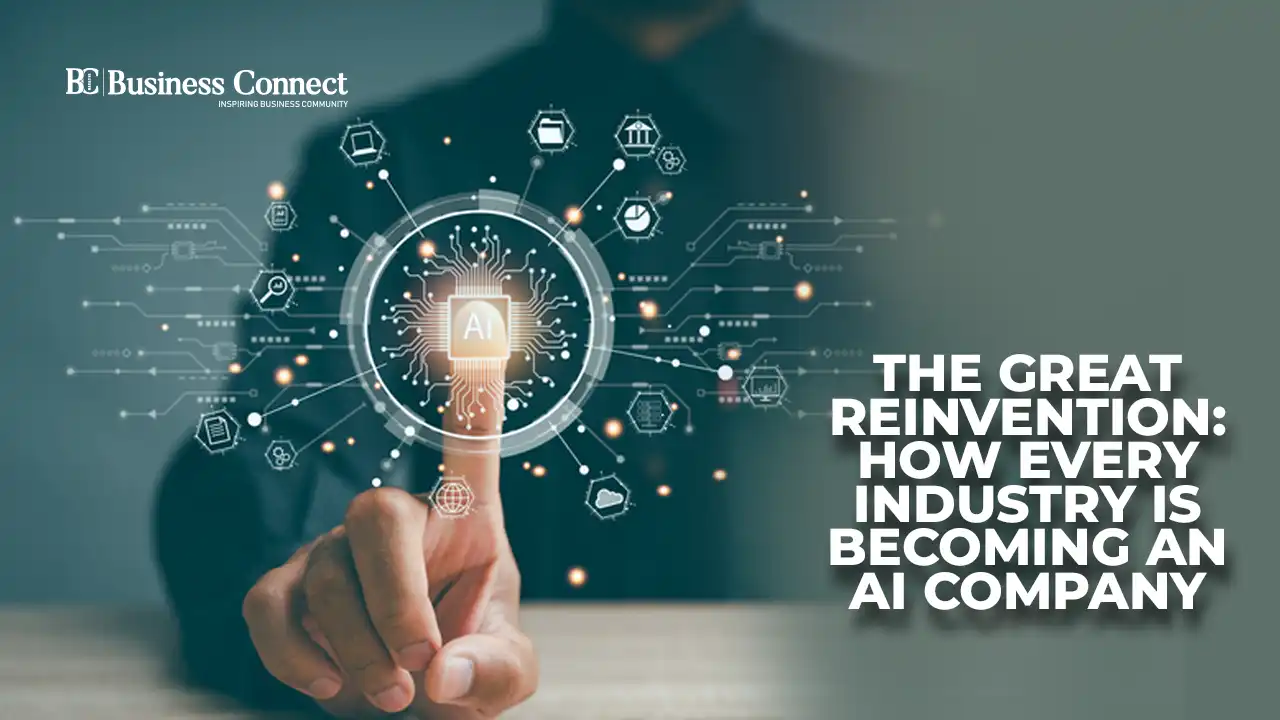
Companies have always competed by producing better products, hiring better professionals and finding more efficient ways of operating. But now they are being asked to compete on something less tangible: how intelligently they can redesign the business itself.
AI is not stuck in the IT department only; it is in marketing, customer service, finance, manufacturing, healthcare, product development, and management as well. Companies today are not just using it to make their tasks faster; they are now building the entire process around humans and AI systems. That is the beginning of what they are calling the Great Reinvention.
It raises a major question now: “How will AI affect my industry? “It is what happens “when every industry starts operating like an AI company.”
The Great Reinvention: How Every Industry Is Becoming an AI Company
The Real Story: Reinvention instead of Adoption
McKinsey’s 2025 State of AI reported that around 88% of organisations currently use AI regularly in at least one function. But only 62% experiment with agents and 39% report any enterprise -level EBIT impact. Companies mostly use AI, but few of them see it on the bottom line.
Accenture reviewed 2,000+ GenAI projects and found that just 36% of executives said they have scaled GenAI, and just 13% reported actual enterprise-level value. Companies with genuine executive buy-in witnessed 2.5x higher ROI. AI has become a part of businesses; knowing what to do with it is the actual edge.
Three Stages, One Destination
Take it as AI-assisted: a tool that speeds up a task; AI-enabled: the whole workflow gets redesigned around AI; and AI-native: AI becomes part of how the company operates. At the third stage, the reinvention begins. As per Microsoft’s 2025 Work Trend Index, 46% of leaders are using agents to automate workstreams, and within five years, leaders expect employees to spend real time training and managing them. The organisational chart may shift before most companies finish writing their AI strategy.
Why Every Industry is Becoming an AI Company
A bank is not turning into a software company or a hospital into an AI lab. AI is basically creating an intelligence layer in existing industries, like banking shifting from transactions to prediction and healthcare shifting to discovery and retail shifting from selling to predicting demand. Marketing is the best case here; agents handle research, strategy, and content, and humans create goals instead of executing every step.
AI is a Capacity, Not a Replacement.
OpenAI’s 2025 enterprise research found that 75% of employees accepted AI to improve their speed and quality and let them do work they could not do before. Here, the question should not be how many jobs AI eliminates but how much more each employee can achieve with it.
PwC’s latest AI Jobs Barometer supports this fact: “AI-skilled jobs pay 62% more than 57% of non-AI-skilled jobs. Entry-level roles supported by AI are now demanding senior skills like judgement. If AI follows the apprenticeship model, who will train the future experts?
Why AI is Everywhere without In-depth Value
A small number of companies had AI deeply integrated into their process, even after adoption more than quadrupled since 2022. Transformation takes place when a company asks, ‘If we built this today, with AI from day one, would we organise it in the same way?’ The answer is mostly no.
Here, the right approach is to choose one real workflow. Separate judgement work from busywork an agent could handle, then redesign around the answer. Some measurable outcomes include saving time, lower errors, and revenue per employee, not just usage. The winning organisations will not have the biggest AI budget. They will be the ones asking what they would build differently.
Frequently Asked Questions
How is every industry becoming an AI company?
Every industry is turning into an AI company because AI presently drives the core operations, major decision-making, and customer value.
Which industry will gain most from AI?
According to experts, the healthcare and life science industries will get the most benefit from AI due to the massive evolution in disease diagnostics, accelerated drug discovery and personalised patient treatment plans.
Add Business Connect magazine to your Google News feed