
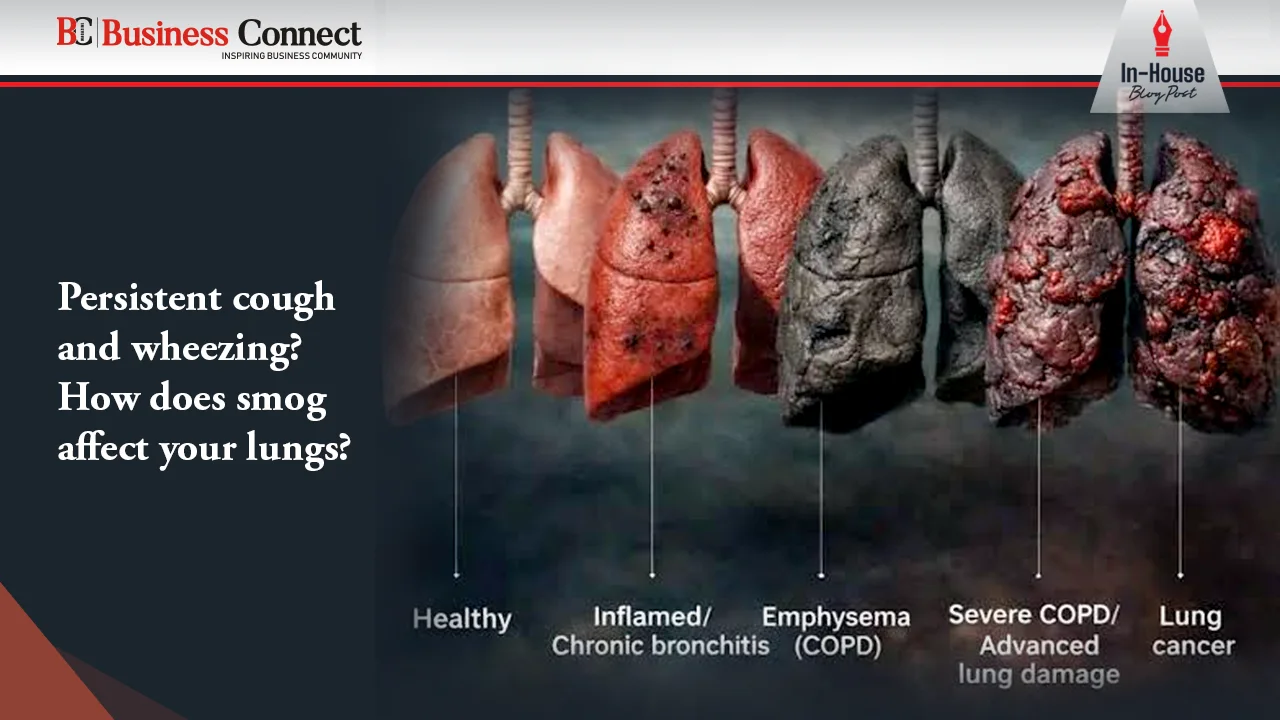
Persistent cough and wheezing? How does smog affect your lungs?
By Jaya Pathak
Respiration is one of the important life processes which help in sustaining human life. But the inhalation and exhalation of air can become a source of harm when it welcomes persistent cough and wheezing.
Imagine that you are climbing stairs and you might feel breathlessness. At first, it might seem like a minor convenience but it can be an early warning sign of polluted air which is affecting your lungs. But what exactly is happening inside our body when we breathe in smog? We will try to understand the same through this blog.
Understanding Smog and its components
Smog is a complex mixture of pollutants which can bring risk to human health. The term was coined in the earlier 20th century to describe the combination of smoke and fog which plagued the industrial cities. In the present time, smoke involves a complex chemical process. During the winter months, it can pose as a blanket of polluted air. It contains a mixture of harmful substances such as nitrogen dioxide, Sulphur dioxide, O3 (ground level ozone), carbon monoxide, volatile organic compounds, ammonia, fine and coarse particulate matter. These particulates deteriorate the air quality and bring a significant risk to the human health as well as the environment.
What happens inside the lung
The respiratory system was designed to filter out impurities, but not this many. Cilia are the fine hairlike projections that line the airways . They beat in unison to expel the mucus that has trapped the foreign matter. Smog attacks the cilia and causes them to swell up and become inactive. The mucus gets thick and the airways constrict.
This is the wheeze. A whistling sound when exhaling due to the narrowed pathways. The inflammation is not an infection but a chemical burn. The body’s reaction mechanism to a foreign irritant is the same as in case of an infection, causing the airways to swell and mucus to flow. So here’s the cough. Persistent, dry and worse in the mornings and nights. Near a traffic signal, perhaps.
The productivity arithmetic
It is not merely a public health concern, but it has become an important issue which is affecting the workplace productivity. When the smog level rises, then due to breathing difficulties and respiratory irritation, it can be tough for the employees to concentrate on their work. .
It also affects the daily life where you will not be able to sleep properly and it will leave you fatigued all day. It affects the concentration power of the body.
With the health deterioration, there is also the drainage of the economy. Healthcare expenses will rise for prescribed treatments and tests.
Who bears the heaviest load
Air pollution is a shared environmental problem but it is not equally distributed. It is more likely to affect the construction workers, street vendors, delivery personnel, traffic constable who are exposed to the polluted air. The prolonged exposure can increase the risk of various chronic respiratory conditions.
Children and adults are quite vulnerable. Children’s lungs are still developing and exposure to pollutants can interfere with the growth of a healthy lung and respiratory function. The repeated exposure may leave a long lasting consequences.
When to see a doctor?
A persistent cough for over three weeks is an indication for a pulmonary consultation. Not that the smog is the concern, but because the differential diagnosis for a persistent wheeze will be narrowed down to asthma and the doctor will want to rule that out. In order to do so, a chest X-ray, a spirometry test and a complete blood count are routine diagnostic procedures. The G.P. will often prescribe an initial course of inhaled corticosteroids and a bronchodilator to bring the inflammation down and open up the airways. These medications do not clear the alveoli of particulate matter, however. They are symptomatic. The cause is still outside the window.
The structural damage over time
One season of smog leads to reversible inflammation of the airways. Repeated exposure make it permanent and fibrotic. Repeated cycles of injury and repair leave behind the scar tissue in the lung parenchyma. The elasticity of the alveoli decreases, decreasing the Forced Expiratory Volume. For a given age, the rate is far lower than the predicted value.
The cost of the open window
The lungs do not deal in ifs and buts. They do not filter the air based on a sustainability report or a municipal policy memo. They process whatever the atmosphere throws at them, sixty thousand times a day, without fail. The cough that does not stop is just a ledger entry. A record of all those diesel exhausts and stubble fires and industrial fumes that have settled in the lower atmosphere and found their way into the nearest pair of bronchioles.
The wheeze will calm down with the change in wind direction. The cough will get better with the rain. But the tissue damage remains. The cilia do not protest. They simply stop, and the next breath carries the particulate matter a little deeper.
Add Business Connect magazine to your Google News feed