
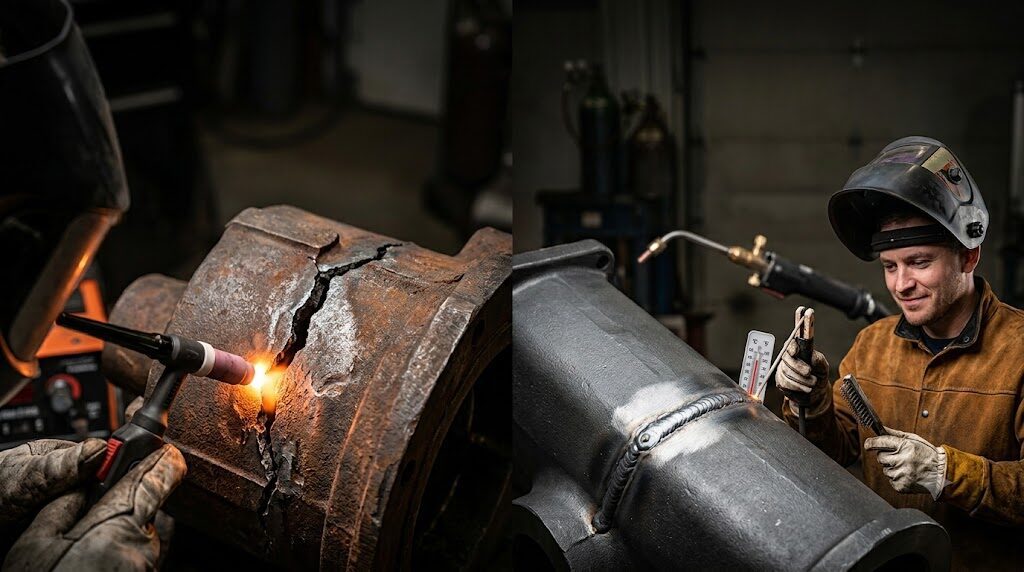
Cast Iron Welding Challenges: Why Cracking Happens and How to Prevent It
Cast iron components form the backbone of industrial machinery, automotive engines, heavy equipment and municipal infrastructure because of their exceptional wear resistance and high compressive strength. However, repairing or joining cast iron parts presents significant technical challenges that often lead to catastrophic weld cracking. A single hairline fracture during the cooling phase can compromise the structural integrity of an entire assembly.
Understanding cast iron metallurgy helps welders manage thermal stress, select appropriate filler metals and execute precise joint preparation. Proper heating and cooling protocols allow fabricators to repair damaged castings successfully, extend component service life and prevent expensive equipment downtime.
Metallurgical Characteristics and Root Causes of Cracking
Cast iron differs fundamentally from standard carbon steel because of its elevated carbon content, which ranges from 2 to 4 percent. This high carbon concentration creates brittle microstructures during localised heating and rapid cooling cycles.
When intense heat is applied to cast iron, the base metal near the weld zone melts and absorbs carbon. Rapid cooling transforms this carbon-rich zone into untempered martensite, a hard and brittle crystalline structure. At the same time, the metal expands and contracts. Because brittle cast iron lacks ductility, it cannot stretch to accommodate these internal tensile stresses, causing immediate or delayed cracking along the heat-affected zone.
| Factor | Effect on Cast Iron | Prevention Strategy |
| High Carbon Content | Forms brittle martensite upon rapid cooling | Slow cooling and preheating routines |
| Low Ductility | Cannot absorb thermal expansion stress | Mechanical peening of warm weld beads |
| Impregnated Contaminants | Causes porosity and severe arc instability | Thermal baking and deep mechanical grinding |
| Extreme Thermal Shock | Triggers immediate transverse cracking | Uniform thermal soaking before welding |
Restricting localised temperature spikes and managing base metal dilution minimise carbon pickup, protecting the surrounding metal from stress fractures.
Selecting the Right Consumables for Repairing Castings
Choosing filler materials engineered specifically for brittle metals determines the success or failure of a casting repair. Standard mild steel electrodes absorb excess carbon from the base material, creating a brittle weld bead that cracks as it cools.
High-nickel alloys serve as the standard choice for manual arc welding on cast iron components. Nickel does not absorb carbon from the base metal and retains high ductility during cooling, allowing the filler metal to stretch and relieve tensile stress instead of pulling on the brittle cast iron walls.
- 99% Pure Nickel Electrodes (Ni-CI): Ideal for thin sections, low-stress joints and applications requiring post-weld machining.
- 55% Nickel-Iron Electrodes (NiFe-CI): Suitable for thick castings, nodular or ductile iron and high-strength industrial components.
- Specialised Flux Core Welding Wire: Formulated for continuous semi-automatic welding on heavy machinery parts, delivering high deposition rates and consistent slag coverage.
Selecting a premium cast iron welding rod or specialised flux core welding wire from established fabrication supply manufacturers, such as Superon Technik, ensures proper arc stability, minimal spatter and controlled chemistry for high-integrity structural repairs. Utilising high-grade consumables reduces micro-cracking risks across critical industrial maintenance projects.
Critical Preheating and Temperature Control Measures
Uncontrolled thermal gradients represent the primary cause of cracking during cast iron joining operations.
Preheating the entire component minimises the temperature differential between the liquid weld pool and the surrounding cold metal. Maintaining uniform preheating temperatures between 150°C and 300°C reduces thermal shock, slows down the cooling rate and inhibits the formation of brittle martensite structures within the heat-affected zone.
Monitor interpass temperatures using temperature-indicating crayons or infrared thermometers throughout the repair process. Preventing sudden temperature drops protects structural integrity during multi-pass operations.
Joint Preparation Techniques and Best Practices
Proper mechanical preparation removes contaminants and distributes stress evenly across the repair area.
Oil, grease, paint and rust soak deep into porous cast iron structures over time. Burning off surface contaminants with a soft flame before grinding ensures a clean, sound base for metal deposition.
Important Joint Preparation Steps
- Drill Crack Arrest Holes: Drill a small hole through the base metal approximately 10 millimetres beyond each visible end of the crack to stop stress propagation.
- Grind a U-Groove Profile: Form a wide U-groove with rounded bottom contours rather than a sharp V-groove to reduce stress concentration points.
- Deposit Short Stringer Beads: Apply short weld passes measuring 25 to 50 millimetres in length to avoid excessive heat input in one localised area.
- Perform Mechanical Peening: Lightly tap warm weld beads with a ball-peen hammer immediately after deposition to introduce compressive stress and offset cooling contraction forces.
Following systematic joint preparation procedures prevents crack continuation and creates a strong foundation for full-penetration welds.
Post-Weld Cooling Protocols to Prevent Delayed Fractures
The cooling stage requires the same level of precise control as the preheating phase.
Exposing a finished weld to ambient room air causes rapid, uneven cooling that can trigger stress-induced fractures hours after the repair is complete. Enclosing the hot component in insulating materials, such as dry sand, vermiculite or thermal blankets, forces the heat to dissipate gradually over several hours.
Retarding the cooling rate allows thermal stresses to equalise naturally throughout the entire casting assembly, securing the structural bond.
Conclusion
Successfully welding cast iron requires strict adherence to metallurgical principles, thermal management and precise mechanical execution. Fabricators can reduce cracking by implementing uniform preheating, grinding stress-relieving joint profiles, selecting high-nickel filler metals and enforcing slow cooling schedules. Mastering these core techniques enables industrial operations to restore damaged castings reliably, reduce material replacement costs and ensure long-term structural performance.
Add Business Connect magazine to your Google News feed