
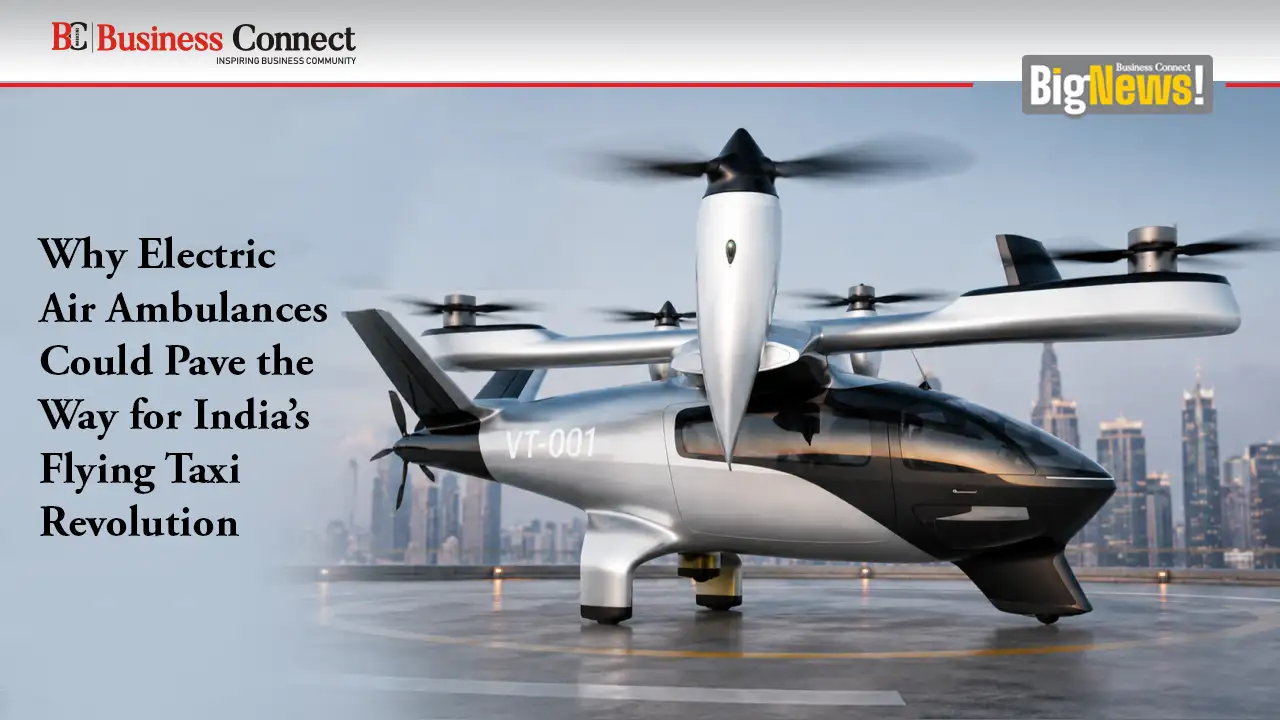
Why Electric Air Ambulances Could Pave the Way for India’s Flying Taxi Revolution
Medical flights may reach the sky before commuter air taxis do. The reasons are as much about economics and regulation as technology.
Bengaluru/New Delhi, October 26: India’s electric air taxi story is often told as a race to rescue commuters from gridlock. The more likely first customer for the technology is a patient. Several Indian developers of electric vertical take-off and landing (eVTOL) aircraft are starting with air ambulances and treating passenger taxis as the second act.
A strategy built around ambulances
The clearest example is The ePlane Company, an IIT Madras-incubated startup. It plans to certify an air ambulance first, followed by a two-passenger taxi and eventually a four-passenger version, rather than launching straight into the crowded air taxi market. The ambulance configuration would carry a pilot, a paramedic and a patient.
The company’s founder has been open about the logic. He has said ePlane can scale up production far more organically with air ambulances than by rushing into air taxis.
Demand has already been signalled. In February 2025, ePlane agreed to supply 788 air ambulances in a deal valued at over $1 billion to ICATT, an air ambulance provider that plans to deploy them across all Indian districts. The agreement is not a firm order. It is a preliminary pact with no binding conditions. Rivals are moving in the same direction. A senior Sarla Aviation executive said the company has signed agreements with hospital group Aster DM Healthcare and with air ambulance operators Blue Dot and Aeromed.
Why ambulances may go first
Several features make medical flights an easier starting point. These points are analysis rather than reported fact, and they remain untested in India.
The economics are more forgiving. A patient transfer is a high-value, time-critical service, and customers will pay more for it than for a commute. Air taxis, by contrast, must compete on price with ride-hailing and the metro. A pilot, a paramedic and a stretcher are a very different business case from a four-seat shuttle that needs high daily utilisation to break even.
The network is smaller. An air taxi service needs many vertiports in dense urban areas before it is useful. An ambulance needs to link hospitals, many of which already have rooftop or ground helipads. A few routes and a handful of aircraft can prove the service.
Regulators and the public may be more accepting. Flights with a clear life-saving purpose are easier to defend to regulators and neighbours than a premium commute over crowded cities. The early operating record would also give regulators real safety data before passengers start boarding in large numbers.
Operations build shared infrastructure. Charging systems, pilot training, maintenance routines and air traffic coordination are the same building blocks air taxis will need later. Ambulance operations would let industry and regulators practise at small scale.
The regulatory groundwork
India has moved earlier than many countries. ePlane became the first Indian private company to have its electric aircraft accepted for type certification by the DGCA under eVTOL rules issued in September 2024. The company says the DGCA has also developed rules covering vertiports, pilot training, maintenance, air operator permits, air traffic control and test pilots.
Reality check
Timelines are long and money is tight. ePlane is in the second of four certification phases and targets flight testing of a certification-conforming prototype in April 2027. It has spent about $20 million so far and is seeking another $60–70 million to reach air ambulance certification. It estimates it will ultimately need $160–170 million to certify its variants and begin commercial operations in five cities. The air taxi side is also some distance away. Sarla Aviation has begun ground testing of its air taxi ahead of a 2028 launch.
Until aircraft are certified and flying, the ambulance-first thesis is a strategy, not a result. If it works, India’s first widely noticed electric flights may carry patients rather than commuters, and the infrastructure and public trust built in the process could make air taxis possible.
Add Business Connect magazine to your Google News feed