
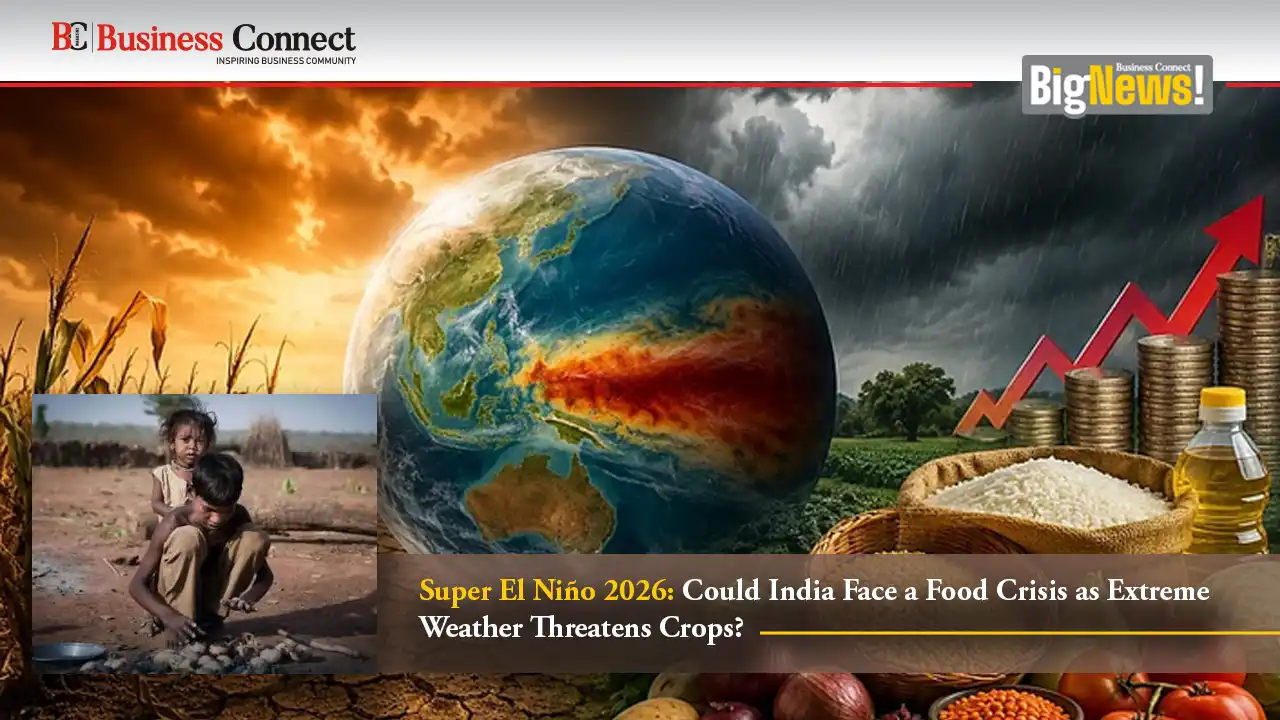
Super El Niño: Is a Global Food Crisis Coming for India?
By Anurag Tiwari | Business Connect Magazine
Imagine a farmer sowing seeds in his field. He has no idea that the temperature of an ocean thousands of kilometres away is rising. Nor does he know that a war is taking place near another distant sea. Yet, over the next few months, the cost of fertilisers could increase, diesel could become more expensive, electricity bills could rise, and the price of the grain he grows could change dramatically.
This is the question facing the world today. India’s External Affairs Minister, S. Jaishankar, has also warned about the risks of a global food crisis at international forums, including the Asia Society and the United Nations General Assembly.
At the heart of this concern are two major developments: ongoing wars disrupting global trade and a powerful climate phenomenon known as Super El Niño.
But how can a war in West Asia and rising ocean temperatures in the Pacific eventually affect an Indian farmer? And could these developments put India’s food security at risk?
Let’s understand the connections between geopolitics, fertiliser supplies, energy prices, climate change and the food on our plates.
1. How Wars Are Disrupting the World’s Food Supply
To understand the potential food crisis, we first need to examine the wars and geopolitical tensions affecting global trade.
The Russia-Ukraine War and the Global Grain Market
Russia and Ukraine are among the world’s major grain-producing and exporting countries. For years, grain shipments through the Black Sea have played an important role in the global food system.
The Russia-Ukraine war has increased risks along this trade route. Ports, ships, insurance arrangements and export operations have all faced disruption.
The impact extends far beyond countries that directly purchase grain from Russia or Ukraine. When a major supplier’s ability to deliver goods comes into question, buyers begin searching for alternative sources. This can suddenly increase demand elsewhere and push prices higher across international markets.
However, grain is not the only commodity at the centre of the current crisis. In 2026, fertilisers have become an equally important part of the story.
2. Why Fertilisers Matter More Than Most People Realise
Fertilisers are not an optional convenience in modern agriculture. They are a basic requirement for maintaining crop yields.
Plants need essential nutrients such as nitrogen, phosphorus and potassium to grow properly. Producing many nitrogen-based fertilisers also requires natural gas and other raw materials.
This creates a direct connection between energy markets and agriculture. When energy supplies become expensive or uncertain, the impact does not stop at petrol pumps and electricity bills. It can eventually reach the cost of growing crops.
The situation in West Asia, particularly around the Strait of Hormuz, demonstrates how this connection works.
The Strait of Hormuz: A Critical Route for Energy and Fertiliser Trade
The Strait of Hormuz is one of the world’s most important maritime trade routes. It carries oil and other essential commodities, including products connected to the fertiliser industry.
In 2026, tensions between the United States and Iran, along with related maritime disruptions, increased risks for ships travelling through the region.
According to the figures cited in the original report, the number of vessels passing through the Strait had fallen considerably by late September 2026. On September 24, only 10 cargo vessels reportedly crossed the route in one day, compared with a 10-day average of 17. Before the conflict began, approximately 125 large commercial vessels reportedly passed through the Strait daily.
These figures do not mean that the route was completely closed. They indicate that normal commercial activity had been severely disrupted.
This matters because West Asia is also a major centre for fertiliser production and exports.
According to estimates cited in the report, approximately 25–35% of the global seaborne trade in nitrogen-based fertiliser products, including ammonia and urea, passes through the Strait of Hormuz. Middle Eastern producers reportedly manufacture around 20 million tonnes of urea annually, representing a substantial share of global seaborne urea trade.
India sources approximately 20–25% of its total fertiliser requirements directly from the Gulf region, according to the figures cited in the report.
If maritime disruptions continue, their effects could eventually reach Indian farms through higher import costs, delayed shipments and tighter international supplies.
Red Sea Disruptions Add Another Layer of Pressure
The Strait of Hormuz is not India’s only concern.
Attacks on ships in the Red Sea have also affected the Suez Canal shipping route, which connects Europe, North Africa and the Middle East with Asia.
In response to security risks, shipping companies have diverted some container and bulk vessels away from the Suez Canal. Instead, ships are travelling around the Cape of Good Hope at the southern tip of Africa.
This alternative route can add approximately 10–14 days to journeys between Europe and North Africa and India’s western ports, including Nhava Sheva and Mundra.
Longer journeys mean higher fuel consumption, increased operating costs, delayed deliveries and potentially more expensive insurance.
India is therefore facing pressure on two important maritime routes at the same time. The consequences could extend beyond energy imports to fertilisers and other essential goods.
3. India’s Fertiliser Dependence: Where Does the Risk Lie?
India’s exposure to international fertiliser disruptions differs depending on the type of fertiliser.
Urea
India produces more than 85% of its domestic urea requirements. Its dependence on imports is therefore relatively limited, at approximately 13–15%, according to the figures cited in the report.
Domestic production provides an important buffer against international supply disruptions. However, local manufacturing still depends on the availability and cost of natural gas and other inputs.
DAP: Diammonium Phosphate
India is much more dependent on imports for diammonium phosphate, commonly known as DAP. Import dependence exceeds 60%.
Major sources include Oman, Qatar, the United Arab Emirates, Saudi Arabia, Morocco, Jordan and Russia.
This makes India’s DAP supply vulnerable to disruptions affecting maritime routes, international production and export availability.
MOP: Muriate of Potash
India meets virtually all of its MOP requirements through imports.
Canada and Russia are among the important sources, while Saudi Arabia and other suppliers also feature in international potash trade.
The key point is that each fertiliser has a different supply chain. Some shipments depend on routes through the Gulf, others travel through the Red Sea or other maritime corridors, while supplies from countries such as Canada must cover long distances.
Consequently, disruptions do not affect every fertiliser in the same way or at the same time.
4. Rising Fertiliser Prices Could Increase Pressure on Farmers
Fertiliser prices may appear to be an issue confined to agriculture, but their effects can reach almost every household.
Farmers need fertilisers to grow crops. If the cost of these inputs rises, the government may need to provide additional financial support, farmers may face pressure on their margins, and food prices could come under pressure.
According to the World Bank figures cited in the report, the global fertiliser price index rose by more than 12% in the first quarter of 2026. In March, the average price of urea reportedly reached $735 per tonne, approximately 55% higher than in February.
The report attributed this sharp increase to supply disruptions associated with the Strait of Hormuz.
International price increases do not automatically translate into an immediate rise in the price paid by Indian farmers. Government subsidies and domestic supply arrangements can help absorb part of the impact. However, those protections also have financial consequences.
If the government keeps fertiliser prices affordable while international costs increase, the difference must be absorbed somewhere, often through a larger subsidy burden.
5. India’s Fertiliser Stocks: A Crucial Safety Net
India entered this period of uncertainty with substantial fertiliser stocks, according to the government figures cited in the report.
In March 2026, the government reportedly stated that the country’s total fertiliser stock stood at 18 million tonnes, compared with 13.1 million tonnes a year earlier. This represented an increase of approximately 39%.
The government also introduced measures through the petroleum ministry to regulate natural gas supplies, prioritising fertiliser manufacturing plants. The objective was to help domestic fertiliser factories continue operating even if international gas supplies tightened.
By June 22, 2026, India’s total fertiliser stocks were reported to have reached approximately 19.6 million tonnes. The breakdown cited in the report included:
- 8.1 million tonnes of urea
- 2.1 million tonnes of DAP
- 5.6 million tonnes of NPK fertilisers
- Approximately 1.3 million tonnes of MOP
The figures listed above do not account for every category in the reported total.
During the same period, the government reportedly stated that four ships carrying fertilisers and other essential goods had arrived in India after passing through the Strait of Hormuz.
For the 2026 Kharif season, India’s total fertiliser requirement was estimated at approximately 38.4 million tonnes. The report put available stocks at around 19.8 million tonnes at the time.
A large existing stockpile provides a valuable cushion. A country with little reserve stock can experience supply shortages soon after international prices rise or deliveries are delayed. A country with adequate reserves has more time to respond.
However, stockpiles are not a permanent solution. Their effectiveness depends on how quickly supplies are replenished, how efficiently fertilisers are distributed and how long international disruptions continue.
6. How Government Subsidies Protect Indian Farmers
India has also relied on fertiliser subsidies to limit the impact of global price movements on farmers.
The retail price of a 45-kilogram bag of urea is fixed at ₹266.50. Meanwhile, international urea prices have at times translated into costs equivalent to thousands of rupees per bag.
A 50-kilogram bag of DAP is available to farmers at a retail price of ₹1,350, while international spot prices have reportedly exceeded ₹5,000 on some occasions.
The difference between the subsidised domestic price and the underlying cost is borne partly by the government.
This system helps shield farmers from sudden international price increases. However, when energy, shipping and fertiliser prices rise simultaneously, the government’s subsidy bill can increase significantly.
Higher expenditure on subsidies can also place pressure on public finances and make it harder to allocate resources to other priorities.
The challenge is therefore twofold: keeping fertilisers affordable for farmers while maintaining a sustainable fiscal position.
7. What Is Super El Niño, and Why Is It Important?
The second major part of the story lies thousands of kilometres away in the Pacific Ocean.
To understand Super El Niño, it helps to begin with the normal functioning of the tropical Pacific.
Under normal conditions, trade winds near the equator push warm surface water towards the western Pacific, around Indonesia and Australia. Near the western coast of South America, colder water rises from deeper ocean layers to the surface.
This circulation helps maintain differences in ocean temperatures across the Pacific and influences weather patterns around the world.
During El Niño, the trade winds weaken and warm surface water shifts towards the central and eastern Pacific. Sea surface temperatures rise in parts of the eastern Pacific, disrupting the usual ocean-atmosphere relationship.
These changes can affect rainfall, temperature and extreme weather across different regions.
When Does El Niño Become a Super El Niño?
Scientists monitor El Niño using several indicators, including the Oceanic Niño Index, or ONI, which measures sea surface temperature anomalies in a specific region of the tropical Pacific.
An El Niño event is generally identified when the relevant temperature anomaly reaches at least 0.5°C above average and persists over the required period. A strong event involves considerably higher anomalies.
The term Super El Niño is commonly used informally to describe exceptionally intense events, often associated with temperature anomalies around or above 2°C. It is not a separate formal category defined by a universally accepted threshold.
Major historical El Niño events include those of 1982–83, 1997–98 and 2015–16. The 2023–24 event was also a significant El Niño episode, although its classification as a Super El Niño is not universally accepted.
The 2026 outlook described in the original report raised concerns that a very strong El Niño could develop during the latter part of the year. It cited probabilities exceeding 90% for a strong event during the 2026–27 Northern Hemisphere winter and a separate estimate of 75% for an event during October–December.
These percentages refer to forecasts cited in the report, rather than confirmation that a Super El Niño has already occurred. Forecasts can change as ocean and atmospheric conditions evolve.
The central concern is that a powerful El Niño could develop over oceans that are already warmer than pre-industrial levels.
Global average temperatures have risen by approximately 1.4°C above pre-industrial levels in some assessments, although the exact figure varies by dataset and averaging period. Additional warming can increase the risks associated with heatwaves and other climate extremes.
8. How Super El Niño Could Affect India’s Monsoon
For India, one of the most important potential consequences of El Niño is its influence on the summer monsoon.
A substantial share of India’s agricultural land depends directly on rainfall. Changes in monsoon patterns can therefore affect crop production, irrigation, reservoir levels, rural incomes, electricity demand and food prices.
The monsoon is influenced by several interacting factors, including Pacific Ocean conditions, the Indian Ocean, regional atmospheric circulation and land temperatures. El Niño can weaken the Indian summer monsoon, but it does not determine rainfall outcomes on its own.
According to the figures in the original report, India’s rainfall between June and September 2026 was 12.6% below normal as of September 30. The report described this as the weakest monsoon in more than a decade and cited an Indian Meteorological Department official who identified El Niño as one of the contributing factors.
These claims should be distinguished from a conclusion that El Niño alone caused the rainfall deficit. India’s monsoon is complex, and several climatic influences can contribute to a weak or uneven season.
Why Less Rainfall Does Not Always Mean Drought Everywhere
A weak national monsoon does not necessarily mean that every region receives too little rain.
The timing, intensity and geographical distribution of rainfall matter just as much as the national total.
For example, the report noted that some parts of Uttar Pradesh experienced rainfall several times higher than normal during the final days of September, creating flood-like conditions.
This highlights an important problem for agriculture. Even when total rainfall is below average, intense rain over a short period can damage standing crops, erode soil and cause flooding. Meanwhile, other areas may suffer from inadequate rainfall and depleted water supplies.
For farmers, irregular rainfall can be as challenging as a prolonged dry spell.
India’s Crop Production Outlook
The original report stated that India’s foodgrain production target for 2026 had been reduced to 373.93 million tonnes, compared with an earlier estimate of 376.56 million tonnes over the preceding seven-year period. It also cited a target of 177.72 million tonnes for the upcoming Rabi season.
These figures illustrate the concern about agricultural output, although production targets and forecasts should not be confused with final harvest estimates.
If monsoon conditions remain unfavourable or extreme weather damages crops, production could face additional pressure. The extent of any impact will depend on crop-specific conditions, irrigation access, reservoir levels, regional rainfall and the performance of the Rabi season.
9. Global Food Prices Are Already Facing Pressure
The possible combination of climate risks and geopolitical disruptions becomes more concerning when viewed against international food prices.
According to the Food and Agriculture Organization (FAO) figures cited in the original report, the FAO Food Price Index reached 133.3 points in August 2026. This was reportedly 1.9% higher than in July and 2.5% higher than a year earlier, marking its highest level since late 2022.
The report also cited a cereal price index of 128.4 points, with Black Sea export disruptions and concerns about dry weather among the factors influencing the market.
Sugar prices reportedly rose by approximately 12%, reflecting weather-related pressure on production in South Asia. Vegetable oil prices also increased amid concerns about palm oil production and rising costs.
These movements matter because food markets are interconnected. When production falls in one region or exports from a major supplier become uncertain, buyers may turn to alternative suppliers. That can increase competition for available stocks and put pressure on prices elsewhere.
If another strong climate event affects production in several regions simultaneously, the consequences could become more serious.
However, higher global food prices do not automatically mean that every country will experience a food shortage. Domestic production, reserves, trade policies and government intervention all influence the final impact.
10. The Hidden Link Between Energy Prices and Food Inflation
The connection between energy and food prices is one of the most important parts of this story.
A farmer needs diesel to operate machinery and transport equipment. Electricity is required for irrigation and other farm operations. Fertiliser production depends on energy and industrial inputs. Railways and trucks transport fertilisers to agricultural regions, while finished crops must travel from farms to markets, processing centres and cities.
If energy becomes more expensive, costs can rise at every stage of this chain.
Geopolitical tensions in West Asia have periodically caused sharp movements in crude oil prices. The original report cited an approximately 3% one-day increase following attacks involving Houthi forces and developments linked to Yemen and Saudi Arabia in September 2026.
An increase in international crude prices does not mean that Indian fertiliser prices or retail fuel prices will rise by the same percentage the following day. Government policies, contracts, taxes, inventories and domestic pricing arrangements influence how quickly changes are transmitted.
Nevertheless, sustained instability in energy, shipping and fertiliser markets can increase the cost of producing and distributing food.
A Weaker Rupee Can Make Imports More Expensive
Currency movements add another layer to the problem.
The original report cited Reuters coverage of a decline in major Indian stock market indices during September 2026, alongside foreign investor outflows and pressure on the rupee.
These developments cannot be attributed entirely to the West Asian conflict. Global interest rates, US market conditions and domestic economic factors also influence investment flows and currency movements.
However, geopolitical and energy risks can contribute to market uncertainty.
When the rupee weakens, imports priced in US dollars can become more expensive in domestic currency terms, all else being equal. This can increase the cost of imported oil, fertilisers and other agricultural inputs.
Higher energy and input costs can then contribute to food inflation. If food prices rise persistently, it may also make it harder for the Reserve Bank of India to reduce interest rates without risking further inflationary pressure.
The result is a chain reaction connecting international conflicts, exchange rates, farm costs and household budgets.
11. What Is India Doing to Reduce the Risk?
India has several tools to reduce the impact of international supply disruptions and unpredictable weather.
1. Maintaining Larger Fertiliser Reserves
Building and maintaining adequate fertiliser stocks allows the country to absorb short-term supply disruptions. It also gives the government and fertiliser companies more time to arrange replacement shipments.
However, stockpiles must be replenished regularly, particularly before major agricultural seasons.
2. Coordinating Fertiliser Purchases
Bringing fertiliser companies together for coordinated or collective purchasing can improve negotiating power in international markets.
Large, well-planned purchases may help secure supplies on more favourable terms and reduce competition among domestic buyers for the same shipments.
3. Diversifying Import Sources
India can reduce dependence on individual suppliers and vulnerable shipping routes by expanding trade relationships with multiple producing countries.
Potential options include:
- Increasing long-term arrangements with Canada for potash.
- Maintaining or expanding supplies from Russia and Belarus where commercially and legally feasible.
- Securing phosphate supplies from Morocco and Australia.
- Exploring additional suppliers in regions less exposed to current geopolitical disruptions.
Diversification cannot eliminate risk entirely, but it can reduce the consequences of a disruption affecting one country or trade corridor.
4. Maintaining Foodgrain Reserves
The Food Corporation of India plays an important role in maintaining public stocks of wheat and rice.
These reserves can help the government respond to shortages, support public distribution and release grain into the market when necessary.
Foodgrain stocks provide an important buffer, although their effectiveness depends on procurement, storage, distribution and the scale of any disruption.
5. Promoting Climate-Resilient Crops
Millets and other crops that can perform well under certain dry or heat-stressed conditions may help farmers diversify production.
Crop diversification can reduce dependence on a narrow range of crops and, in suitable locations, improve resilience to irregular rainfall.
However, the right choice depends on local soil, water availability, climate and market demand.
6. Exploring Alternative Fertiliser Options
Organic fertilisers, biofertilisers and nano-fertilisers may offer opportunities to improve nutrient management and reduce some dependence on conventional chemical inputs.
Their suitability varies by crop, soil conditions and application method. They should be evaluated for effectiveness and used according to appropriate agronomic guidance rather than treated as universal replacements for conventional fertilisers.
12. What More Can India Do for Long-Term Food Security?
India’s current preparations provide some protection, but long-term resilience requires investment across the entire agricultural supply chain.
Secure Long-Term International Supply Agreements
India could strengthen long-term supply arrangements for DAP, MOP and phosphate rock with multiple countries, including Canada, Morocco, Australia and suppliers in South America.
Agreements with a diverse group of partners could reduce exposure to geopolitical shocks in any single region.
Indian fertiliser companies could also explore investments or ownership stakes in overseas mines and production facilities. Direct participation in upstream production may help secure supplies, although it requires capital, careful risk management and commercially viable agreements.
Upgrade Ports and Transport Infrastructure
Improving ports on India’s eastern coast could provide greater flexibility in handling shipments from alternative suppliers and routes.
Better port capacity, storage facilities, railway connections and inland transport systems could reduce delays and help fertilisers reach farmers more efficiently.
The objective is not simply to secure supplies at international ports, but to ensure that those supplies reach agricultural regions at the right time.
Expand Micro-Irrigation
Drip and sprinkler irrigation can improve water-use efficiency when appropriately designed and maintained.
Greater adoption of these systems, along with better water management, can help farmers cope with irregular rainfall and reduce their vulnerability to dry spells.
Satellite-based monitoring of reservoirs and improved water forecasting could also support more informed decisions about irrigation and water allocation.
Invest in New Fertiliser Technologies
Biofertilisers, nano-fertilisers and other nutrient-management technologies deserve continued research and evaluation.
The broader objective should be to improve nutrient-use efficiency, minimise waste and reduce unnecessary dependence on imported inputs while protecting crop yields.
These measures will not remove India’s exposure to international markets overnight. But over time, they could make the agricultural system more flexible and resilient.
13. Is India Heading Towards a Food Crisis?
India has reasons for concern, but it also has several important safeguards.
The country has domestic fertiliser production, government-supported retail prices, substantial fertiliser stocks and established systems for maintaining foodgrain reserves. These measures can help cushion short-term shocks and protect farmers and consumers from some international price movements.
At the same time, India’s dependence on imported DAP and potash, its exposure to energy prices and its reliance on the monsoon leave it vulnerable to a combination of prolonged supply disruptions and adverse weather.
A powerful El Niño could increase the risk of irregular rainfall and heat stress. Geopolitical instability could raise shipping and energy costs. Higher input costs and lower crop yields, if they occur together, could put pressure on farmers’ incomes and food prices.
Yet a global food crisis is not inevitable. Its severity would depend on how these risks develop, how long they persist, whether major crop-producing regions are affected simultaneously and how effectively governments respond.
The most important question is not simply whether a Super El Niño will occur. It is whether India can manage the combined effects of climate uncertainty, international conflicts and agricultural supply-chain disruptions.
The Bottom Line
Food security is about much more than the amount of grain growing in India’s fields.
It depends on whether farmers have access to water, fertilisers, energy and transportation at the right time and at an affordable cost. It also depends on the country’s ability to maintain reserves, diversify imports, manage prices and prepare for extreme weather.
The Pacific Ocean may be thousands of kilometres away from an Indian village, and the Strait of Hormuz may seem even more distant. But developments in both places can influence the cost of farming, the price of food and the livelihoods of millions of people.
India’s existing stocks and policy measures offer some protection. Nevertheless, a weak monsoon, an exceptionally strong El Niño, continued tensions in West Asia and disruptions to major shipping routes could create a difficult combination of risks.
The real issue is therefore not whether India is already facing a guaranteed food crisis. It is how effectively the country can prevent separate global shocks from combining into a serious challenge for agriculture, inflation and rural incomes.
What do you think? Is India adequately prepared to deal with the combined risks of Super El Niño, geopolitical tensions and rising agricultural costs? Share your views in the comments.
Note: Figures and forecasts attributed to 2026 in this article follow the supplied source material and should be independently checked against the relevant official reports before publication. Forecast probabilities are not guarantees, and the term “Super El Niño” is not a universally standardised scientific classification.
FAQs: Super El Niño – Is a Global Food Crisis Coming for India?
Q1. What is Super El Niño?
Super El Niño is an informal term used to describe an exceptionally strong El Niño event, when sea surface temperatures in parts of the tropical Pacific Ocean rise significantly above normal. It can influence global weather patterns, rainfall and temperatures.
Q2. How could Super El Niño affect India’s food security?
A strong El Niño can weaken India’s summer monsoon, increase the risk of heatwaves and irregular rainfall, and affect crop production. If agricultural output declines, food prices could rise, depending on domestic supplies and government intervention.
Q3. How do wars and geopolitical tensions affect food prices in India?
Wars can disrupt grain exports, shipping routes, energy supplies and fertiliser trade. Higher transportation, fuel and agricultural input costs can increase farmers’ expenses and contribute to food inflation.
Q4. Why is the Strait of Hormuz important for India’s fertiliser supply?
The Strait of Hormuz is a major maritime route for energy and fertiliser-related trade. Disruptions can delay shipments, increase shipping costs and put pressure on international fertiliser prices, potentially affecting India’s agricultural supply chain.
Q5. Which fertilisers is India most dependent on imports for?
India is particularly dependent on imports for diammonium phosphate (DAP) and muriate of potash (MOP). Although India produces most of its urea domestically, its production also depends on the availability and cost of natural gas and other inputs.
Q6. Can rising fertiliser prices increase food inflation?
Yes. Higher fertiliser prices can increase cultivation costs and reduce farmers’ profit margins. If these costs coincide with lower crop yields or higher transportation expenses, they may contribute to rising food prices.
Q7. How do fertiliser subsidies protect Indian farmers?
Government subsidies help keep fertilisers such as urea and DAP affordable for farmers despite fluctuations in international prices. However, prolonged increases in global prices can raise the government’s subsidy expenditure.
Q8. Is India prepared for a possible global food crisis?
India has several safeguards, including domestic fertiliser production, fertiliser stockpiles, government subsidies and public foodgrain reserves. However, prolonged geopolitical disruptions and adverse weather conditions could still put pressure on agricultural production and food prices.
Q9. What steps can India take to strengthen food security?
India can diversify fertiliser imports, secure long-term international supply agreements, improve port and transport infrastructure, expand efficient irrigation, promote climate-resilient crops and strengthen foodgrain reserves.
Q10. Is a global food crisis inevitable if a Super El Niño develops?
No. A strong El Niño does not automatically cause a global food crisis. The outcome will depend on rainfall patterns, crop production across major agricultural regions, international trade conditions, existing food reserves and government policy responses.
Add Business Connect magazine to your Google News feed