
A look at the people, sectors and money patterns that make up India’s startup ecosystem in late 2026
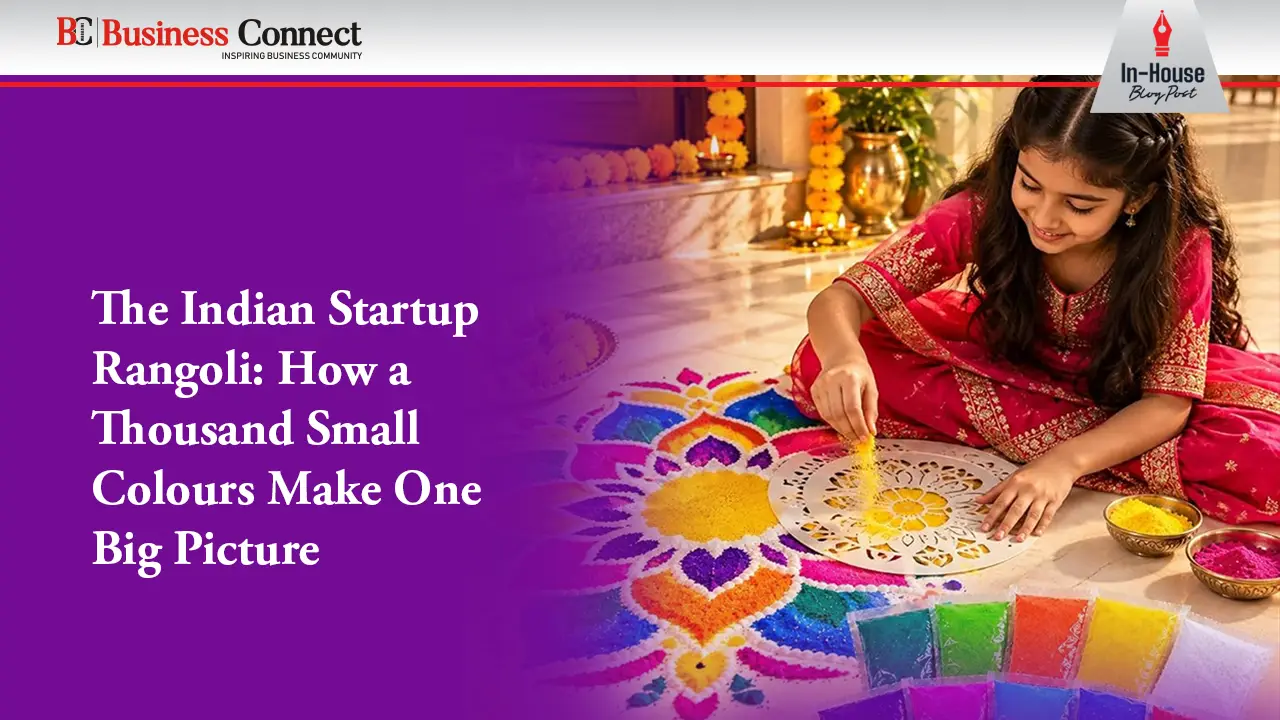
Every Diwali, millions of Indian homes start the day the same way. Someone steps outside the front door, bends down, and begins to draw. A few dots, a few lines, a handful of coloured powder. By the time the pattern is done, the doorstep looks completely different.
The Indian Startup Rangoli: How a Thousand Small Colours Make One Big Picture
The word itself carries the idea. Rangoli means “an array of colours” in Sanskrit, and it is created during festivals such as Diwali and Onam as decoration. No single colour makes the design. It works because many colours sit next to each other, each in its own place.
India’s startup ecosystem looks a lot like that. No single company defines it. A jewellery brand, an electric motorcycle maker, a chain of tiny health clinics, an audio brand, a software giant that never took outside money: each is a different colour, and together they form the picture. This blog walks through that picture as it stands now, in November 2026, a time when the colours are bright in some corners and noticeably thinner in others.
The canvas: a year when money got scarce
Every rangoli needs a surface, and for Indian startups the surface in 2026 has been uneven.
Start with the funding data. Total startup funding fell 60.8% to $677.8 million in October 2026, from $1.73 billion in October 2025, and no startup raised $100 million or more during the month. A second tracker, DealStreetAsia, reported that funding dived 62% in October after hitting a peak in September. Different trackers count differently, which is why a headline you may have seen puts the drop at 66%, but all point in the same direction.
October wasn’t a one-off. The whole year has felt tighter:
- The first quarter had no $100 million-plus deals for the first time since 2022.
- Second-quarter funding dropped 43% to $7.81 billion, driven by West Asia geopolitical tensions and a depreciating rupee.
- May saw a 55% year-on-year decline, attributed to fewer deals and a scarcity of high-value transactions.
The pattern is that mega-rounds went missing. When a handful of huge cheques usually carry a month’s total, their absence makes the chart look like a cliff. But a drop in headline numbers doesn’t mean startups stopped existing. It means the money got pickier. Startups that can show clear unit economics and a path to profitability are best placed in this tighter environment.
That is the canvas: dry, a little cracked, and unforgiving of sloppy lines. The interesting part is who is still drawing on it, and how.
Colour one: the consumer brands that learned to be loud
The most visible colour in the Indian startup rangoli is consumer brands that grew online and then crossed over into the real world.
GIVA is a good recent example. The fine jewellery retailer has raised over $100 million in a round led by Multiples Alternate Asset Management, after raising $28 million in debt earlier this year. It has been raising steadily: in June 2025 it secured ₹530 crore in a Series C. A jewellery brand attracting that much capital in a year when funding is falling says something. Investors haven’t lost their appetite for Indian consumer businesses. They want the ones with a clear product, repeat customers and a path to scale.
boAt is the older, more famous cousin, and its story is a useful reminder that growth and comfort are not the same thing. In FY25, boAt reported revenue of ₹3,070 crore, a profit turnaround, and 34 million units sold. That is a huge number for a brand that began by selling affordable earphones to young Indians. Yet FY25 revenue from operations was marginally lower than the ₹3,117.67 crore reported in FY24, a fall of 1.4%. Scale was there, but growth had flattened.
Then came complications on the road to a stock-market listing. Auditors flagged inconsistencies between financial information given to lenders and the company’s own books across FY23, FY24 and FY25. One report said the IPO was deferred for a second time, with co-founders Aman Gupta and Sameer Mehta stepping back from executive roles in late 2025. I couldn’t confirm that boAt has listed, so its IPO status should be treated as pending.
The lesson from these two brands is the same one rangoli artists learn: a bold colour gets attention, but clean edges earn trust. Brand love can build a company, but only discipline in the books lets it walk onto a public market.
Colour two: healthtech that goes where hospitals can’t
If consumer brands are the loud colour, healthtech is the quiet one that holds the pattern together.
Clinics On Cloud, a Pune-based startup, is a good example. It has secured ₹120 crore in Series A funding at a ₹600 crore valuation, backed by Dubai-based Model42. What makes the story unusual is its path. The company was founded in 2018 and grew through eight years of bootstrapped effort before taking its first institutional cheque. It started with Health ATMs and has grown into AI-enabled Health Lounges, Box Clinics and Mobile Medical Units. The company reports more than 3,500 installations, over 12 million health screenings and operations in more than eight countries, though these figures are company-reported.
Why does this model matter in India? Because primary care access is uneven, and building a full hospital in every district isn’t realistic. Compact, tech-led clinics fit the gap. And the fact that the first outside money came from a Gulf investor, aimed partly at a UAE expansion, shows how Gulf capital and Indian healthtech are finding each other.
Colour three: hardware and the long road of deep tech
Some colours take longer to dry. Electric mobility is one of them.
Ultraviolette Automotive, the Bengaluru maker of the F77 electric motorcycle, shows both the promise and the pain of building hardware. It has raised about $100 million in total, with TVS Motor and Mudhal Partners as lead investors. In FY25, it reported ₹32 crore in revenue and a ₹116 crore loss. That gap is typical of an early-stage manufacturing company, where tooling, testing and certification cost money long before sales catch up.
Its cap table also reads like a map of Indian industry. As of 27 February 2026, TVS Motor held 25.5%, the largest stake in the company, and the founders collectively held 26.4%. Investors include Lingotto, TDK Ventures, Qualcomm Ventures, Zoho Corporation, TVS Motors and Speciale Invest. A strategic backer like TVS brings manufacturing and distribution know-how that a pure financial investor can’t, which is why such partnerships matter so much in hardware.
The trade-off is dilution. In March 2024, founders Narayan and Rajmohan held 26.31% and 22.48%, but their combined stake has since fallen as new rounds came in. Every round buys runway and costs ownership. Founders in capital-heavy businesses learn to live with that.
Colour four: infrastructure, the unseen layer beneath the pattern
Behind every app, every online order and every AI chatbot sits a data centre. It is not the flashiest colour in the rangoli, but it may be the one that determines whether the pattern lasts.
A Crisil report projects that India’s data centre capacity will grow five-fold to about 7.5 GW by March 2030, drawing more than ₹3 lakh crore of investment over four fiscal years. Big global names are placing bets, and Indian conglomerates are too. Adani’s data centre arm, AdaniConneX, is reportedly in talks to borrow about $1.5 billion to expand.
For startups, this matters in a practical way. Cheaper, closer, faster cloud capacity lowers the cost of building software and AI products in India. It is the paper under the powder: invisible when things go well, and a disaster when it tears.
Colour five: AI and the Indian user
Then there is the colour that changed fastest this year: artificial intelligence.
OpenAI India’s managing director told The Economic Times that India’s weekly active user base for ChatGPT has doubled since January 2026, and that India now ranks first globally on that measure. Earlier in the year, OpenAI said India had more than 100 million weekly users. That is company-reported data, and it comes with a catch: most of those users are on free plans, and converting them to paying customers is the hard part.
For Indian startups, this is both an opportunity and a warning. The opportunity is a huge, young, digitally comfortable user base. The warning is that if global AI players already dominate Indian attention, home-grown startups must find a niche that the giants can’t easily fill, such as local languages, specific industries or low-cost distribution.
The bootstrapped thread: colours that never needed borrowed powder
Not every colour in this rangoli came from an investor’s tin.
Zoho, the software company often described as a bootstrapped unicorn, shows another path. It built a business without chasing outside funding, and it now invests in others, including Ultraviolette. Clinics On Cloud grew the same way for eight years before taking its first outside round.
In a year when capital is hard to find, this story matters more than it used to. Bootstrapping isn’t right for every business. Hardware and deep tech often can’t avoid raising money. But for software, services and capital-light models, growing on customer revenue buys independence, and it makes the eventual fundraise, if there is one, much stronger.
The cracks: what the pattern also shows
An honest look at any rangoli notices where the lines wobble. A few themes stand out.
Governance. boAt’s story is a warning that financial hygiene can matter as much as product-market fit. Mismatched numbers and leadership changes make public investors nervous, and a delayed listing costs time and credibility.
Losses. Ultraviolette’s ₹116 crore loss on ₹32 crore of revenue is a normal early-stage profile, but it is only sustainable while investors keep believing. When funding slows, as it has this year, companies with big burn rates feel it first.
Dependence on mega-rounds. October’s missing $100 million cheques show how much the ecosystem’s headline numbers lean on a few big deals. A healthier picture would have more mid-sized rounds spread across more sectors and cities.
Concentration of attention. Delhi, Bengaluru and Mumbai still dominate funding conversations, even though several of the companies above, such as Clinics On Cloud in Pune, show that strong businesses can grow elsewhere.
What founders can take from this
If you are building a startup in India right now, the patterns above point to a few practical ideas.
- Show real unit economics early. Investors have become selective, and clear margins and repeat customers matter more than growth stories.
- Keep your books clean from day one. Mistakes in financial reporting are cheap to fix at the start and very expensive to fix just before an IPO.
- Choose investors for more than money. A strategic partner like TVS can open doors that cash alone can’t.
- Plan for dilution, not against it. Raising money is a trade-off. Know how much ownership you can give up before you start.
- Consider growing slowly first. Several of the strongest stories here, including Zoho and Clinics On Cloud, were built without outside money for years.
- Pick a problem India has in a very Indian way. Low-cost health access, affordable audio, electric two-wheelers: the winners are often solving something specific to Indian conditions.
What investors are watching
On the other side of the table, a few signals matter in late 2026:
- Whether $100 million-plus rounds return in November and December, or stay absent.
- How the rupee and global tensions affect foreign capital, since they were cited as drags earlier in the year.
- Whether delayed IPOs, like boAt’s, finally reach the market, and how they are received.
- Whether AI startups keep taking a growing share of whatever funding is available.
The bigger picture
Step back from the individual colours, and the rangoli of Indian startups has a few clear features.
It is diverse: jewellery, audio, health, mobility, infrastructure and AI all sit side by side. It is resilient: even in a year when funding fell sharply, a $100 million jewellery round, a ₹120 crore health round and a ₹3 lakh crore infrastructure outlook all appeared. And it is uneven: some sections are bright and complete, while others are still half-drawn.
Rangoli is also, by nature, temporary. It is drawn fresh each morning, and a gust of wind or a passing foot can wipe out hours of work. The artist doesn’t take that personally. They sweep, take a breath, and start again, usually with a better pattern than before.
That is perhaps the best way to think about the Indian startup ecosystem after a tough year. The funding slump is real, the governance problems are real, and the losses are real. But the people drawing are still drawing, and the new designs, like Clinics On Cloud’s bootstrapped climb or GIVA’s steady fundraising, show that the pattern keeps evolving.
If you’re a founder, the message is simple: draw with clean lines, choose your colours carefully, and expect to redraw. If you’re a reader, the next time you see a headline about a funding round or a falling chart, remember that it is only one small corner of a much larger picture.
Add Business Connect magazine to your Google News feed