
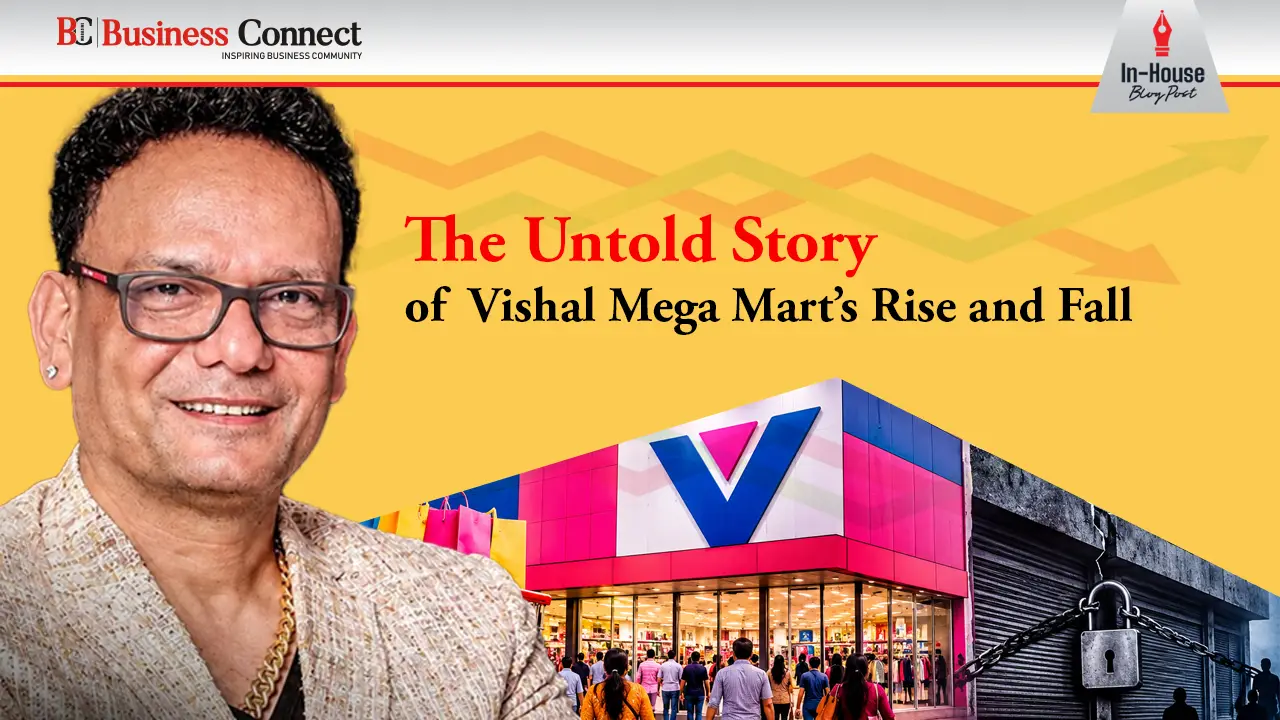
By Anurag Tiwari, Business Connect Magazine
In 2025, a strange piece of internet trivia took over Instagram and YouTube. A post claimed that to become a security guard at Vishal Mega Mart, you had to clear a written exam, a medical test and a physical test. The guard at the exit, the one who stamps your bill before you leave, became an overnight meme. People compared the job to the UPSC and IIT-JEE. Jokes about unemployment poured in. The post was later found to be fake, but by then the damage, or the free publicity, was done.
The timing was almost too perfect. Only months earlier, in December 2024, Vishal Mega Mart had gone public, and its IPO was subscribed about 28 times over. A company known for selling affordable clothes and groceries in small towns suddenly ranked among India’s most talked-about retailers.
Yet one man watched the celebration with very different feelings. His name is Ram Chandra Agarwal. He built the company from nothing. At one point he owned all of it. Today he holds not a single share. This is his story, and the story of how a business can be brilliant in its idea and still be lost to its own speed.
A boy from Kolkata who refused to slow down
Ram Chandra grew up in Kolkata and was struck by polio as a child. At an age when other kids were learning to run, even walking steadily was hard for him. But weak legs did not mean a weak will.
According to reports, in 1986 he opened a small photocopy shop, the kind you still see outside colleges and courts. It didn’t earn much, but it taught him the first rule of business: know what the customer wants and what he is willing to pay for it.
A few years later he moved into clothes. In Kolkata’s Lal Bazar area he opened a ready-made garment store and called it Vishal Garments. At the time, many middle-class families still got their clothes stitched by a tailor. Readymade clothes were either pricey or found only in a few big-city shops. Agarwal saw a gap and aimed at it: affordable, decent-quality clothes that wouldn’t burden an ordinary family’s wallet.
He spent about 15 years in Kolkata, and those years gave him his most valuable insight. Customers from small towns didn’t care much about big brand names. They cared that the cloth was good, lasted long and fit the budget. He had understood the buyer whom big brands often ignored.
2001: one roof, one idea, Delhi
India had opened its economy in 1991, and incomes and shopping habits were changing. Agarwal could see where the country was heading. In 2001 he left Kolkata for Delhi and launched Vishal Mega Mart.
The idea was simple, and at the time it was fresh. One large store where you could find clothes, utensils, household items and groceries, all at low prices. Before this, shopping could eat a whole day: one shop for clothes, another for vessels, the neighbourhood grocer for staples. Vishal put it all under one roof.
Its stores opened mostly in towns and smaller cities, where the middle-class family could walk in without calculating every rupee in advance.
Three men, one customer, three strategies
Here comes the most interesting part of this story. Agarwal wasn’t alone in spotting this customer. The same year he opened in Delhi, Kishore Biyani launched Big Bazaar in Kolkata. A year later, in 2002, investor Radhakishan Damani opened his first DMart in Mumbai. All three targeted the same family, with nearly the same promise: more goods, lower prices, one place.
But they played the game differently. Agarwal and Biyani wanted speed: more cities, more stores, as fast as possible. Damani went slowly. He controlled costs and, wherever he could, bought the land under his stores, so he wouldn’t carry the weight of rent for decades.
Remember these three approaches, because everything that follows comes from this difference.
The climb
For a while, Vishal’s speed looked like genius. Stores opened one after another. The company began making many of its own clothes, which reduced its dependence on middlemen and kept prices low.
Then came 2007. Vishal Retail decided to go public, and the market was booming. Investors showed interest, and within a few months of listing, the share price had multiplied. At the time of its initial public offer, Vishal Retail was valued at about ₹2,000 crore. A boy who started with a photocopy machine now ran a listed company.
On paper, everything shone: more stores, rising valuation, a bigger dream.
The danger inside the speed
But growing fast and growing strong are two different things. Vishal was opening new stores at a pace that needed enormous money, and a large part of that money was borrowed from banks.
As long as sales climbed, it all worked. A new store opened, it earned, and the earnings paid the loan instalments. Then 2008 arrived. Lehman Brothers collapsed, the world slid into recession, people cut spending, banks tightened lending and stock markets crashed.
Think of someone who has bought a house, a car and a shop on EMIs, and then watches his income fall by half. The instalments don’t shrink. Each month becomes a mountain. That is what happened to Vishal. Sales dropped while loan payments stayed the same. By 2011, the company had run up a debt of ₹760 crore with lenders such as HDFC Bank, HSBC, ING Vysya Bank and State Bank of India.
Suppliers waited longer for their payments. Shelves in some stores ran low on goods. A few stores had to shut. The share that investors once fought to buy slid far below its peak.
Agarwal tried everything: talks with banks to restructure the debt, a search for new investors. Nothing closed in time. In March 2011, the end came. Vishal Retail completed the sale of its retail and wholesale businesses to the Shriram Group and private equity firm TPG, respectively, for ₹70 crore.
Think about that number. A company once valued at around ₹2,000 crore changed hands for ₹70 crore. The journey that began in a Kolkata photocopy shop and rose to a Delhi mega mart ended in a single stroke, and the founder walked out of the company he had built with his own hands.
What happened to the other two
The same fork in the road later showed up in the stories of Agarwal’s two contemporaries.
Biyani’s Big Bazaar kept growing quickly, and his Future Group eventually crumbled under its own debt. In 2020 he tried to sell his retail business to Reliance, but the deal could not be completed, and Future Retail slid into bankruptcy proceedings.
Damani, meanwhile, kept building slowly, on land he owned, with little debt. DMart went public in 2017 and is now counted among India’s most valuable retail companies.
Same idea. Same customer. Very different endings, and the difference was how fast each man grew and how much he borrowed to do it.
Vishal without its founder
Vishal Mega Mart’s story did not end in 2011. In fact, the most commercially successful part was yet to come, under new owners.
The new management stopped the mistake that had sunk the company: reckless expansion. Each new store was opened with thought, and expenses were watched closely. But the company didn’t change its core customer. Vishal remained a store for middle- and lower-middle-class families in small towns, and the new owners leaned even harder into places where bigger brands hadn’t reached.
Its greatest strength in this phase was its own labels. If you look closely at the clothes in a Vishal store, most don’t carry a famous brand name. They carry the company’s own. This gave the company two advantages: it didn’t have to share profit with another brand, so it could sell cheaper, and making goods at low cost improved its own margins.
During this period, Vishal also made headlines for something almost every customer could relate to: carry bags. Many shoppers had been asked at the billing counter whether they wanted a bag, and a few rupees were added to the bill. The bag had the company’s name printed on it. Some customers felt that was wrong and took the matter to consumer courts. Courts in different cities fined the company, with a simple argument: if the bag carries the company’s name and logo, it is advertising, so why make the customer pay to promote it? The amounts were small, but the cases drew plenty of attention.
In 2018, the company changed hands again. A consortium of Kedaara Capital and Partners Group agreed to buy Vishal Mega Mart for about ₹5,000 crore from TPG Capital and the Shriram Group. Seven years after its lowest point, the company was back at an all-time high, but without the man who started it.
The founder’s second innings
In the same year that Vishal left his hands, 2011, Ram Chandra Agarwal started again. The new company was called V2 Retail, and its focus was the same: middle-class families in small towns who wanted good clothes at fair prices.
The idea was unchanged. The approach was not. He had seen first-hand how fast store openings and heavy borrowing can bring down a company. The early years were a struggle: opening stores, reaching customers, becoming profitable, all of it took time. But this time he didn’t repeat his old mistakes.
Slowly, V2 Retail picked up pace. Stores multiplied, the business widened, and the stock began to attract notice. Agarwal has since taken V2 Retail to a market capitalisation of ₹6,500 crore, with returns of over 3,200% for shareholders in five years, according to one report.
December 2024: the twist
While Agarwal was busy rebuilding with V2, his first company came back into the headlines. In December 2024, Vishal Mega Mart launched its IPO. According to reports, the issue was worth about ₹8,000 crore, priced at ₹78 a share.
There was an interesting detail that few people noticed. Not a single rupee from this IPO went into the company as fresh capital. It was entirely an offer for sale, which means the investors who bought the company in 2018 were selling shares to exit with a profit.
Even so, investors rushed in. The IPO was subscribed around 28 times, and at the issue price the company was valued at roughly ₹35,000 crore. Media reports at the time said Vishal Mega Mart ran over 600 stores in more than 400 cities and did about ₹9,000 crore in annual business. Thirteen years after nearly collapsing, the company that once sold for ₹70 crore was worth thousands of crores.
The lesson in the rubble
Strip away the memes, the meme guard and the market buzz, and this story carries a clear lesson for anyone building a business.
Vishal’s idea was never wrong. The proof is that the same company, with the same customer and the same kind of stores, became a market success under new owners who moved with more caution. What hurt it was the way it grew: too fast, too much borrowed money, no cushion when the world turned.
Agarwal appears to have learned that. The man who lost a company to debt built the next one more carefully, and it worked.
It also says something about how business stories get told. We celebrate the founders who rise and the companies that list on the stock market. We forget that, sometimes, the person who laid the first brick isn’t there when the building is finished.
That is the real, untold story of Vishal Mega Mart: a polio survivor who started with a photocopier, built an empire, lost it all to a crisis, and began again.
Add Business Connect magazine to your Google News feed