
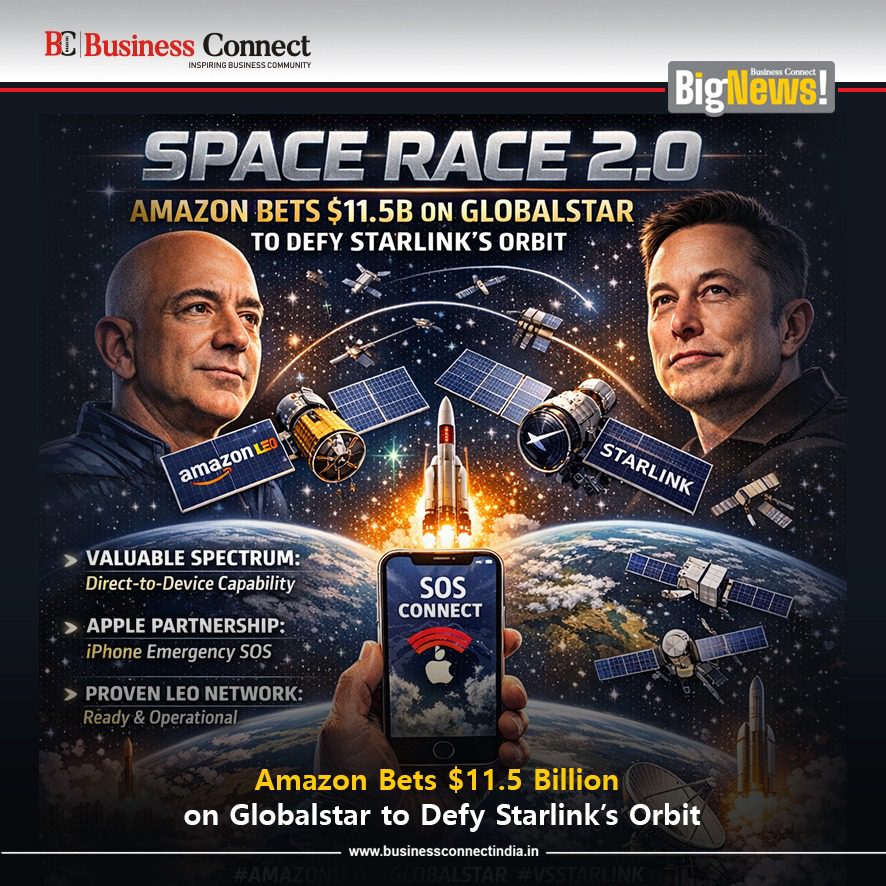
The battle for the final frontier just got a lot more expensive—and a lot more interesting. In a blockbuster move that has sent shockwaves from Wall Street to Cape Canaveral, Amazon has officially announced its acquisition of satellite pioneer Globalstar for a staggering $11.57 billion.
This isn’t just a corporate merger; it’s a strategic “all-in” by Jeff Bezos’s empire to ensure Project Kuiper (now being referred to internally as Amazon Leo) doesn’t just play catch-up with Elon Musk’s Starlink, but fundamentally changes how we connect our devices to the stars.The $11 Billion Strategy: Why Globalstar?While Amazon is currently scaling its own constellation—with over 200 satellites already in orbit—Globalstar brings three massive assets to the table that Amazon desperately needs:Valuable Spectrum: Globalstar holds critical “direct-to-device” (D2D) spectrum licenses.
This is the “holy grail” of satellite tech, allowing standard smartphones to connect to satellites without a bulky dish.The Apple Connection: Globalstar is the backbone of Apple’s Emergency SOS feature. In a fascinating twist, Amazon and Apple have already signed a new pact ensuring that iPhones will continue to use these satellites, potentially making Amazon the silent partner in Apple’s future safety features.A Proven Network: While Amazon is still in the “build” phase, Globalstar is an “operate” phase veteran with a functional LEO network and ground stations ready to go.
The Deadline Looming Over BezosAmazon is under the gun. Regulatory requirements dictate that the company must have half of its planned 3,236-satellite constellation in orbit by July 2026.With only a few months left to hit that milestone, the Globalstar acquisition provides a much-needed infrastructure boost. Meanwhile, Starlink isn’t sitting still—Musk’s network recently crossed the 10,000-satellite mark, serving over 9 million users worldwide. Amazon is effectively trying to build a decade’s worth of space presence in a matter of months.
What This Means for YouFor the average consumer, this deal signals the end of “dead zones.” Within the next two years, the competition between Amazon, Starlink, and mobile carriers will likely mean:Universal Connectivity: Your phone working in the middle of the Sahara or the deep Pacific.Integrated Ecosystems: Your Prime subscription eventually including satellite backup for your Echo devices or Kindle.Cheaper Satellite Internet: As the two giants clash, expect hardware costs for satellite dishes to plummet.
The Fine PrintThe deal offers Globalstar shareholders a choice: $90 in cash or Amazon stock. As the transition unfolds through 2027, the tech world will be watching to see if Amazon can bridge the 9,800-satellite gap with Starlink, or if Musk’s head start is simply too vast to overcome.One thing is certain: the sky is about to get a lot more crowded.