
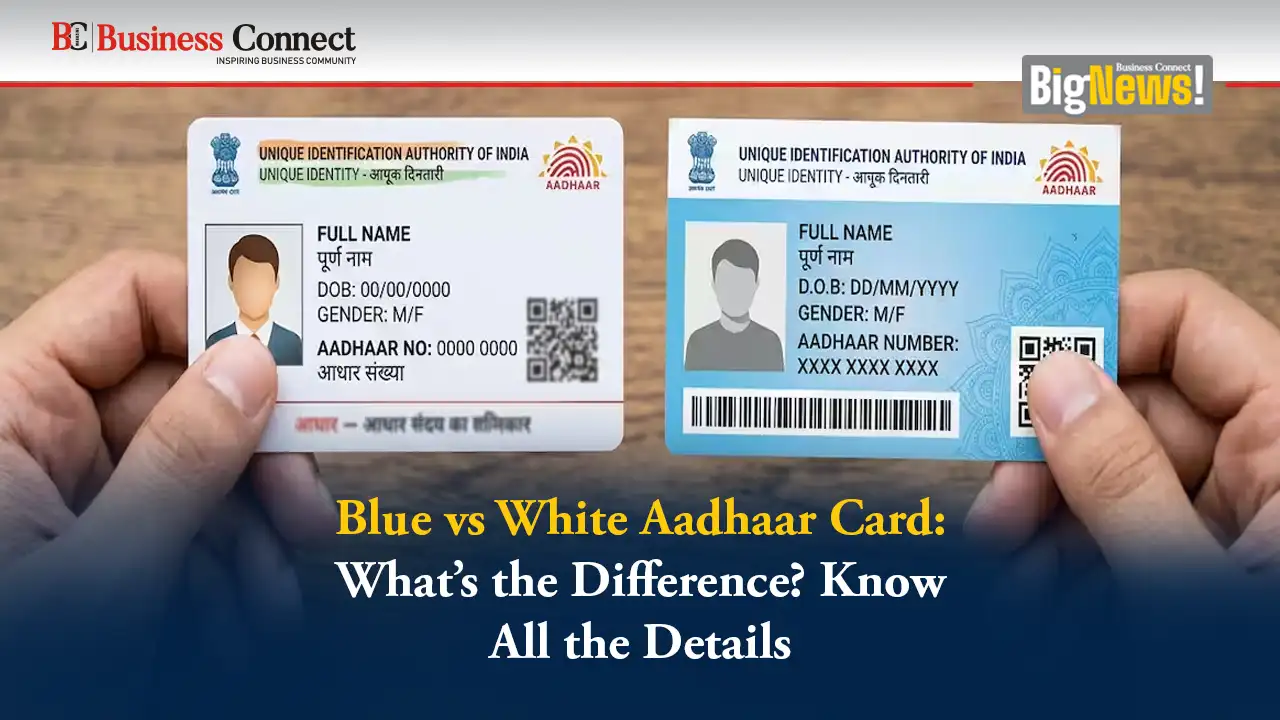
Blue vs White Aadhaar Card: What’s the Difference? Know All the Details
Two Colors, One Identity System — Here’s What Actually Sets Them Apart
If you’ve ever compared your own Aadhaar card with your toddler’s, you may have noticed something odd: yours is white, theirs is blue. It’s not a printing error or a cosmetic choice — the Blue Aadhaar card, officially known as Baal Aadhaar, is a distinct category within India’s Aadhaar system, built specifically for children under five. Here’s everything you need to know about how it differs from the standard white Aadhaar, who’s eligible, and how the transition between the two actually works.
What Is a Blue Aadhaar Card?
The Blue Aadhaar card, or Baal Aadhaar, is a special identity document issued by the Unique Identification Authority of India (UIDAI) exclusively for children below the age of five. As the name suggests, it’s printed with a light blue background, making it visually distinct from the regular white Aadhaar card most adults carry.
The Blue Aadhaar isn’t a lesser version of Aadhaar — it carries the same 12-digit unique identification number, a QR code, and the child’s demographic information. The real difference lies in what’s collected to create it.
What Is the “White Aadhaar” Card?
Here’s something worth clarifying upfront: “White Aadhaar” isn’t an official UIDAI category. It’s simply the common term people use to describe the standard Aadhaar card — the regular version issued to adults and children over five, generally printed on white paper. UIDAI itself doesn’t formally classify it separately; the term has just become shorthand in everyday conversation to distinguish it from the blue version.
Blue Aadhaar vs. White Aadhaar: The Real Difference
The easiest way to understand the distinction isn’t the color at all — it’s biometrics.
| Feature | Blue Aadhaar (Baal Aadhaar) | White/Regular Aadhaar |
|---|---|---|
| Eligible age | Below 5 years | 5 years and above |
| Biometric data (fingerprints, iris scan) | Not collected | Collected and mandatory |
| Identity basis | Child’s photo, date of birth, one parent’s Aadhaar number | Child/adult’s own biometrics |
| Card color | Light blue | White |
| Validity | Temporary — requires mandatory biometric updates | Standard, long-term |
| Cost | Free | Free (nominal fee for color printout/PVC card) |
Since infants and very young children can’t reliably provide fingerprints or iris scans, UIDAI designed the Blue Aadhaar to rely on a parent or guardian’s Aadhaar number combined with the child’s photo and date of birth, rather than requiring biometric capture that simply isn’t practical at that age.
How to Apply for a Blue Aadhaar Card
Getting a Baal Aadhaar for your child involves a fairly straightforward process:
- Visit an Aadhaar Enrolment Centre or Aadhaar Seva Kendra, or begin the process via the UIDAI portal — note that the application isn’t entirely completable online, since in-person verification is still required.
- Carry the required documents: the child’s birth certificate and the Aadhaar card of at least one parent or guardian.
- Complete the enrolment form, providing the child’s photo and basic demographic details.
- Receive the Blue Aadhaar, which is typically delivered to the registered address within 90 days.
The Blue Aadhaar card itself is issued free of cost, though a nominal fee (around ₹30) may apply if you want a colour printout.
What Happens When the Child Turns 5?
This is the part many parents miss — and it’s important. A Blue Aadhaar isn’t permanent. Once a child crosses the age of five, UIDAI requires a Mandatory Biometric Update (MBU), capturing the child’s fingerprints and iris scan for the first time. A second biometric update is required again at age 15, once the child’s physical features and fingerprints have further developed and stabilized.
Letting this update lapse is one of the most common mistakes parents make — an outdated or non-updated child Aadhaar can cause complications later when the ID is needed for school admissions, passport applications, or other essential services. The Aadhaar number itself doesn’t change through this process; only the underlying biometric data gets added as the child grows.
Why Does the Blue Aadhaar Matter in 2026?
With India’s Digital Personal Data Protection (DPDP) Act now in full implementation, the Blue Aadhaar has taken on a more prominent role than just being a formality for newborns. It’s increasingly being used as a tool for age-verification and “age-gating”, allowing parents to confirm a child’s identity for schools, apps, and services without needing to share more sensitive biometric data than necessary. With the UIDAI’s Aadhaar App also enabling selective sharing features, parents now have more control over exactly what child-related data gets disclosed and to whom.
Why Getting a Blue Aadhaar Early Matters
Despite being meant for very young children, the Blue Aadhaar serves real, practical purposes:
- School admissions — increasingly required as proof of identity and age
- Government scheme enrollment — many child welfare and subsidy schemes require an Aadhaar-linked identity
- Passport applications — Aadhaar is commonly accepted as supporting ID documentation
- Healthcare and vaccination records — linking a child’s medical history to a verifiable ID
Delaying enrollment can create friction later, especially as more services digitize and expect Aadhaar-linked verification as a default.
The Bottom Line
The difference between a Blue and White Aadhaar card ultimately comes down to one thing: biometric readiness. A Blue Aadhaar lets UIDAI issue a valid, trackable identity to a child too young for fingerprint or iris capture, while the white Aadhaar represents the fully biometric-verified version everyone eventually transitions into. If you have a child under five without an Aadhaar yet, enrolling for the Blue Aadhaar — and staying on top of the mandatory biometric updates at age 5 and 15 — is one of the simplest ways to keep their identity documentation ready for whatever comes next, from school admissions to government benefits.
Frequently Asked Questions
1. What is the main difference between a Blue Aadhaar and a White Aadhaar card?
The Blue Aadhaar, issued to children under five, doesn’t include biometric data like fingerprints or iris scans, relying instead on the child’s photo, date of birth, and a parent’s Aadhaar number, while the White Aadhaar for adults and older children includes full biometric verification.
2. Who is eligible for a Blue Aadhaar card?
Only children below the age of five are eligible for the Blue Aadhaar, also known as Baal Aadhaar.
3. Does the Aadhaar number change when a Blue Aadhaar is updated to a regular one?
No. The 12-digit Aadhaar number remains the same throughout the child’s life — only the biometric data gets added during the mandatory updates at ages 5 and 15.
4. Is the Blue Aadhaar card free?
Yes, the Blue Aadhaar card is issued free of cost, though a small fee (around ₹30) may apply for a colour printout.
5. What documents are needed to apply for a Blue Aadhaar?
You’ll need the child’s birth certificate and the Aadhaar card of at least one parent or legal guardian.
6. How long does it take to receive a Blue Aadhaar card?
It’s typically delivered to the registered address within 90 days of enrollment.
7. What happens if the mandatory biometric update is missed after age 5?
An outdated child Aadhaar without the required biometric update can cause issues later when the ID is needed for school admissions, passport applications, or other essential services, so it’s important not to let the update lapse.
8. Can a newborn get an Aadhaar card?
Yes, newborns are eligible for Blue Aadhaar enrollment shortly after birth, using the parent’s Aadhaar and the child’s birth certificate.
9. Is “White Aadhaar” an official UIDAI term?
No. UIDAI doesn’t officially classify a separate “White Aadhaar” category — it’s simply the commonly used term for the regular, non-child Aadhaar card.
10. How many times must biometrics be updated for a child’s Aadhaar?
Two mandatory biometric updates are required — once at age 5 and again at age 15 — to keep the Aadhaar record current as the child’s physical features change.
Add Business Connect magazine to your Google News feed