
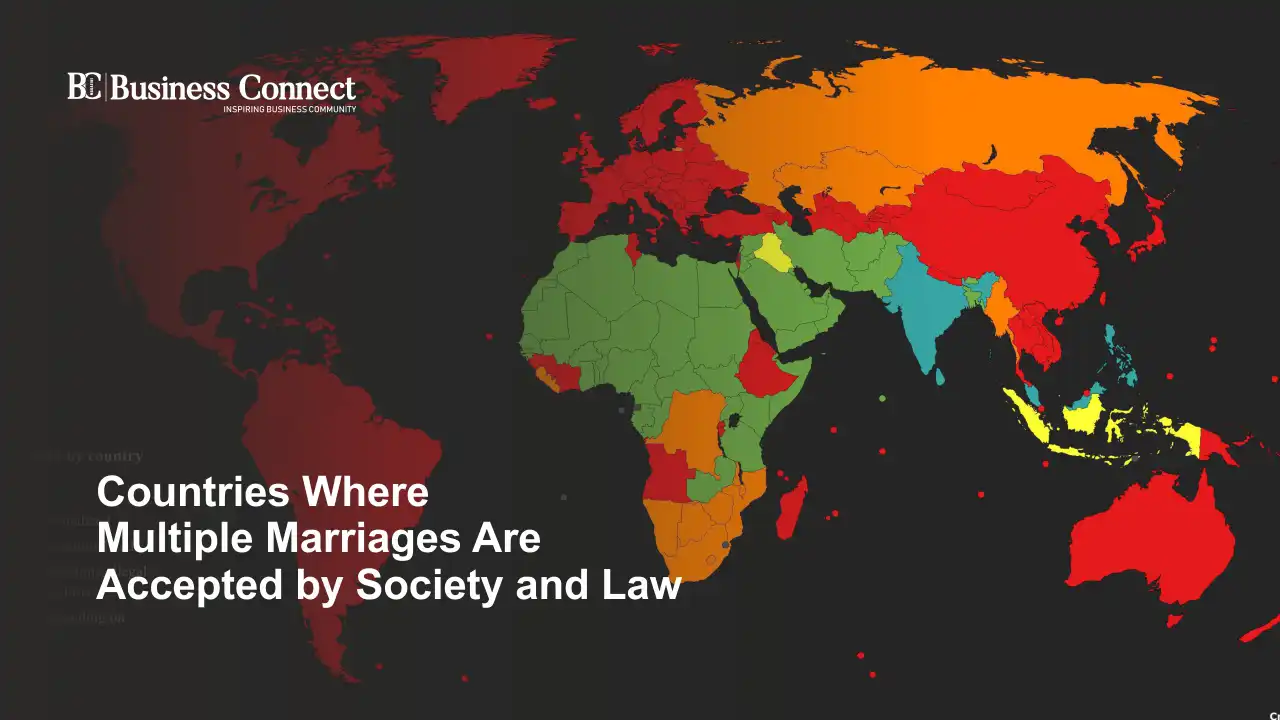
From Saudi Arabia to Nigeria, Indonesia to Mali — around 58 countries permit polygamous marriages under religious, customary, or civil law. Here is an in-depth country-by-country guide, legal explainer, regional breakdown. Around 58 countries permit polygamy by law. This 2026 guide covers every region — Middle East, Africa, Asia — with country-by-country legal rules.
| Statistic | Details |
|---|---|
| ~58 | Countries where polygamy is legal |
| 2% | Estimated global population living in polygamous households (Pew Research) |
| 4 | Maximum number of wives allowed under Islamic law |
| Africa | Region with the highest prevalence of polygamy — reaching up to 34% in some nations |
Marriage is one of humanity’s oldest institutions — and across cultures, it has never been a single, fixed thing. While the Western model of monogamy dominates global media, approximately 58 countries around the world legally permit or formally tolerate polygamy: the practice of having more than one spouse simultaneously. This guide examines every major region where multiple marriages are accepted in law and daily life, the religious and cultural frameworks that underpin them, and what the data actually says about how common these arrangements are in the modern world.
It is important to note the difference between what is legally permitted and what is socially practiced. In many countries, polygamy is technically allowed but rates have declined sharply due to economics, urbanisation, and changing attitudes — particularly among younger generations. In others, it remains a deeply embedded social norm. This article presents the facts without advocacy.
The legal frameworks governing polygamy fall into three broad categories. The first is formal legal permission under national civil or religious personal law — as in Saudi Arabia, Egypt, and most of Sub-Saharan Africa’s Muslim-majority states. The second is a dual-track system: civil law prohibits polygamy but religious or customary marriages are legally recognised, effectively allowing multiple unions — as in Nigeria, South Africa, and several Southeast Asian nations. The third is toleration without formal recognition: polygamy exists, prosecutions are rare, and courts look the other way — as in parts of Central Asia.
“Only about 2% of the world’s population lives in polygamous households — but the practice is legally recognised in nearly 30% of the world’s nations, concentrated in Africa, the Middle East, and South Asia.” — Pew Research Center
| Country | Region | Legal Status | Key Rules | Current Trends / Notes |
|---|---|---|---|---|
| Saudi Arabia | Middle East | Up to 4 wives | Legal under Sharia law for Muslim men. Financial and emotional equality among wives is required. | Around 10% of married men practise polygamy; Bedouin communities show higher rates. |
| UAE | Middle East | Up to 4 wives | Allowed under Sharia with court approval and proof of financial ability. | Non-Muslims cannot practise polygamy unless they convert to Islam. |
| Egypt | Middle East | Up to 4 wives | Legal under Islamic personal law. Existing wives must be informed. | Rates are declining in urban Cairo but remain higher in rural areas. |
| Pakistan | Asia | Up to 4 wives | Governed by Muslim Family Laws Ordinance 1961 with wife’s consent and Union Council approval. | Less than 1% of Muslim men reportedly practise polygamy. |
| Nigeria | Africa | Up to 4 wives (North) | Northern states follow Sharia law, while southern regions follow civil monogamous law. | Nearly 28% of married men have multiple wives nationally. |
| Indonesia | Asia | Up to 4 wives | Muslim men require court permission and proof of financial capability. | Only about 2% of marriages are polygamous. |
| Malaysia | Asia | Up to 4 wives | Sharia court approval required for Muslims; non-Muslims barred. | Approval procedures are strict and rates continue to decline. |
| Mali | Africa | Unlimited under customary law | Islamic and customary laws permit multiple wives without a fixed cap in some cases. | One of the world’s highest polygamy rates at nearly 34%. |
| Senegal | Africa | Up to 4 wives | Men must declare monogamy or polygamy during marriage registration. | Once monogamy is chosen, it cannot later change to polygamy. |
| South Africa | Africa | Customary marriages recognised | Polygamous customary marriages are legal under the 1998 Act. |
The legal frameworks governing polygamy fall into three broad categories. The first is formal legal permission under national civil or religious personal law — as in Saudi Arabia, Egypt, and most of Sub-Saharan Africa’s Muslim-majority states. The second is a dual-track system: civil law prohibits polygamy but religious or customary marriages are legally recognised, effectively allowing multiple unions — as in Nigeria, South Africa, and several Southeast Asian nations. The third is toleration without formal recognition: polygamy exists, prosecutions are rare, and courts look the other way — as in parts of Central Asia.
| Term | Explanation |
|---|---|
| Polygamy | The practice of having more than one spouse at the same time. It is the broad umbrella term covering all forms of multiple marriages. |
| Polygyny | A marriage system in which one man has multiple wives. This is the most common and legally recognised form in many Islamic and customary-law countries. |
| Polyandry | A marriage system where one woman has multiple husbands. It is extremely rare and largely prohibited worldwide, though it exists in isolated communities in Tibet and Himalayan regions. |
| Customary Marriage | A marriage recognised under traditional tribal or community laws instead of formal civil law. Several African countries recognise both civil and customary marri |
| Question | Answer |
|---|---|
| Which country has the highest rate of polygamy in the world? | Mali, Niger, and Burkina Faso consistently report some of the world’s highest polygamy rates. In Mali, nearly 34% of married men reportedly have more than one wife. Agricultural economies, Islamic traditions, and rural social structures contribute to the practice, where multiple marriages are often linked with status and wealth. |
| Is polygamy legal in India? | Polygamy is illegal for Hindus, Sikhs, Buddhists, and Christians under Indian civil law. However, Muslim men may legally marry up to four wives under the Muslim Personal Law (Shariat) Application Act, 1937. The issue remains politically and socially debated in India. |
| Is polygamy legal in the United States? | No. Polygamy is illegal in all 50 US states. In 2020, Utah reduced cohabitation with multiple partners from a felony to a minor infraction, but no US state legally recognises multiple simultaneous marriages. |
| How many countries allow a man to have four wives? | Around 48–58 countries allow Muslim men to marry up to four wives, following interpretations of Surah 4:3 of the Quran. These include nations such as Saudi Arabia, UAE, Egypt, Pakistan, Indonesia, Malaysia, and several African countries. |
| Which African countries allow multiple marriages? | More than 40 African countries legally recognise or tolerate polygamy. These include Nigeria, Kenya, South Africa, Tanzania, Senegal, Mali, Niger, Burkina Faso, Cameroon, Uganda, and Ethiopia. Several North African nations also allow polygyny under Islamic law. |
| Which countries banned polygamy after previously allowing it? | Turkey banned polygamy in 1926, while Tunisia became the first Arab nation to prohibit it in 1956. China outlawed it in 1953. Morocco still technically permits polygyny, but strict court procedures make approvals rare. |
| Does Islam require equal treatment of all wives? | Yes. Islamic teachings state that a man may marry multiple wives only if he can treat them equally in finances. |
Changing trends — why polygamy rates are falling
Despite its legal status in dozens of countries, polygamy is declining almost everywhere it is measured. Urbanisation is the single largest driver: in cities, the cost of maintaining multiple households is prohibitive for most men. A second wife in a major urban centre means two rents, two school fee bills, and two sets of daily expenses — a financial burden that makes polygamy a privilege of the wealthy rather than a broad social norm.
In Saudi Arabia, where Islamic tradition formally permits four wives, rates are falling fastest among the under-35 urban population. In Indonesia — the world’s largest Muslim-majority country — polygamy requires court permission and evidence of financial capacity, and actual rates are below 2% of all marriages. Even in Nigeria, where northern Sharia states show rates above 20%, studies from Lagos and Abuja show urban rates well below 5%.
Women’s education is the second major driver. Longitudinal studies across Sub-Saharan Africa consistently show that as female educational attainment rises, acceptance and entry into polygamous marriages falls — both because educated women have greater economic independence and greater legal literacy to understand and exercise their rights within or outside marriage.