
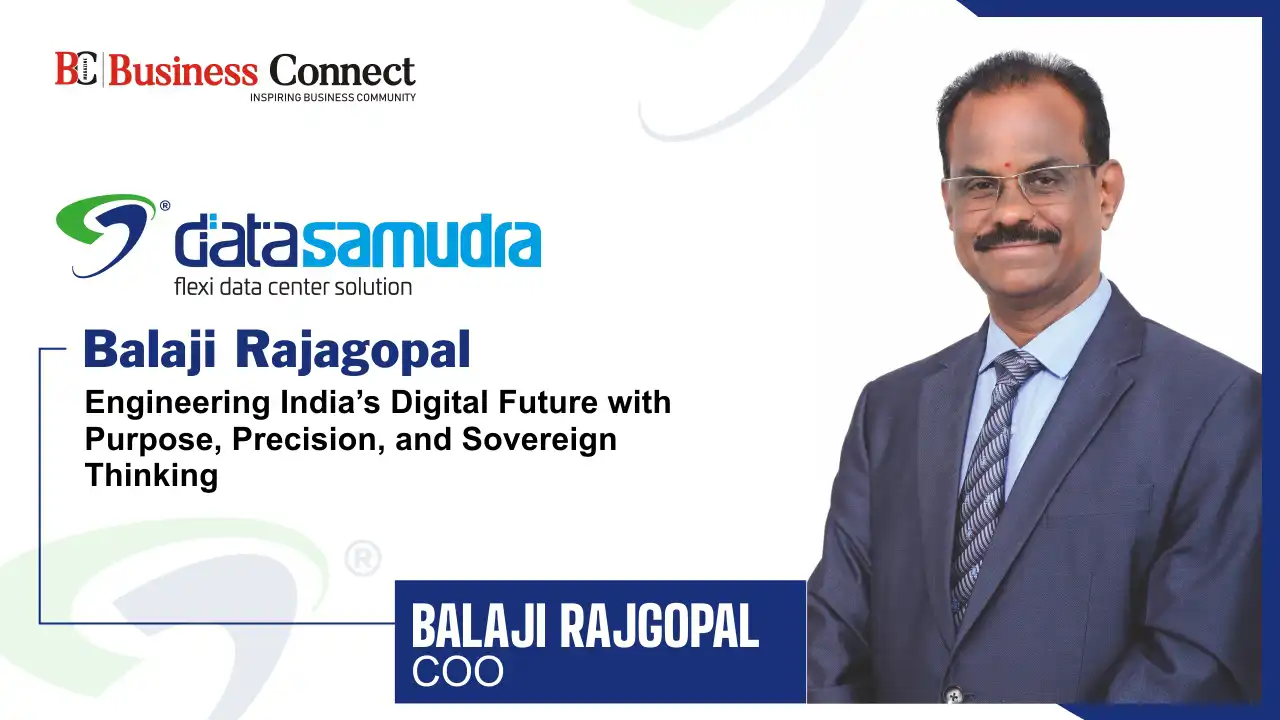
Data Samudra: Balaji Rajagopal Engineering India’s Digital Future with Purpose, Precision, and Sovereign Thinking
Every industry has its hinge moments i.e. the points where businesses split into two camps: the ones reacting to a trend, and the ones who saw it coming years earlier. Balaji Rajagopal, Chief Operating Officer of Datasamudra, belongs firmly to the second camp.
And his moment arrived long before cloud computing became the buzzword filling up boardroom agendas across India. Back in mid of 2016, while Digital India was still finding its foot as a national mission, Balaji was already looking a few steps ahead. Enterprises were generating more data than ever, digital services were scaling at a pace nobody quite expected, and cloud adoption in global markets was quietly writing the playbook India would eventually pick up. He and his team didn’t wait around for that opportunity to fully arrive. .
They started building it. That instinct, to prepare before the market demands it, is what eventually became Datasamudra: an infrastructure company built on one uncomplicated conviction. India’s digital economy needed infrastructure that was actually built in India, for India, not borrowed from somewhere else and retrofitted.
THEY SAW IT COMING BEFORE THE REST OF THE WORLD DID
For most companies, the pandemic was a crash course in digital preparedness. For Datasamudra, it just confirmed something they already believed in. When businesses were forced overnight into remote work, a lot of assumptions fell apart fast. Keeping mission-critical IT infrastructure inhouse stopped being practical almost overnight. Reliability, scalability, security, uninterrupted connectivity, these weren’t nice-to-haves anymore.
They were the whole ballgame. Datasamudra team understood something a lot of infrastructure players missed: enterprises didn’t just need more server space. They needed a dependable digital backbone, the kind backed by real expertise, flexibility, and the confidence that it would hold up over the long run. Datasamudra landed at exactly that intersection to help businesses modernize without gambling on reliability or compliance.
TRUST FIRST, SCALE LATER
Ask Balaji Rajagopal what actually sets Datasamudra apart, and he won’t point to a shiny facility or the latest tech stack. He’ll say “Trust”. Plainly, without much embellishment. You can see that philosophy baked into how the company operates, redundant power architecture, multiple ISP connectivity, TIA-942 Rated-3 standards, ISO 27001-certified security. None of this is marketing language dressed up for a pitch deck. It’s engineered on day one.
Because for Datasamudra, infrastructure ultimately comes down to accountability. Businesses are handing over their most valuable digital assets to someone else’s data centre. Earning that kind of trust isn’t a one-time pitch, it’s every single day, quietly, without fanfare.
MAKING ROOM FOR THE BUSINESSES EVERYONE ELSE OVERLOOKS
One place where Datasamudra has deliberately pushed against industry norms is pricing. Most data centre providers push businesses toward bigger packages than they actually need — fine if you’re a large enterprise with room to spare, but a real barrier if you’re a startup or a growing SME watching every rupee.
Datasamudra took a different route. Instead of forcing customers into predefined boxes, the company lets businesses pay for exactly what they use, a smaller colocation footprint, custom bandwidth, cloud resources that scale up as the business does, not before it needs to. The team doesn’t frame this as a pricing gimmick. They see it as a simple commitment: help businesses spend smartly instead of carrying infrastructure they don’t need yet.
GETTING INDIAN ENTERPRISES READY FOR THE AI ERA
AI has moved past the experimentation phase. It is now something businesses are actually implementing, and Datasamudra has convinced that infrastructure decides who gets the transition right. Through its GPU-as-a-Service platform, enterprises can tap into high-performance computing without sinking capital into specialized hardware they may not fully utilize.
Healthcare, education, manufacturing, oil and gas sectors you wouldn’t necessarily expect, are already using GPU-powered computing to move faster. And Datasamudra sees this as just the opening chapter. As AI adoption deepens, they expect flexible computer access to become a basic utility as internet connectivity is today.
GROWTH WITHOUT CUTTING CORNERS ON RESPONSIBILITY
Data centre conversations tend to fixate on technology. At Datasamudra, sustainability has an equal seat at the table. It has been steadily weaving energy-efficient engineering into its roadmap i.e. cold aisle containment, air-cooled chillers that cut down water usage, renewable energy initiatives, and a planned 5 MW solar installation near Bengaluru. Sustainability isn’t a box to check for compliance its operational responsibility. Digital infrastructure needs to be resilient not just for the businesses depending on it, but for the environment carrying the weight of all this computing.
STANDING FIRM ON INDIA’S DATA SOVEREIGNTY
If there’s one thread that runs through everything Datasamudra believes, it is: India’s digital future has to be built on sovereign infrastructure. Not imported, not outsourced. With data protection regulations evolving and localization becoming a bigger priority, enterprises are actively looking for infrastructure that fits within India’s regulatory framework, where sensitive data actually stays within the country’s jurisdiction, not just on paper.
Datasamudra has positioned its Sovereign Cloud and Private Cloud solutions to meet exactly this need, giving organizations room to move fast on digital transformation while staying ready for whatever compliance requirements come next.
BEYOND THE METRO CITIES
Datasamudra’s ambition isn’t just about adding more capacity. It’s about who gets to access that capacity in the first place. It already has an operational presence in Bengaluru, Ahmedabad, and Mangalore, and it’s now working to expand into edge data centres in Chennai, Vizag, and Machilipatnam.
Their logic is refreshingly simple: don’t lock enterprise-grade infrastructure inside a handful of metro hubs. Put it wherever India’s digital economy is actually growing, because growth, these days, isn’t confined to the usual cities anymore. That, in essence, is Balaji Rajagopal’s leadership. He isn’t just building data centres. He’s quietly laying down the digital foundation India’s next decade of innovation, enterprise, and technological self-reliance is going to stand on.