
-by Jaya Pathak
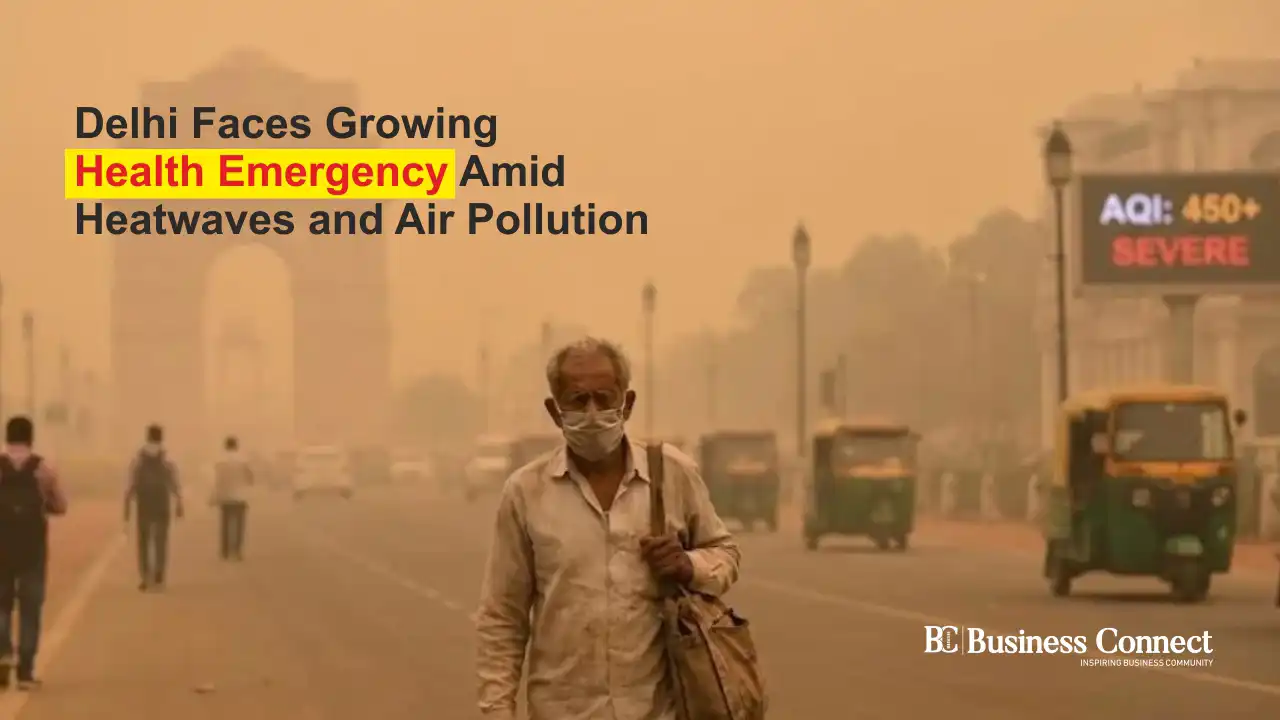
Delhi is not just facing harsh weather, it is dealing with it. It is negotiating, season after season, the conditions of the public health emergency which has started to change the economy of work, mobility, housing, health and urban confidence. This crisis is frequently told as a tale of discomfort- hotter summers, dirtier winters, school closures, wearing masks, bringing water tankers, installing air purifiers, and hospitals filled to capacity.
That is no longer the language that is needed. Heat waves and polluted air are no longer a nuisance in Delhi’s periphery. They are fast becoming a part of the most politicized city in India’s working conditions.
It’s not that Delhi is being suddenly hot or polluted. It has been a long time both of these. The greater worry is that the “down periods” are getting shorter. The summer heat can come before it, last longer and come with increasing difficulty to fade at night. Winter pollution is no longer an annual blip on the radar which can be attributed to farm fires and while it is still very tempting for policy makers to do so, there are other factors at play.
The months even once deemed to be tolerable now have their own dangers: dust storms, ozone, urban exhaust gases, construction dust and a blanket of unintentionally low-grade respiratory stress. A bad week is OK for a city. It can’t take the shit calendar down the road and forget about it and still keep functioning.
Delhi was headed back to mid 40 Celsius maximums by the end of May 2026, as the Indian Meteorological Department (IMD) stated that there would be a heatwave and “hot nights” in the city. Today, these numbers don’t shock people as they once did and they certainly don’t serve as proof that the United States is any kind of a healthy nation.
Delhi is getting hotter and its air is a little better than before, but both problems are still serious. The city may be adjusting to extreme heat, yet it is not adequately protected from it, and the air pollution remains far above healthy levels. This was not a valid statement. There have been some increases in the policy effort.
However, the figure is still higher than the Indian norm of less than one per year, and almost 20 times the WHO norm. But progress in Delhi can still occur as danger.
In the eyes of business leaders, this should be used more as an urban risk indicator than an environmental statistic. The loss of capacity-constrained labour is particularly noticeable during construction, in logistics, street retail, security and transport and delivery services. Pollution increases absenteeism, increases the prevalence of chronic diseases, decreases cognitive function and leads to disruption of schools and offices.
Dirty air and heat cost the economy together in a silent cost, or “tax. It is not always reflected in the quarterly profits but it’s reflected in delayed projects, increased insurance costs, hospital bills, employee turnover, increased power needs, lost working days, and the increased value of controlled indoor environments.
This hard-hit the first and hardest on the city’s informal economy. An executive of a senior rank can transform a meeting to an online format when conditions get severe in the air. A brick can’t be sent via e-mail to a construction worker.
There are times when a delivery rider must not wait for the heat index to get “humane”. It is not feasible for a roadside merchant to put an Air Purifier at a traffic intersection. Delhi’s economy relies heavily on just those workers who can’t easily avail themselves of the luxury of avoiding exposure. This isn’t simply a moral deficiency; it’s a fault in the urban development paradigm.
Hospitals are starting to become reflective of that. Heatstroke units and ice baths, and emergency procedures are no longer bizarre preparing methods. They are now an essential item each season. In recent hot spells, the number of heat-related admissions and deaths at Delhi’s public hospitals spiked, with many patients reaching hospital too late, and already ill or unconscious, dehydrated.
Heat doesn’t usually strike with a grander of an opening. It increases the strain on the cardiovascular system, kidneys, respiratory tract and leads to fatigue. Pollution does something similar—year by year it makes its mark on lungs and hearts, before being added to death rates as a less obtrusive, more comfortable term.
This confusion has been used to official denial time and time again. Governments like hazards which can be easily counted and recognized as the responsibility of only one cause. You can’t force heat and air pollution. These are the sorts of events that can happen during a heatwave, like a heart attack; during an asthma attack, like a kidney injury, or during a period of time spent outdoors and doing physical work, like an asthma attack.
Not innocent is the complex. The problems of attribution should not be an excuse for inadequate action.
But, the business fraternity has been lagging as well in the realization of the strategic importance of Delhi’s health crisis. Corporate India has been able to make a tactical adjustment. Office building air filters are installed. HR give hydration recommendations.
Towers are marketed to real estate developers as green. Schools shift online. Back-up power and additional cooling for upscale homes. However, a lot of this is rather an adaptation that is personal, rather than systemic resilience. It leaves the bigger city unprotected while protecting those within the formal economy.
This parting is growing wider. The rich can afford filtered air, insulated glass, remote working and summer exits, as well as air-conditioning. The poor have to purchase the sachets of oral rehydration salt and hope that the fan would last the entire night.
There’s not much respite at night in poor neighbourhoods, where houses are cramped, lanes narrow, roofs heat up and there is a lack of trees. If it’s a warm minimum temperature, the body is depriving itself of the opportunity to cool down. Fatigue accumulates. Illness follows. If productivity starts to drop before anybody classifies it as a health event, then it is a productivity problem.
Urban design is at the very centre of this crisis but is frequently considered a beautification problem. The city of Delhi has grown using concrete, asphalt, flyovers, parking lots and glass-fronted buildings, which take for granted that cooling can be bought later. Shade is considered as ornamental. The punishment of walking has been instituted.
Water resources have not been utilized. Development dust has been accepted as a price for construction. The outcome is a city that retains warmth, produces dust and then invests a lot of money to protect individual parts from suffering its effects.
There is no lack of a policy mechanism. There are plans for the control of pollution, graded restrictions, heat advisories, monitoring stations and emergency plans in Delhi. However, the majority of the reaction is still ‘reactive. The Graded Response Action Plan is triggered during air quality conditions where it becomes intolerable.
Heat action measures are triggered by temperatures exceeding thresholds. The school closes, the trucks stay put, the construction stops and the warnings are issued. These steps are important, but they are more of a crisis-management approach than a governance approach. The issue is that the crisis in Delhi is not just about a few instances but is widespread. This is an operating condition that is chronic.
The new ozone problem illustrates the problem of “old thinking”. The issue of public visibility and familiarity with the PM2.5 and winter smog are responsible for their status; visibility and familiarity make them a topic that has already been discussed in politics.
However the ground-level ozone produced as a result of chemical processes that occur when motor vehicle and industrial emissions react with sunlight in the atmosphere has turned into a problematic air pollutant in the summer.
It’s not as conspicuous, it’s not as easily understood and it’s easier to overlook. This doesn’t mean that it’s not dangerous. Tomorrow’s lungs cannot be safeguarded by a clean-air strategy which is oriented towards yesterday’s air quality.
Delhi will be one of the most apparent markets for cooling in India, which will become one of India’s biggest economic opportunities. The World Bank has come up with an assessment of the huge investment opportunity for sustainable cooling in buildings, cold chains and refrigerants.
This has some rationale to it. Cooling is an essential need for India, and the solution to provide it at an affordable cost and efficient way to save lives and livelihoods. However, there’s a fine balance here, too: cooling.
This will only lead to further proliferation of power consumption, additional heating on the streets and exacerbation of inequity between the air conditioned interiors and the streets, if Delhi simply adds more air-conditioners to poorly designed buildings. Adaptation which aggravates the disease is bad cooling.
The more severe opportunities are cool roofs, pedestrian shade, reflective materials, ventilation, tree cover, water sensitive planning, cleaner buses, electrified freight, dust enforcement, decentralised healthcare readiness, and occupational heat standards.
The more severe opportunities include cool roofs, pedestrian shade, reflective materials, ventilation, tree cover, water sensitive planning, cleaner buses, electrified freight, dust enforcement, decentralised healthcare readiness, and enforceable occupational heat standards. All this is no bed of roses. A lot of it is tedious to do administratively. Serious cities are constructed by hard work and competence.
The crisis should awaken the sense of urgency for investors and corporate boards to ask Delhi’s employees a more pressing question: at what cost is it to operate in a city where the population can’t commute, breathe or sleep for a big part of the year? Talent can’t be lost over night.
The government will NOT move. It is not easy to turn away capitals from markets. However, there is a gradual shift in perception that suddenly takes place. When a city starts to be known for its ill health, there’s no simple remedy.
Yet, there are certain things which few cities in India can boast of – institutions, infrastructure, purchasing power, political interest, and a rich pool of labour in Delhi. But such advantages are being challenged by a public health problem which can’t be solved with private solutions. While expressways, offices and investment summits will be part of the next level of competitiveness for the capital, its inhabitants will be able to live in the city without suffering from chronic injuries.
No one summer or pollution season will determine the future of Delhi. Whether it is possible to shift the perception of policymakers, businesses and citizens from heat and air as background conditions to the basis for urban viability.
A capital does not need to be worn. Can withstand backlog, conflict and bureaucratic delays. It doesn’t seem able to withstand the gradual normalisation of inhospitable air and lethal heat, at least not as a viable city of aspiration.