
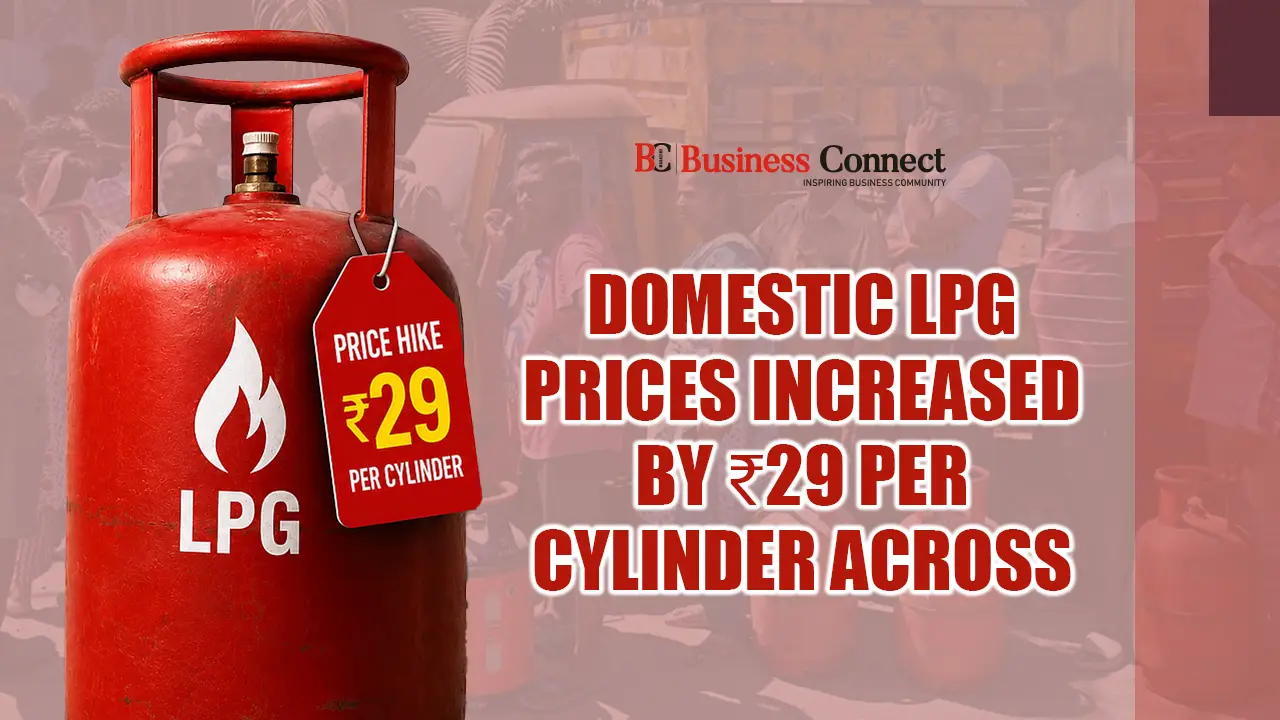
Domestic LPG Price Hiked by ₹29 Per Cylinder, Second Rise in Three Months
State-owned oil marketing companies raised the price of a 14.2-kg domestic cooking gas cylinder to ₹942 in Delhi effective Sunday, as the West Asia crisis drives India’s fuel import costs to record highs and the under-recovery on each household cylinder swells past ₹700.
India’s three state-owned oil marketing companies — Indian Oil Corporation, Bharat Petroleum, and Hindustan Petroleum — raised the retail price of domestic cooking gas by ₹29 per 14.2-kilogram cylinder on Sunday, the second price increase in three months as the ongoing West Asia conflict continues to drive international liquefied petroleum gas benchmarks to multi-year highs. The revised prices came into effect on June 7, 2026, and apply uniformly across the country, with city-level variations reflecting local taxes and transport costs.
The hike takes the price of a domestic LPG cylinder to ₹942 in Delhi — up from ₹913 — and to ₹941.50 in Mumbai. In Hyderabad, where state levies are higher, the new price stands at ₹994 per cylinder. The revision marks the second hit to household cooking gas budgets in 2026, following a sharper ₹60-per-cylinder increase imposed on March 7, when the West Asia crisis first sharply disrupted international energy supply chains. Together, the two hikes add up to a cumulative increase of ₹89 per cylinder since the conflict began.
“The cost of supplying a cylinder has risen to over ₹1,600, implying an under-recovery of around ₹700 on each domestic cylinder — against a Saudi CP benchmark price for LPG that has risen by 46 per cent since February 28.”
City-Wise New LPG Prices from June 7, 2026
| City | Price Before June 7 | New Price (June 7, 2026) | Increase |
|---|---|---|---|
| Delhi | ₹913.00 | ₹942.00 | +₹29 |
| Mumbai | ₹912.50 | ₹941.50 | +₹29 |
| Hyderabad | ₹965.00 | ₹994.00 | +₹29 |
| Kolkata | ₹939.00 | ₹968.00 | +₹29 |
| Bengaluru | ₹915.50 | ₹944.50 | +₹29 |
| PMUY (Ujjwala) Beneficiaries – Delhi | ₹613.00 | ₹642.00 | +₹29 |
Why Prices Are Rising: The West Asia Factor
India imports approximately 60 per cent of its LPG requirement, primarily from the Middle East. The international reference rate for LPG pricing — the Saudi Contract Price (Saudi CP) — serves as the primary benchmark against which domestic cost calculations are made. Since February 28, 2026, when the West Asia conflict materially escalated, the Saudi CP benchmark has risen by 46 per cent, the Ministry of Petroleum and Natural Gas disclosed in its June 7 statement. This steep increase in the cost of the underlying commodity — the LPG “molecule” — is the primary driver of the revision.
In terms that make the distortion visible: a 19-kilogram commercial LPG cylinder — the kind used by hotels, restaurants, and caterers — is sold at fully market-linked prices with no subsidy buffer. In Delhi, that cylinder now sells at ₹3,113.50 following five successive hikes since the West Asia crisis began, which works out to approximately ₹164 per kilogram. By contrast, the domestic household cylinder, after Sunday’s hike, costs around ₹66 per kilogram — less than half the market rate. The gap, described as “under-recovery” in government parlance, is absorbed by the OMCs and partially offset by the exchequer.
Cost of supply per cylinder: Over ₹1,600 (per MoPNG, June 2026)
Retail price after June 7 hike (Delhi): ₹942 (general); ₹642 (Ujjwala)
Estimated under-recovery per cylinder: ~₹700 (general); ~₹1,000 (Ujjwala)
Who absorbs it: Oil marketing companies (OMCs) and central government subsidy transfers
Saudi CP benchmark change since Feb 28: +46%
Ujjwala Households: Protected, But Not Immune
Beneficiaries of the Pradhan Mantri Ujjwala Yojana — the government’s scheme providing subsidised LPG to Below Poverty Line households — see an identical ₹29 per cylinder increase, taking their revised price from ₹613 to ₹642 in Delhi. While the Ujjwala price remains significantly below the general consumer rate due to direct government subsidy transfers, the increase is acutely felt by the approximately 10.33 crore Ujjwala households across India, many of whom operate on fixed or daily-wage incomes with limited buffer against fuel cost inflation.
The government has not announced any additional subsidy relief or top-up payment for Ujjwala beneficiaries in response to Sunday’s revision. In the absence of such relief, refilling frequency among poorer households is likely to decline, raising the risk of a partial reversion to traditional biomass fuels — kerosene, wood, and dung cakes — which carry significant health and environmental costs that the Ujjwala scheme was specifically designed to eliminate.
February 28, 2026: US-Israel-Iran conflict escalates; international LPG benchmarks begin rising sharply.
March 7, 2026: First domestic LPG hike — ₹60 per cylinder (Delhi: ₹853 → ₹913). Commercial LPG raised by ₹115 simultaneously.
June 1, 2026: Commercial LPG raised again by ₹46 per cylinder. Delhi commercial cylinder hits ₹3,113.50.
June 7, 2026: Second domestic LPG hike — ₹29 per cylinder (Delhi: ₹913 → ₹942). Cumulative domestic hike since war: ₹89.
Commercial LPG: A Warning for Restaurants and Hotels
The divergence between domestic and commercial LPG prices tells a stark story of a subsidy structure under stress. In January 2026 — before the conflict began — the 19-kg commercial LPG cylinder in Delhi was priced at ₹1,640. By June 1, 2026, following five successive hikes, the same cylinder reached ₹3,113.50 — an increase of ₹1,473.50, or approximately 90 per cent, in under four months.
Vijay Shetty, President of the Indian Hotel and Restaurant Association, confirmed that the spiralling commercial LPG cost has already translated into price increases for consumers. “The highest increase was in April and May,” he said, adding that menu card prices have risen by approximately 15 per cent across hotel and restaurant establishments. With commercial cylinder costs nearly doubling from pre-war levels, hospitality industry representatives warned that further LPG hikes would force additional price revisions in the weeks ahead.
“In January 2026, before the war started, the price of commercial LPG was ₹1,640. As of June 1, it is ₹3,070 — the highest increase was in April and May. The government is increasing prices step by step, and given the war situation in the Middle East, prices are likely to increase more.”
Price History at a Glance: Domestic LPG in Delhi (Jan 2026 – June 2026)
| Period | Delhi LPG Price (14.2 kg) | Change | Trigger |
|---|---|---|---|
| Jan 2026 (Pre-War) | ₹803 | — | Last stable price before the West Asia crisis |
| Feb 2026 (Pre-War Hike) | ₹853 | +₹50 | General increase in global energy costs |
| March 7, 2026 | ₹913 | +₹60 | West Asia conflict caused supply chain disruptions |
| June 7, 2026 | ₹942 | +₹29 | Continued surge in Saudi CP benchmark prices (+46%) |
| Ujjwala Price (June 7, 2026) | ₹642 | +₹29 | Mirrored increase; subsidy impact absorbed by the government |
What It Means for Household Budgets
For a family that consumes one cylinder per month — a reasonable average for an urban household using LPG as its primary cooking fuel — the annual expenditure on cooking gas has risen by ₹1,068 compared to the pre-war January 2026 baseline of ₹803 per cylinder. That represents an increase of roughly 17 per cent in annual fuel cost in the span of four months, at a time when food inflation is itself elevated and the RBI has separately raised its CPI inflation forecast to 5.1% for FY27.
The compounding effect is significant: a household simultaneously facing higher cooking gas prices, higher food costs, and stagnant nominal wages — a profile that describes tens of millions of urban and semi-urban families — faces a meaningful erosion of discretionary purchasing power. Economists tracking rural consumption patterns note that any reduction in LPG refill frequency among Ujjwala beneficiaries would compound the problem through adverse health outcomes and reduced cooking efficiency.
Ujjwala benefit scheme: The government has maintained the PMUY programme without structural changes. Beneficiaries continue to receive direct subsidy transfers and a concessional rate, though the ₹29 increase applies to them too.
12-cylinder annual entitlement: The cap of 12 subsidised cylinders per household per year remains unchanged.
Cylinder availability: OMCs have confirmed no supply disruptions. Distribution through dealer networks continues normally.
What Comes Next: More Hikes Possible
The Ministry of Petroleum and Natural Gas has not ruled out further price revisions if international LPG costs remain elevated. Given that the Saudi CP benchmark has risen 46 per cent since late February, and the under-recovery on each domestic cylinder is now estimated at over ₹700, Sunday’s ₹29 revision recovers only a fraction of the gap between retail price and supply cost. The OMCs continue to absorb the remainder — a position that is financially unsustainable if the West Asia crisis persists or deepens.
Industry watchers note that the pattern of the 2026 hikes — a large initial revision (₹60 in March) followed by a smaller supplementary one (₹29 in June) — mirrors the approach used in previous energy price cycles, where the government attempts to balance cost pass-through with political and inflationary sensitivity. With India’s general CPI inflation already heading toward 5.9% by Q3 FY27 per RBI projections, the room for another large domestic LPG hike before the August monetary policy review is constrained. The next revision, if any, is likely to follow a similar incremental logic.