
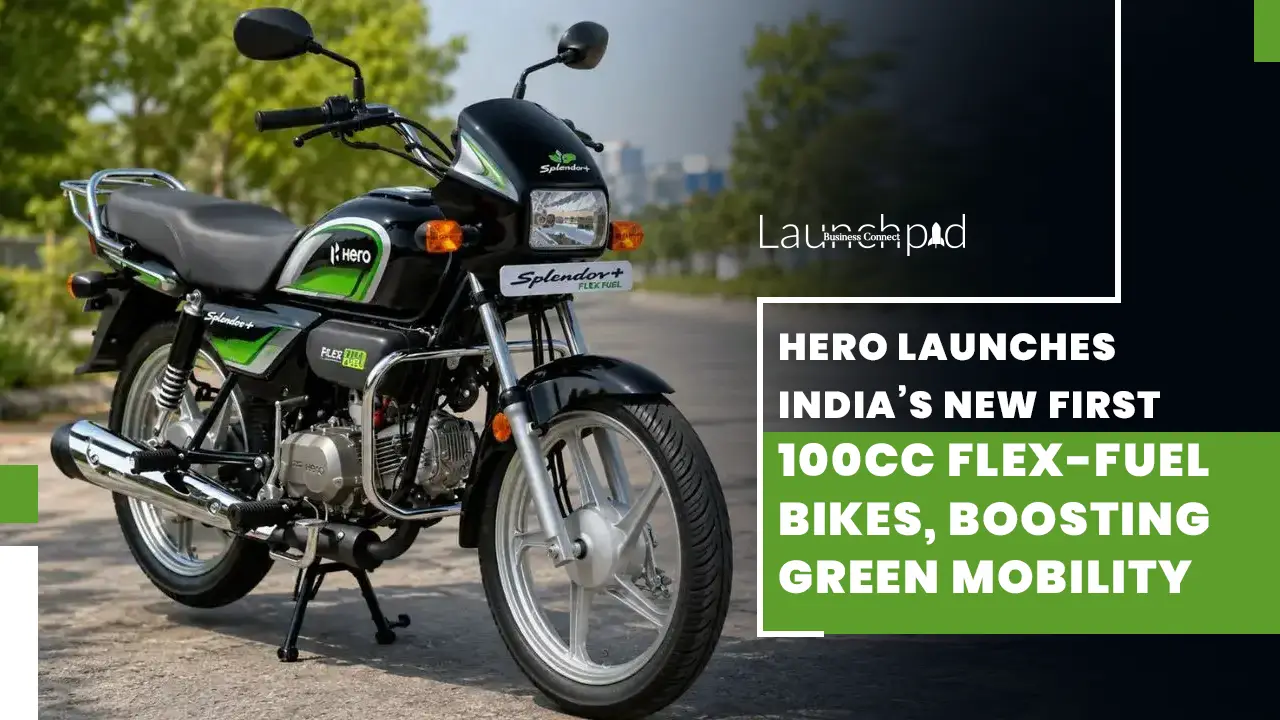
Hero MotoCorp has unveiled the flex-fuel Splendor+ and HF Deluxe — the world’s largest two-wheeler maker’s boldest bet yet on ethanol-blended fuel for India’s mass commuter segment. Here’s everything you need to know.
| Specification | Details |
|---|---|
| Price (Ex-Delhi) | ₹72,792 |
| Model | HF Deluxe Flex Fuel |
| Maximum Ethanol Blend Supported | E85 |
| Engine Displacement | 97.2cc |
Hero MotoCorp, the world’s largest manufacturer of motorcycles and scooters, has officially launched flex-fuel versions of its two most iconic commuter motorcycles — the Splendor+ and the HF Deluxe — marking a pivotal moment in India’s push toward energy self-reliance and reduced fossil-fuel dependence. The event, held on June 3, 2026, brings flex-fuel technology from premium and mid-size bikes squarely into the hands of India’s everyday commuter.
The bikes are priced at ₹72,792 for the HF Deluxe Flex Fuel and ₹82,710 for the Splendor+ Flex Fuel (both ex-showroom, Delhi) — making them among the most affordable flex-fuel two-wheelers available anywhere in the world. Sales begin in Delhi and select regions of Maharashtra from July 2026, with a phased nationwide rollout to follow.
“The Splendor and HF families collectively account for roughly one in every three motorcycles on Indian roads. This launch brings flex-fuel technology to a segment that forms the backbone of India’s two-wheeler market.”
What Is Flex-Fuel Technology — And Why Does It Matter?
A flex-fuel vehicle can run on a mixture of petrol and ethanol in varying proportions — from the currently standard E20 (20% ethanol, 80% petrol) all the way up to E85 (85% ethanol, 15% petrol). Unlike conventional bikes, which are calibrated for a fixed ethanol blend, flex-fuel motorcycles automatically adapt to whatever blend is available at the pump, without any manual adjustment from the rider.
This is significant in the Indian context. The Government of India has been aggressively pushing its ethanol blending programme, having advanced its 20% blending target from 2030 to 2025. Ethanol, derived largely from sugarcane and surplus foodgrain, is domestically produced — reducing India’s crude oil import bill and cutting tailpipe emissions simultaneously. A move to E85 fuel, for instance, can reduce carbon monoxide emissions by over 30% compared to pure petrol combustion.
India’s Ethanol Blending Programme — At a Glance
India has set a national target of 20% ethanol blending in petrol (E20) by 2025, advanced from an earlier 2030 deadline. India currently imports roughly 85% of its crude oil requirement, making the country highly vulnerable to global price shocks.
Ethanol is priced at approximately ₹63–65 per litre — roughly half the cost of petrol at current retail prices. Wide adoption of E85-capable vehicles could save consumers significant fuel costs over a vehicle’s lifetime, while reducing India’s annual crude import expenditure by tens of thousands of crores.
Technical Specifications: What’s Under the Hood
Both motorcycles are powered by Hero’s long-serving 97.2cc, air-cooled, 4-stroke, single-cylinder engine — now re-engineered by Hero’s Centre for Innovation and Technology (CIT) in Jaipur to handle ethanol blends from E20 to E85. The modifications are more than skin-deep.
Hero has equipped both bikes with revised ECU (Engine Control Unit) calibration specifically tuned for ethanol combustion, along with an upgraded fuel pump and secondary fuel filter — necessary because ethanol has different energy density, viscosity, and combustion properties compared to petrol. Crucially, the performance has not been compromised: running on E85, both bikes produce 8.6 hp at 8,000 rpm and 8.3 Nm of torque at 6,000 rpm — a slight improvement over the standard petrol versions.
| Specification | HF Deluxe Flex Fuel | Splendor+ Flex Fuel |
|---|---|---|
| Engine | 97.2cc, Air-Cooled, 4-Stroke | 97.2cc, Air-Cooled, 4-Stroke |
| Max Power (E85) | 8.6 hp @ 8,000 rpm | 8.6 hp @ 8,000 rpm |
| Max Torque (E85) | 8.3 Nm @ 6,000 rpm | 8.3 Nm @ 6,000 rpm |
| Ethanol Compatibility | E20 to E85 | E20 to E85 |
| Gearbox | 4-Speed Manual | 4-Speed Manual |
| Instrument Cluster | Digi-Analogue | Digi-Analogue |
| Side Stand Cut-Off | Yes | Yes |
| i3S Technology | Yes | Yes |
| Tyres | Tubeless | Tubeless |
| Price (Ex-Delhi) | ₹72,792 | ₹82,710 |
Notably, the HF Deluxe Flex Fuel is priced at just ₹172 more than its standard E20-compliant counterpart — an almost negligible premium that Hero has consciously engineered to drive mass adoption. The Splendor+ Flex Fuel carries a ₹5,153 premium over the standard model, which Hero says is justified by the additional fuel system components required.
From Prototype to Production: The Development Journey
The flex-fuel HF Deluxe prototype was first publicly unveiled at the Bharat Mobility Global Expo in January 2025, where Hero also showcased ethanol-ready versions of the Splendor+ and Glamour. The production model has been in development at Hero’s Centre for Innovation and Technology in Jaipur, which received full regulatory approval from Indian authorities before the commercial launch.
The path from prototype to showroom has taken roughly 18 months — a relatively swift turnaround for a powertrain adaptation of this scale, reflecting both the urgency Hero has placed on this programme and the maturity of its CIT facility.
How Does It Compare to Other Flex-Fuel Two-Wheelers in India?
Hero is not the first Indian manufacturer to offer a flex-fuel two-wheeler, but it is the first to do so at the 100cc commuter level — the segment that makes up the overwhelming majority of motorcycle sales in India. Existing flex-fuel offerings have been confined to larger-displacement, higher-priced segments.
| Model | Displacement | Max Ethanol Blend | Price (Approx.) |
|---|---|---|---|
| Hero HF Deluxe Flex Fuel (NEW) | 97.2cc | E85 | ₹72,792 |
| Hero Splendor+ Flex Fuel (NEW) | 97.2cc | E85 | ₹82,710 |
| Suzuki Gixxer SF 250 Flex Fuel | 249cc | E85 | ~₹1.98 Lakh |
| Royal Enfield Classic 350 Flex (Under Testing) | 349cc | E85 (Expected) | TBA |
| TVS Raider 125 Flex (Showcased) | 124.8cc | E85 | TBA |
Industry Context: A Broader Green Mobility Wave
Hero’s launch is the most prominent entry yet in what is rapidly becoming an industry-wide movement. Royal Enfield has been spotted testing E85-compatible versions of the Classic 350. TVS showcased a flex-fuel Raider 125 at the 2025 Bharat Expo. Maruti Suzuki is widely reported to be preparing an E100-ready vehicle — with an announcement expected in the days following Hero’s launch. Honda India has also indicated a phased flex-fuel implementation in its product lineup.
The timing is not coincidental. India’s ethanol blending rate has risen sharply, and the domestic ethanol supply chain — largely anchored by the sugar industry — has matured to a point where E85 and E100 availability at fuel stations is becoming a realistic near-term possibility in key states. For manufacturers, the flex-fuel moment has arrived.
“Making entirely flex-fuel vehicles works out much better for the entire industry. Consumers no longer have to worry about which ethanol blend is available at the pump — the motorcycle handles it automatically.”
What It Means for Indian Commuters
The practical case for everyday riders is compelling. Ethanol is priced at approximately ₹63 per litre against petrol at ₹100+ in most Indian cities. Even accounting for ethanol’s slightly lower energy density — which means marginally more fuel consumed per kilometre on high-ethanol blends — the cost per kilometre drops meaningfully on E85. For a daily commuter covering 30–40 km a day, the annual fuel savings on E85 versus E20 could be in the range of ₹8,000–₹12,000, recouping the small price premium in a matter of months.
Hero’s after-sales network — the largest in India — also works in the flex-fuel models’ favour. With over 9,000 service centres across the country, owners in rural and semi-urban India, who are most sensitive to running costs and most likely to benefit from lower-cost ethanol fuel, will have easy access to qualified service support.
Availability and What Comes Next
Both the HF Deluxe Flex Fuel and Splendor+ Flex Fuel will go on sale in Delhi and select Maharashtra regions starting July 2026. Hero has confirmed a phased nationwide rollout, with broader availability tied to the expansion of E85-capable fuel infrastructure across the country.
Industry observers expect GST rationalisation on flex-fuel two-wheelers — currently taxed at 18% on par with conventional petrol bikes — to be a key policy ask in coming months. EVs attract a 5% GST rate; a reduced rate for flex-fuel vehicles would further close the price gap and accelerate adoption.
What is the price of the Hero HF Deluxe and Splendor+ Flex Fuel?
The Hero HF Deluxe Flex Fuel is priced at ₹72,792 and the Splendor+ Flex Fuel at ₹82,710 — both ex-showroom, Delhi. Notably, the HF Deluxe Flex Fuel costs just ₹172 more than its standard E20 version, making the flex-fuel upgrade almost negligible in cost.
When and where will the bikes go on sale?
Sales begin in Delhi and select regions of Maharashtra from July 2026. A phased nationwide rollout is planned after that, tied to the expansion of E85-compatible fuel infrastructure across India.
What is flex-fuel technology and how does it work?
Flex-fuel technology allows a motorcycle to automatically run on any blend of petrol and ethanol — from E20 (20% ethanol) up to E85 (85% ethanol) — without any manual adjustment. The engine’s ECU detects the ethanol content and recalibrates combustion parameters in real time. Hero has also upgraded the fuel pump and added a secondary fuel filter to handle ethanol’s different viscosity and corrosion properties.
Are these India’s first 100cc flex-fuel motorcycles?
Yes. While flex-fuel two-wheelers existed before in India — such as the Suzuki Gixxer SF 250 — those were all in higher-displacement, higher-price segments. The Hero HF Deluxe and Splendor+ are the first 100cc mass-market motorcycles in India to offer flex-fuel compatibility.
What modifications were made to the engine?
The 97.2cc engine received revised ECU calibration for ethanol combustion, an upgraded fuel pump, and a secondary fuel filter. The frame, suspension, and mechanical components remain unchanged. Both bikes also gain a new digi-analogue instrument cluster, i3S idle stop-start technology, side stand engine cut-off, and tubeless tyres.
How much can I save on fuel by using E85 instead of petrol?
Ethanol is priced at approximately ₹63–65 per litre versus petrol at ₹100+ in most cities. Although ethanol has slightly lower energy density — meaning a marginal increase in consumption per kilometre — the cost-per-km on E85 is still significantly lower. A daily commuter covering 30–40 km could save an estimated ₹8,000–₹12,000 per year, recouping any price premium within a few months.
What ethanol blends can these bikes use?
Both bikes are compatible with ethanol blends ranging from E20 to E85. This covers the current national standard (E20), the emerging E40 and E50 intermediate blends, and the high-ethanol E85 available at select pumps. The rider does not need to do anything differently — the ECU adapts automatically.
Will E85 fuel be available at petrol stations near me?
Currently, E85 availability is limited — Hero is initially launching in Delhi and Maharashtra partly because these states have more advanced ethanol infrastructure. However, since these bikes also run on standard E20 (already widely available), you are never stranded. As India’s ethanol blending programme expands, E85 availability is expected to grow significantly over the next 2–3 years.
Does running on ethanol affect performance?
What is the mileage of the flex-fuel HF Deluxe and Splendor+?
What other manufacturers are launching flex-fuel bikes in India?
Is there a GST benefit on flex-fuel bikes?
Currently, flex-fuel two-wheelers are taxed at 18% GST — the same as conventional petrol bikes. EVs attract a much lower 5% GST. Industry bodies are lobbying for a reduced GST rate on flex-fuel vehicles to accelerate adoption, but no formal announcement has been made as of June 2026.