
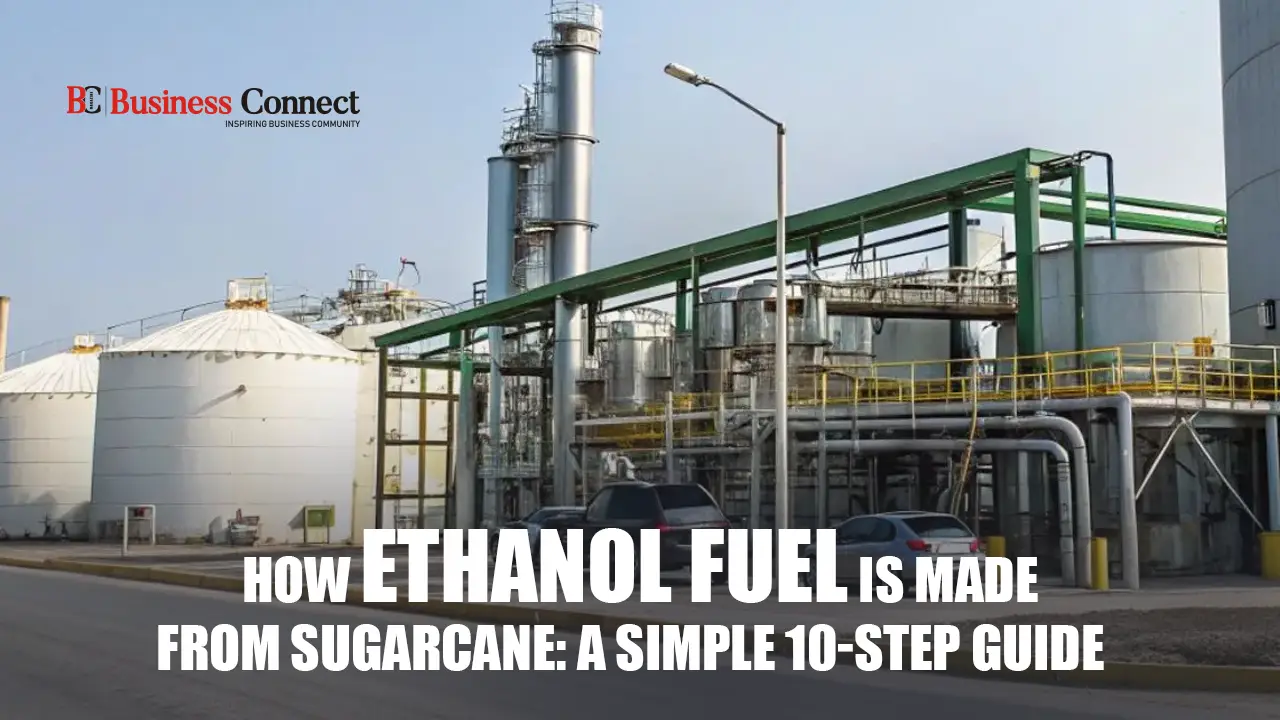
As countries around the world look for cleaner and more sustainable alternatives to fossil fuels, ethanol fuel has become one of the most promising biofuels. In countries like India and Brazil, sugarcane plays a vital role in ethanol production because it is rich in natural sugars that can be easily converted into alcohol.
But have you ever wondered how sugarcane becomes ethanol fuel?
From harvesting sugarcane fields to filling fuel tanks, ethanol production involves several carefully controlled stages. This guide explains the 10-step journey of converting sugarcane into ethanol fuel in simple language.
What Is Ethanol Fuel?
Ethanol is a renewable alcohol-based fuel produced from plants containing sugar or starch. When blended with petrol, it helps reduce greenhouse gas emissions, lowers dependence on imported crude oil, and supports agricultural economies.
Today, ethanol is commonly used in blends such as:
- E10 (10% ethanol + 90% petrol)
- E20 (20% ethanol + 80% petrol)
- E85 (85% ethanol)
- E100 (100% ethanol)
Step 1: Growing Sugarcane
Everything begins in the farm.
Sugarcane is cultivated for around 10–18 months depending on climate and region. It requires:
- Warm temperatures
- Plenty of sunlight
- Adequate rainfall or irrigation
- Fertile soil
Once mature, the stalks contain high amounts of sucrose, making them ideal for ethanol production.
Step 2: Harvesting the Sugarcane
After reaching maturity, sugarcane is harvested either manually or using mechanical harvesters.
Freshly harvested cane must reach the sugar mill quickly because the sugar content begins to decline after cutting.
Transportation is usually done through:
- Trucks
- Tractors
- Rail systems (in some regions)
Step 3: Crushing the Sugarcane
At the sugar mill, the harvested cane passes through heavy rollers that crush it to extract juice.
The process separates:
- Sugarcane juice
- Fibrous residue called bagasse
Interestingly, bagasse is not wasted. It is commonly used as biomass fuel to generate electricity and steam for the factory itself.
Step 4: Extracting and Cleaning the Juice
The extracted juice contains:
- Sugar
- Water
- Soil particles
- Plant fibers
- Organic impurities
The juice is filtered and clarified to remove unwanted materials before fermentation.
This improves ethanol quality and production efficiency.
Step 5: Fermentation
Fermentation is the heart of ethanol production.
During this process:
- Yeast is added to the sugar-rich juice.
- The yeast converts natural sugars into alcohol.
- Carbon dioxide is released as a by-product.
Depending on conditions, fermentation generally takes between 24 and 48 hours.
The resulting liquid contains approximately 8–12% alcohol.
Step 6: Distillation
The fermented liquid is transferred to distillation columns.
Heat separates ethanol from water and other compounds because ethanol evaporates at a lower temperature than water.
The result is highly concentrated ethanol, usually around 95% purity.
Step 7: Dehydration
Fuel-grade ethanol must contain almost no water.
Special dehydration technologies remove the remaining moisture, producing ethanol with approximately 99.5% purity.
This stage is essential because water can reduce engine performance and affect fuel quality.
Step 8: Quality Testing
Before ethanol is supplied for fuel use, it undergoes rigorous quality checks.
Technicians test:
- Purity
- Water content
- Alcohol concentration
- Chemical composition
- Fuel standards
Only ethanol meeting government and industry specifications proceeds to distribution.
Step 9: Blending with Petrol
Pure ethanol is transported to fuel terminals, where it is blended with petrol.
Common blends include:
| Fuel Blend | Ethanol Content |
|---|---|
| E10 | 10% |
| E20 | 20% |
| E85 | 85% |
| E100 | 100% |
Many countries are increasing ethanol blending to reduce fuel imports and carbon emissions.
Step 10: Distribution to Fuel Stations
The blended fuel is delivered to fuel stations through pipelines, tankers, and storage terminals.
Consumers can then purchase ethanol-blended petrol for compatible vehicles.
As more flex-fuel vehicles enter the market, ethanol demand is expected to grow significantly.
Why Sugarcane Is Ideal for Ethanol Production
Sugarcane is considered one of the world’s most efficient biofuel crops because it offers:
- High sugar content
- Excellent ethanol yield
- Renewable cultivation
- Lower greenhouse gas emissions
- Productive use of agricultural waste
In addition, by-products such as bagasse and molasses are valuable resources for electricity generation and additional ethanol production.
Benefits of Sugarcane Ethanol
Cleaner Environment
Ethanol burns cleaner than conventional petrol, reducing carbon monoxide and greenhouse gas emissions.
Energy Security
Domestic ethanol production reduces dependence on imported crude oil.
Farmer Income
Growing demand for sugarcane provides additional income opportunities for farmers.
Renewable Fuel
Unlike fossil fuels, sugarcane can be grown and harvested repeatedly, making ethanol a renewable energy source.
Supports Rural Economy
Ethanol plants generate employment in farming, transportation, processing, and manufacturing sectors.
Challenges in Ethanol Production
Despite its benefits, ethanol production faces several challenges:
- High water consumption during cultivation
- Seasonal availability of sugarcane
- Large investment required for processing plants
- Logistics and transportation costs
- Need for compatible engines in higher ethanol blends
Governments and researchers continue to develop technologies that improve production efficiency while reducing environmental impacts.
The Future of Sugarcane Ethanol
With countries focusing on cleaner transportation, ethanol is expected to play an increasingly important role.
India aims to expand ethanol blending to reduce crude oil imports, improve energy security, and lower emissions. Advances in flex-fuel vehicles, second-generation biofuels, and modern distilleries are likely to make ethanol even more important in the coming years.
As the world transitions toward sustainable mobility, sugarcane ethanol will remain a key component of the renewable fuel ecosystem.
Conclusion
The journey from a sugarcane field to your vehicle’s fuel tank involves much more than simply extracting juice. Through harvesting, crushing, fermentation, distillation, dehydration, and quality testing, sugarcane is transformed into a clean, renewable fuel that helps reduce pollution and supports energy independence.
Understanding this 10-step ethanol production process highlights how agriculture and technology work together to create a more sustainable future. As governments continue promoting ethanol-blended fuels, sugarcane will remain one of the world’s most valuable renewable energy resources.