
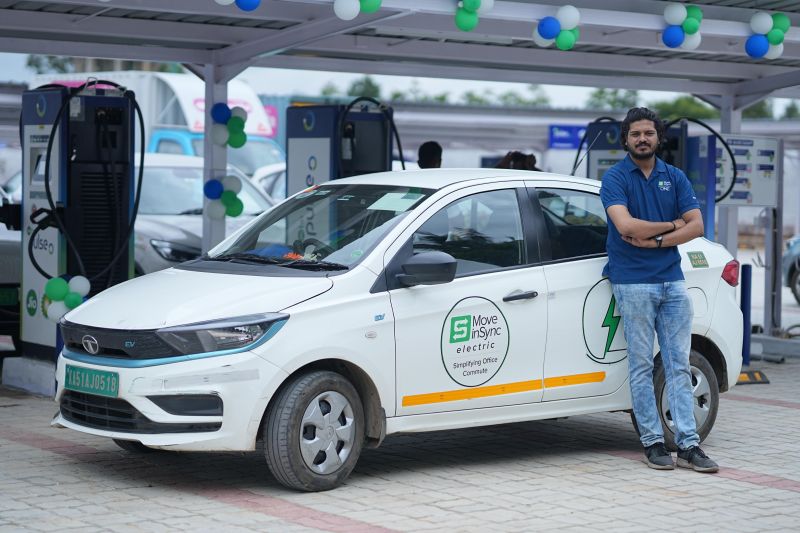
Every weekday morning, a vast network of tens of thousands of electric cabs, shuttles and buses converge on IT Parks and GCC campuses all over India. They have fixed routes and schedules mapped out in advance, and they return to the same parking spots each night. These fleets are the closest any system in India comes to a perfectly suited candidate for fleet electrification.
Corporate commute is (perhaps unbeknownst to many) actually among the fastest growing sectors in the Indian EV Transition. The electrical shuttles/taxis are efficient for routes with a lower per kilometer rate, while also fulfilling reporting requirements under Scope 3 that are to be met by these companies.
Although EVs for consumers and the public sector are more common, fleet economics and ESG compliance interests have been blending well in the enterprise mobility sector. Let’s delve into how the corporate customer segment in India adopted and executed the model.
The Business Case for Electric Employee Mobility
Employee transportation used to be an entry in the P&L of any facilities team. Now, it’s a serious conversation in boardrooms. No wonder, because an EV commute fleet does a lot: it tackles Scope 3 emissions, drives operational efficiencies, optimizes cost, and mitigates regulatory risks.
Why EV Fleets Are Gaining Importance
The sustainability of fuel transportation is rapidly in doubt. Fuel, after all, continues to represent the single biggest operating cost of any leased fleet and perhaps, the most volatile. Maintenance and compliance issues with old ICE vehicles are also factors that a lot of organizations have considered, and therefore, made the switch to the electric side of things.
ESG, Scope 3 Emissions, and Measurable Sustainability Outcomes
Electrifying your commute fleet doesn’t just cut emissions, it generates data too. With a proper employee commute partner like MoveInSync, every trip produces a verifiable number: kilometres travelled, energy consumed, emissions avoided.
That’s a different game from most Scope 3 categories, where you’re often stuck estimating emissions you can’t directly measure. This number feeds cleanly into your ESG reporting, whether that’s BRSR or CDP. And for the stakeholders reading those reports, how auditable it is will matter just as much as how big it is.
Total Cost of Ownership and the Economics of Electric Fleets
Employee transport is typically tendered over a period of 3-5 years. The TCO in this period of time is what actually matters, not the upfront pricing or face value costs.
Routes that are heavily used often make the best candidates for an EV commute fleet. Since EVs have a lower per-kilometer-cost, the savings compound and add up for each additional kilometre on these routes.
Give your finance director the numbers that matters: cost per passenger per month over the vehicle’s lifetime, and savings per kilometre.
Employee Experience, Safety, and Shared Mobility Benefits
It’s not all about sustainability either. The ride quality also exponentially increases for the employees using the service. A quiet cabin, no engine noise, no diesel rattle. For someone doing a 90-minute commute, that’s the difference between arriving frazzled and arriving ready to work.
There’s a practical side to this too. Most EV fleets come with onboard telematics as standard, which means real-time visibility into where every vehicle is, is part of the default package, not an add-on. It’s a safety layer, and it matters even more for night-shift routes.
This combination of comfort, safety, compliance is especially useful for IT and BPM companies running large nocturnal workforces. It is a retention lever as much as a compliance checkbox. It’s easier to hold onto night-shift talent when the ride home doesn’t feel like an afterthought.
Where Adoption Is Accelerating Across India
- Adoption has concentrated in locations with large headcounts, consistent travel patterns, and the scale to support EV infrastructure. Whether that’s charging on campus, at a nearby depot, or through a provider’s own network. Bengaluru, Hyderabad, Pune, Gurugram and Noida lead this shift, driven by their concentration of IT Services, GCC and BPO operations, where multi-shift transport is the norm rather than the exception.
- Business parks and SEZs with multiple co-located businesses tend to move faster on this than standalone office developments, simply because the capex for shared charging infrastructure gets split across several tenants instead of falling on one.
- The push is usually initiated by MNCs which are operating under a Group wide carbon footprint reduction charter, though several Indian enterprises that are bound by BRSR compliance requirements are also making similar plans.
Building and Operating a Scalable Campus EV Program
This is where the business case starts to become a reality, where you have to answer questions like; “What type of vehicles to cover that route?”, “How much power to make it happen?”, “What software to serve up thousands of seats per day based on a schedule?”, and so forth.
The result is a Multi Year Operational Delivery Plan which includes things like vehicle purchasing, electrical infrastructure, software, funding agreements and the service contract, all of which is implemented step-by-step.
Selecting Electric Cabs, Buses, Shuttles, and Intra-Campus Vehicles
Plenty of organizations make the mistake of procuring vehicles and having them work around the routes. The truth is, it should be the other way around. Work out your travel mileages, occupant density, and operational timelines before anything else. Pickups and drop-offs within a 40–60 km zone usually fit the electric Sedan segment.
High-traffic routes change the equations. For example, a 40 seater EV Bus or 20-seater shuttle on a defined shuttle route is able to move far more employees per kWh of energy compared to the same capacity trips from alternatives.
Low-speed electric buggies and three-wheelers are the perfect match for movements within the campus with minimal costs per employee move. Some campuses continue to house a few diesel/CNG options for longer inter-city travel, having electrified the daily commute layer already.
Planning Charging Stations and Smart Charging Capacity
Before you buy a single EV, you need to check if your building’s power supply can handle it. A 50-cab fleet needs a serious chunk of extra power, more than most office buildings have spare capacity for.
The good news is that cabs are easy: they come back late at night and can charge slowly overnight. Buses and shuttles are trickier, they need fast charging between shifts, not overnight.
Bottom line: there’s no point in buying EVs if you don’t have the infrastructure and plan to charge them, that needs to be ensured early.
Using Fleet Management and Real-Time Tracking for Reliable Service
Reliability at scale is a software problem as much as a vehicle one.
Fleet management software gives visibility into state of charge, remaining range, and charger availability alongside routing data, letting dispatchers reassign trips before a shortfall hits pick-up time.
Real-time tracking serves employees (accurate ETAs, boarding alerts) and operations teams (deviation, speeding, idling alerts) alike. Useful platforms also log energy consumption per trip for cost-per-kilometre reporting and vendor invoice validation, and should integrate with your HRMS and access control systems.
Policy Support, From FAME II to PM E-DRIVE and State-Level EV Policies
As FAME II closed its door in March 2024, the new PM E-DRIVE, which covers electric two/three wheelers, e-buses, ambulances, trucks and public charging infrastructure, excluded electric cars from purchasing subsidies; changing the math.
State EV policies often take precedence for campus programs, with many states providing road tax exemption, no registration fees, capital subsidy on charging stations, and cheaper commercial electricity tariffs for charging stations.
It is imperative to be aware of your state’s policy on permit/aggregator regulations for commercial EVs, the relevant electricity tariff category for charging stations at depots, and if EV-ready parking regulations exist when buildings are constructed. Purchasing vehicles in sync with specific policies can significantly reduce and optimize the initial investment.
Conclusion
The business case for electric employee mobility isn’t really about the vehicles. It’s about ownership, infrastructure, and data. Getting Facilities, HR, Finance, and Sustainability aligned on a single plan, sizing your power supply before the fleet arrives, and choosing employee transportation providers like MoveInSync who can prove performance, not just quote a price.
Companies that get this right have ended up with more than a smaller carbon number, they get a commute that’s easier to audit, easier to budget, and easier for employees to actually enjoy, which, over a five-year contract, is what makes the switch to EVs pay off in every sense.