
-by Jaya Pathak
Mission Drishti matters because it alters the burden of proof for India’s private space companies. Until recently, the sector was assessed generously, often through the language of promise: policy reform, young founders, patient capital, engineering talent, and the familiar halo of ISRO’s institutional credibility.
Drishti pushes the conversation into a harder zone. A private Indian company has placed a complex Earth observation satellite in orbit, aimed not at symbolism but at customers, contracts, and repeatable commercial intelligence.
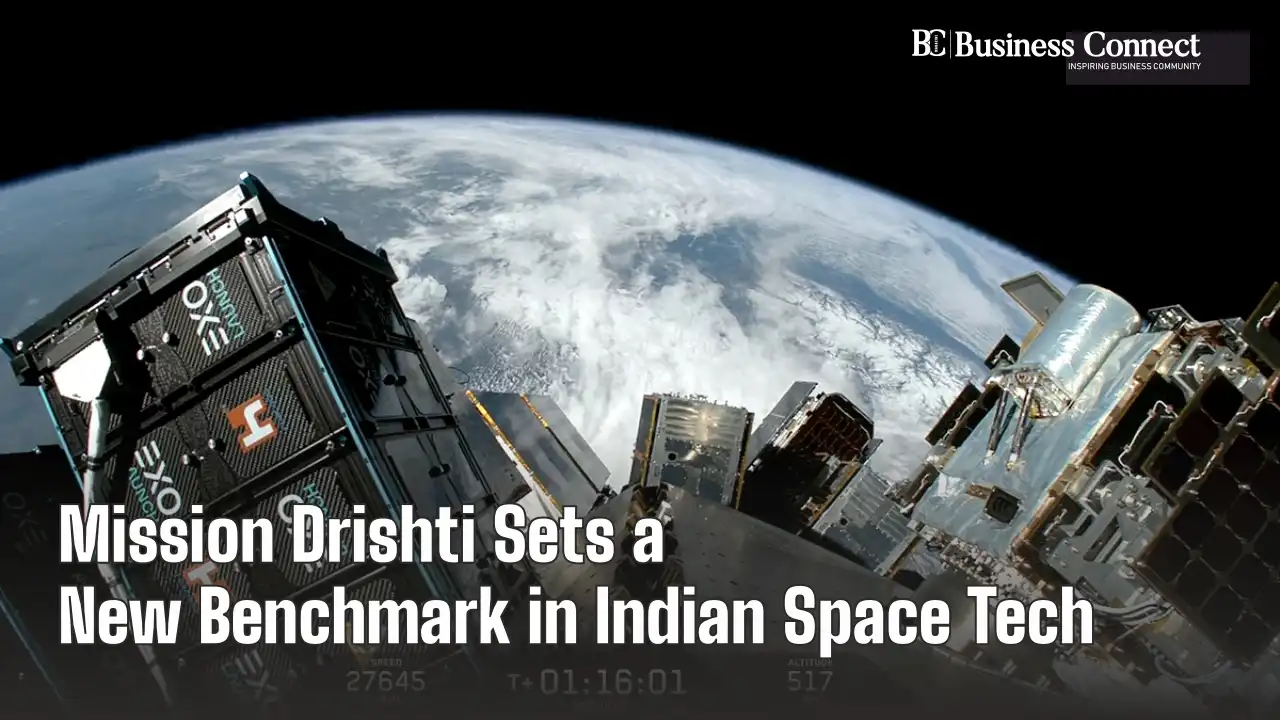
The May 3, 2026 launch of GalaxEye’s 190 kg mission Drishti satellite on SpaceX Falcon 9 from Vandenberg is more than a symbolic milestone photograph. It marks a concrete step forward in India’s private satellite and space tech capabilities. It is a business event.
Reported as India’s largest privately built Earth observation satellite, Drishti represents a shift from capability demonstration to market-facing infrastructure. The distinction is crucial. Space technology earns admiration through engineering, but it earns enterprise value through reliability, distribution, pricing power, and recurring use.
The satellite’s central claim is its OptoSAR architecture: synthetic aperture radar and a seven-band multispectral imager on a single platform. In commercial terms, this is not merely a technical flourish. Optical imagery is intuitive and rich, but it is constrained by cloud cover, weather and darkness.
Radar can see through several of those limitations, but its outputs require more interpretation. Combining both streams in one satellite promises better-aligned data and fewer compromises for users who do not have the luxury of waiting for clear skies.
That proposition is particularly relevant in markets where delay is expensive. A flooded district, a shifting border zone, a delayed infrastructure corridor, a disputed insurance claim, or a stressed crop belt does not wait for ideal imaging conditions.
The value of Earth observation lies less in producing attractive pictures than in compressing the time between an event and a decision. If Drishti can make that compression dependable, its importance will extend well beyond national pride.
There is also a quieter strategic point here. India’s space economy has long had talent, frugality and institutional depth. What it has lacked is a broad class of private companies capable of building differentiated products for global users.
The space policy 2023 set up a more open and or massive framework for india’s space sector. It allows private firms to take part in activities like satellite based remote sensing and data distribution as long as they work within the oversight of IN-SPACe. But policy can only open the gate. Companies still have to walk through it with products that survive international comparison.
Drishti is an early test of that transition. GalaxEye has spoken of commercial interest, international channel partners and plans for a larger OptoSAR constellation. These details matter because the Earth observation business is not won by a single satellite, however advanced.
It is won through revisit frequency, trusted data quality, downstream partnerships and the ability to serve customers who often buy outcomes rather than imagery. The satellite is the beginning of the sales argument, not the end of it.
For India, this is where the benchmark changes. The question is no longer whether private space startups can build impressive hardware. It is whether they can convert engineering ambition into sovereign capability and exportable business models.
Defence, disaster management, agriculture, infrastructure, utilities and insurance are all obvious markets, but each is difficult in its own way. Government procurement processes are usually slow and complex, while enterprise customers expect new technology to integrate smoothly into their current workflows needed foreign national sales, start its must navigate regulations, build global partnerships and maintain a high level of service which may many of deep tech companies do not fully anticipate.
At the same time, launching on a SpaceX rocket adds A practical and crowded note to what might otherwise be seen as pure celebration. India’s private space ambitions are expanding, but launch dependence remains a strategic wrinkle.
There is no shame in using the most efficient global launch infrastructure available; serious companies make pragmatic choices. Even as India pushes for more autonomy in space, many critical missions may still need foreign launch services.
This achievement itself confirms that Indian private firms can build advanced satellites but also highlights how much of the broader space supply chain remains incomplete in this environment, the competitive landscape you will be really tough and the little room for error.
The competitive landscape will not be forgiving. Global Earth observation already includes powerful incumbents with constellations, archives, analytics platforms, defence relationships and established distribution networks.
A differentiated payload may open doors, but it does not automatically command budgets. Customers will ask uncomfortable questions: How often can the system revisit a location? How consistent is the imagery across geographies and seasons? How quickly can data be delivered? How cleanly can it be integrated into existing analytical pipelines? How resilient is the company if one satellite underperforms?
These are not objections to Drishti; they are the conditions under which its significance will be proven. The best deep-tech companies learn early that novelty is only one part of trust. In high-stakes markets, especially defence and disaster response, users prize continuity. They do not merely buy what works once. They buy what can be depended upon when the cost of failure is politically, financially or operationally severe.
The timing for such venture is really favorable. Geospatial intelligence is now entering from niche technical teams enter boardrooms and command centers. Businesses and governments increasingly rely on location and imaged data to guide critical decisions.
At the same time growing climate risk has made physical asset even more vulnerable, increasing the demand for sophisticated monitoring and forecasting. Supply chains are being monitored with greater suspicion.
Infrastructure financiers want independent verification. Governments want faster situational awareness. Insurers want sharper loss assessment. Agricultural markets need better risk signals. In each case, satellite data is becoming less exotic and more operational. The winners will be those who can turn orbital data into routine decision infrastructure.
India has a credible opening in this market because its companies can combine engineering cost discipline with domestic demand at scale. A country of India’s size produces complex use cases almost daily: monsoon volatility, coastal exposure, border sensitivity, urban expansion, railway and highway networks, mining, agriculture and disaster response.
If a space-tech company can solve for India, it often develops instincts relevant to other emerging markets. That may prove to be one of GalaxEye’s less visible advantages.
The risk, however, is that the ecosystem celebrates launches more readily than business endurance. India has become adept at producing moments of technological pride. the real challenge is to build companies with patient investors, global sales capability, regulatory know how and reliable manufacturing processes.
Mission drishti helps give the sector a clearer and more compelling narrative. But a good story alone won’t keep the finances healthy. The coming months will matter: commissioning, first imagery, customer evaluation, commercial conversions and the pace at which a constellation can be financed and deployed.
There is a reason serious investors watch first products differently from prototypes. A prototype says a team can build. A product says a market may exist. A constellation says the company may scale. Drishti sits between the second and third stages. It gives GalaxEye a credible platform from which to argue that India can produce not just satellites, but differentiated satellite intelligence. That is a much more consequential claim.
For policymakers the key take away is straightforward you did it relationship evolved from just allowing activity to actively enable the markets read it rules on data, requirement process, export control, liability laws and public private collaboration we will determine whether forms like GalaxEye can grow quickly without endangering national security unit India must avoid would excessive caution from over regulation and unnecessary danger from lack of guidance. Thus, there is a need of balanced approach.
Mission Drishti does not make India a global space-tech power by itself. No single launch could. But it does something more valuable than theatrical triumph: it raises expectations. It shows that a young Indian company can attempt a complex payload, position it for global customers, and force the market to evaluate Indian space technology on performance rather than sentiment.
That is a sterner standard, and a healthier one. The next benchmark will not be whether India can celebrate another satellite in orbit, but whether its private space companies can make the world depend on what they see from there.