
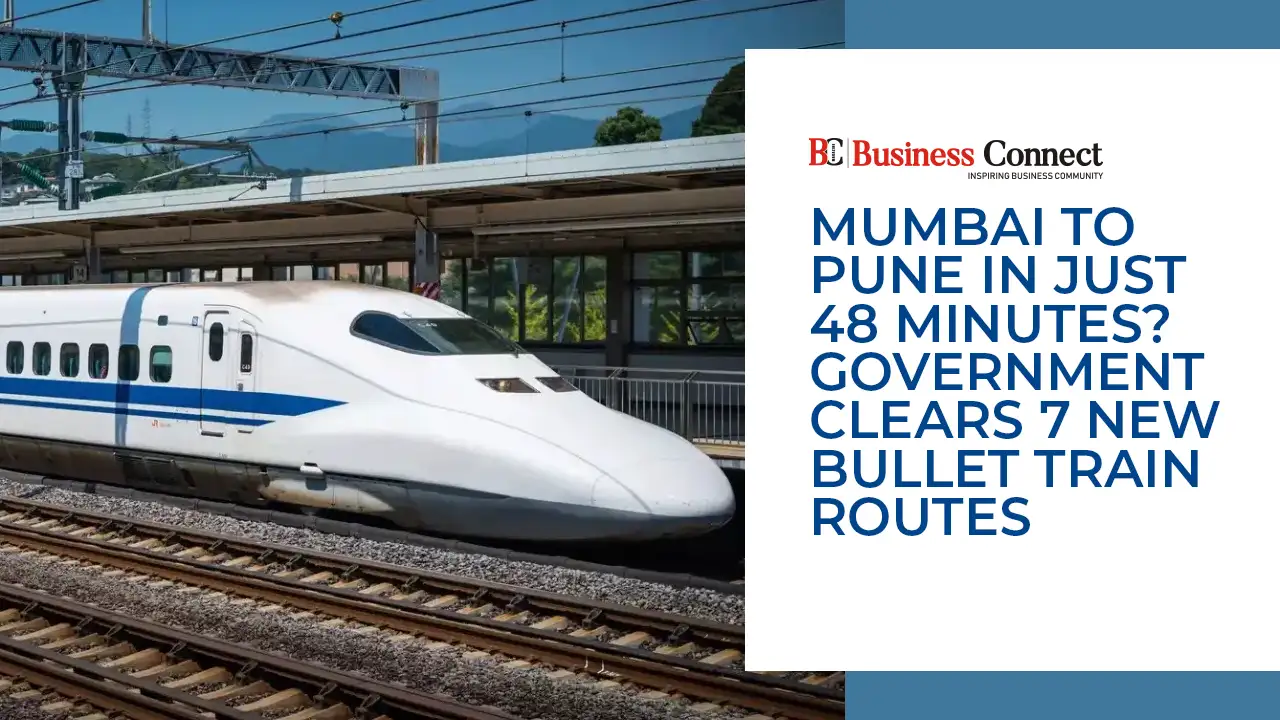
While work continues on the flagship Mumbai-Ahmedabad High Speed Rail project, the nation’s first such line, Union Railway Minister Ashwini Vaishnaw announced on Saturday that Prime Minister Narendra Modi has approved seven new bullet train corridors, giving India’s aspirations for high-speed rail a major boost.
The Seven New Corridors
According to Vaishnaw, the newly approved corridors are:
- Mumbai-Pune
- Bengaluru-Chennai
- Bengaluru-Hyderabad
- Pune-Hyderabad
- Delhi-Lucknow
- Delhi-Varanasi
- Delhi-Siliguri
Together, these routes span the western, southern and northern regions of the country, reflecting an ambition to extend high-speed rail well beyond the original Mumbai-Ahmedabad corridor and into a genuinely national network.
How Much Travel Time Each Route Will Save
Vaishnaw detailed the expected travel times for each corridor once completed, illustrating the scale of the time savings these projects are designed to deliver.
- Mumbai-Ahmedabad (the original corridor): 1 hour 57 minutes
- Mumbai-Pune: 48 minutes, the shortest among the newly announced corridors
- Bengaluru-Chennai: 73 minutes
- Bengaluru-Hyderabad: 2 hours 10 minutes
- Pune-Hyderabad: 2 hours 8 minutes
- Delhi-Lucknow: 2 hours
- Delhi-Varanasi: 3 hours 15 minutes
- Delhi-Siliguri: 6 hours, the longest of the new routes, down dramatically from the roughly 20 hours the journey currently takes by conventional rail
Constructing Integrated Economic Corridors
Vaishnaw presented the growing network as a means of altering regional economic geography, going beyond the trip time statistics. Major cities like Mumbai, Pune, Ahmedabad, Surat, and Hyderabad could operate as part of a closely connected economic ecosystem once these projects are finished, he said, with high-speed connectivity allowing business, talent, and investment to move much more easily between cities that would otherwise be treated as separate, distant markets.
This concept is similar to how high-speed rail networks have transformed regional economies in nations like China and Japan, where the development of integrated urban and economic clusters spanning many cities has historically been made possible by bullet train routes.
Parallel Developments in Bihar
This week, a number of other railway-related news coincided with the bullet train announcement. A new weekly train service between Chhapra Junction and Anand Vihar Terminal was launched earlier this week by Vaishnaw and Bihar Chief Minister Samrat Choudhary. Vaishnaw virtually launched two more train services that connected Zahirghat to Varanasi and Maul to Delhi during the same event.
Speaking to the crowd, Vaishnaw announced that Bihar would receive more than 200 new trains over the course of the next seven to eight years as part of a larger railway expansion program for the state. This indicates that substantial conventional rail investment is being made in tandem with the push for high-speed rail, especially in areas with historically poorer rail infrastructure.
What This Signifies Moving Forward
India’s bullet train program is progressing from a single demonstration project to what the government is portraying as a truly national high-speed rail network, with seven more corridors currently approved and the Mumbai-Ahmedabad project already under construction. How quickly the trip time estimates for commuters across these city pairs turn from projections to reality will depend on the following steps for these recently designated corridors, including thorough feasibility studies, land acquisition, and construction schedules.