
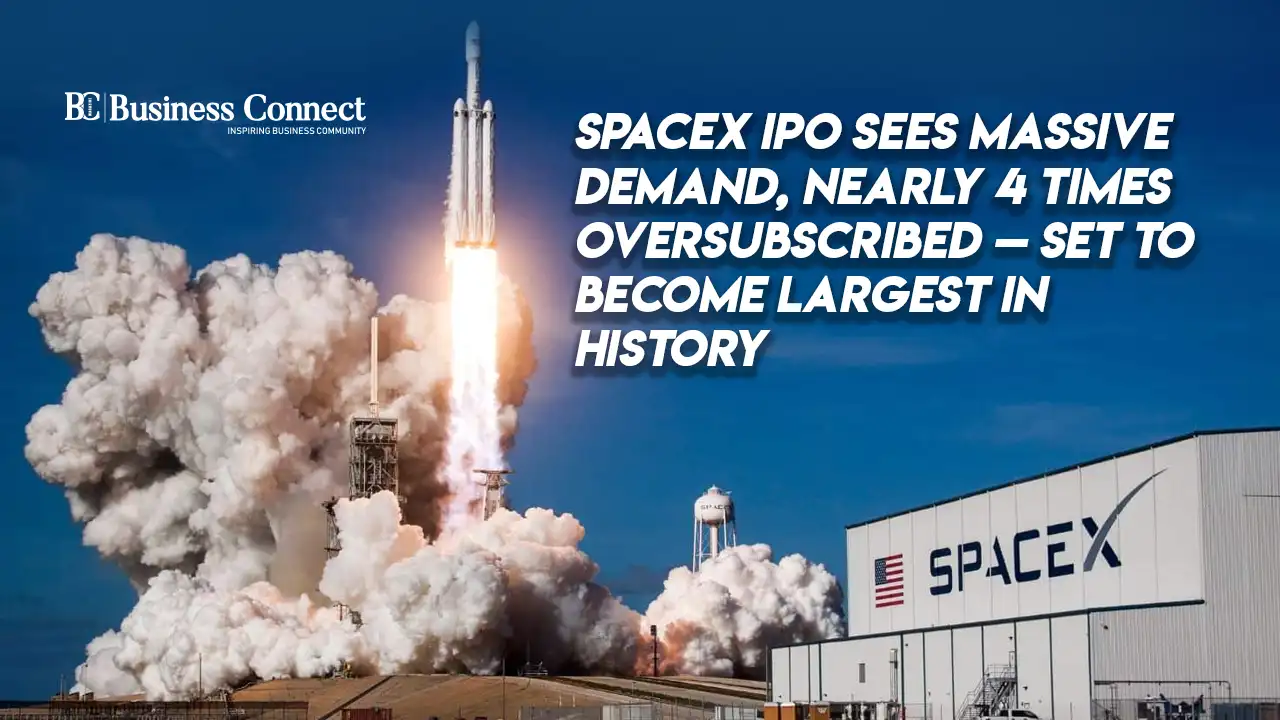
Wall Street’s order books have closed on what is now confirmed to be the most sought-after IPO in market history. SpaceX, the Elon Musk-led rocket, satellite, and AI company, attracted more than $250 billion in institutional demand for a $75 billion offering — nearly four times the available shares. Pricing tonight. Trading begins Friday.
“SpaceX’s initial public offering has attracted demand for more than four times the available shares. The banks stopped taking orders from institutional investors after the market closed at 4 p.m. Wednesday.”
What Is SpaceX? From Garage Rocket Company to $1.8 Trillion Giant
Founded in 2002 by Elon Musk with the stated ambition of making humanity a multi-planetary species, SpaceX spent its first decade as an audacious outsider to a launch industry dominated by Boeing and Lockheed Martin’s United Launch Alliance. The company’s early years were defined by spectacular failures and near-bankruptcy — Musk has publicly said the company was weeks from insolvency before its Falcon 1 rocket succeeded on its fourth launch attempt in 2008. From that foothold, SpaceX methodically dismantled the economics of the global launch market.
The Falcon 9 rocket — reusable, reliable, and dramatically cheaper than any competing system — became the backbone of global commercial launches. SpaceX now controls an estimated 60 per cent of the global commercial launch market. Its Starship vehicle, the most powerful rocket ever built, is in advanced operational testing. Its Dragon spacecraft carries astronauts to and from the International Space Station under NASA contracts. But it is a fourth business that has made SpaceX the financial juggernaut investors are now clamouring for: Starlink.
SpaceX Business Segments — Revenue Breakdown (FY2025)
Total revenue FY2025: $18 billion (up from $14 billion the prior year)
Starlink: ~$10 billion+ — satellite internet service, now the dominant revenue driver. Over 8 million active subscribers worldwide as of late 2025. Military version (Starshield) generating growing government contract revenues.
Launch services: Falcon 9 commercial launches, NASA contracts, DoD launches — estimated $5–6 billion
Cloud / AI services: New and fastest-growing segment. Google deal: $920 million per month through 2029. Anthropic deal: similar structure. Estimated $2B+ run-rate.
Net income (loss): $4.9 billion net loss in FY2025 — SpaceX is investing heavily in Starship and Starlink expansion.
The Google Deal That Changed the IPO Story
The single most consequential development in SpaceX’s pre-IPO roadshow was a disclosure made just days before order books opened. On Friday, June 6, SpaceX announced a cloud services agreement with Alphabet’s Google under which the Gemini AI model developer will pay $920 million per month as part of a deal running through 2029. The structure — which has SpaceX hosting or routing AI computing workloads through its satellite-and-ground network infrastructure — is broadly similar to a previously disclosed arrangement with Anthropic PBC.
Together, these two AI cloud deals represent a dramatic reframing of SpaceX’s investment story. The company is no longer simply a rocket launch provider with a profitable internet satellite business. It is now being positioned — and largely accepted by institutional investors — as an AI infrastructure play with a uniquely valuable global distribution network that no terrestrial cloud provider can replicate: 7,000+ low-Earth orbit satellites providing global, low-latency coverage, including over oceans, polar regions, and conflict zones where traditional infrastructure does not exist.
The Biggest IPO in History — By a Wide Margin
| Company | IPO Year | Capital Raised | Debut Valuation |
|---|---|---|---|
| SpaceX (SPCX) | 2026 | $75 Billion | ~$1.8 Trillion |
| Saudi Aramco | 2019 | $29.4 Billion | $1.7 Trillion |
| Alibaba | 2014 | $25 Billion | ~$231 Billion |
| SoftBank | 2018 | $23.5 Billion | ~$56 Billion |
| Agricultural Bank of China | 2010 | $22.1 Billion | ~$130 Billion |
| Meta | 2012 | $16 Billion | ~$104 Billion |
| Uber | 2019 | $8.1 Billion | ~$75 Billion |
Largest IPOs by Capital Raised (Historical Comparison)
| Rank | Company | Capital Raised |
|---|---|---|
| 1 | SpaceX (2026) | $75 Billion |
| 2 | Saudi Aramco (2019) | $29.4 Billion |
| 3 | Alibaba (2014) | $25 Billion |
| 4 | SoftBank (2018) | $23.5 Billion |
| 5 | Agricultural Bank of China (2010) | $22.1 Billion |
| 6 | Meta/Facebook (2012) | $16 Billion |
| 7 | Uber (2019) | $8.1 Billion |
Who Has Been Buying — And at What Scale
Multiple institutional investors placed individual orders of $10 billion or more during the bookbuilding process, Bloomberg reported, citing people familiar with the matter. This level of single-order size is extraordinary even by the standards of large-cap IPOs, where individual orders typically run in the hundreds of millions of dollars at most. The implication is that some of the world’s largest sovereign wealth funds, pension funds, and asset managers are allocating a meaningful share of their deployable capital to a single offering.
The breadth of demand — with more than $250 billion of orders chasing $75 billion of shares — means that even large-ticket institutional investors will receive significantly less than they ordered. Allocation ratios in heavily oversubscribed IPOs are typically determined by the bookrunning banks on the basis of relationship quality, long-term investment horizon, and order size. Goldman Sachs Group and Morgan Stanley are leading the offering; neither has commented publicly on the allocation process.
IPO Timeline — Key Dates
June 6, 2026: Google cloud deal announced — $920M/month through 2029
June 8, 2026: Bloomberg first reports IPO “well oversubscribed” with multiple $10B+ orders
June 10, 2026: Order books close at 4:00 PM ET. Bloomberg confirms 4x+ oversubscription. $250B+ in total demand.
June 11, 2026 (tonight): IPO pricing. Final allocation notifications to institutional investors.
June 12, 2026 (tomorrow): First day of trading on Nasdaq and Nasdaq Texas. Ticker: SPCX. IPO price: $135 per share.
The Bull and Bear Case: What Investors Are Debating
Not all commentary has been celebratory. Al Jazeera and a number of independent market analysts have raised pointed questions about whether SpaceX’s $1.8 trillion valuation is justified by its current fundamentals — or whether it prices in an enormously optimistic vision of the future that may not materialise on Elon Musk’s stated timelines.
| The Bull Case 🟢 | Why Investors Are Optimistic |
|---|---|
| 🟢 Market Leadership | Dominant global launch provider with ~60% commercial market share, creating a near-unassailable competitive moat. |
| 🟢 Starlink Growth | 8M+ subscribers, $10B+ annualized revenue, and expanding military Starshield contracts. |
| 🟢 AI Infrastructure Revenue | High-margin growth from AI cloud infrastructure deals, including agreements reportedly worth hundreds of millions per month. |
| 🟢 Starship Potential | If fully operational, Starship could dramatically reduce launch costs and unlock a trillion-dollar space logistics market. |
| 🟢 Strong Revenue Growth | Revenue increased approximately 29% YoY, from $14B to $18B in FY2025. |
| 🟢 Competitive Advantage | No credible rival currently matches its reusable heavy-lift launch capabilities; competitors remain years behind. |
| The Bear Case ⚠️🔴 | Key Risks & Concerns |
|---|---|
| 🔴 Profitability Issues | Reported $4.9 billion net loss in FY2025, indicating continued heavy investment spending. |
| 🔴 Valuation Risk | A $1.8 trillion valuation implies an extremely high revenue multiple, requiring massive future growth to justify. |
| 🔴 Execution History | Critics point to a mixed record on ambitious timelines and long-term project delivery. |
| 🔴 Leadership Concentration | Dependence on Elon Musk creates governance and key-person risk across multiple ventures. |
| 🔴 Oversubscription Perspective | While 4× oversubscribed is strong, some analysts view it as moderate relative to a $75 billion offering size. |
| 🔴 Institutional Exposure Concerns | Pension funds and retail investors may gain indirect exposure to a high-risk, loss-making company without direct voting input. |
The Oversubscription Nuance Wall Street Is Discussing
A 4x oversubscription ratio sounds impressive — and it is. But context matters. As Barron’s noted in its analysis, the larger the deal, the harder it becomes to generate extreme oversubscription ratios. Finding $150 billion of demand is far easier than finding $300 billion or $1 trillion. Some blockbuster consumer tech IPOs in the 2010s generated oversubscription multiples of 10x–30x precisely because they were raising $5–15 billion, not $75 billion.
This does not diminish the SpaceX IPO’s historical significance or the genuine scale of demand. It does caution against interpreting 4x oversubscription as a signal of near-infinite post-IPO price appreciation. The post-offering “pop” may be smaller than retail investors accustomed to tech IPO dynamics expect.
The OpenAI and Anthropic Domino Effect
SpaceX’s debut has significant implications for the broader calendar of anticipated mega-IPOs. Both OpenAI and Anthropic — two of the most valuable AI companies in the world — are widely expected to enter public markets in the near term. A new Nasdaq rule change means individual investors could own stock in either company as soon as 15 business days following the first trading day of their IPO. The question hanging over both offerings is whether the market has the appetite to absorb multiple trillion-dollar listings within a compressed timeframe — or whether SpaceX will temporarily exhaust institutional capital that would otherwise flow to those deals.
Stocks fell last week as analysts speculated that investors were liquidating existing equity positions to free up capital for SpaceX allocations — a pattern known as “making room” for an anticipated oversubscribed offering. Whether that selling resumes or reverses after SpaceX begins trading will be an early signal of the market’s willingness to absorb whatever comes next.
SpaceX IPO — At a Glance
Company: Space Exploration Technologies Corp. (SpaceX)
Ticker: SPCX | Exchange: Nasdaq and Nasdaq Texas
IPO Price: $135 per share
Shares offered: 555.6 million
Capital raise: ~$75 billion
Implied valuation: ~$1.8 trillion
First trading day: Friday, June 12, 2026
Bookrunners: Goldman Sachs, Morgan Stanley
Oversubscription: More than 4x — $250B+ demand