
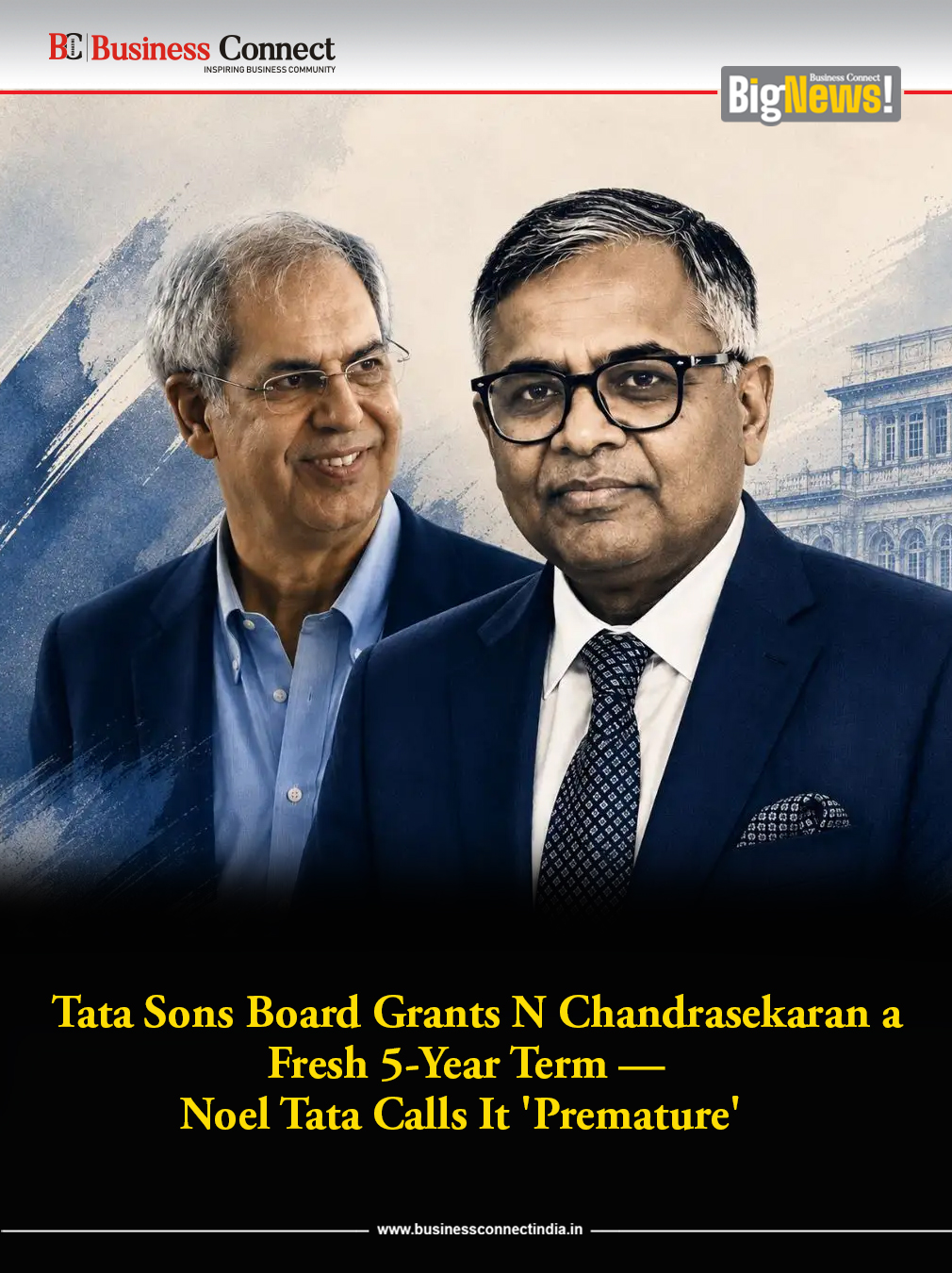
Tata Sons’ board approved a fresh five-year term for chairman N Chandrasekaran at a meeting on September 17, 2026, reversing his own August decision to step down when his current tenure ends on February 20, 2027. Tata Trusts chairman Noel Tata publicly opposed the move at the meeting, calling it “premature” and arguing it disregarded Chandrasekaran’s own freely made decision. The board also moved forward on steps toward a long-pending Tata Sons stock market listing. Tata Group stocks reacted immediately — Tata Chemicals shares jumped as much as 13.5% to ₹831, alongside gains in Tata Investment Corporation, TCS, and Tata Technologies.
A decade after the very public boardroom battle between Ratan Tata and Cyrus Mistry played out at Bombay House, the same building hosted another contentious leadership showdown on Thursday — one that ended with a leadership U-turn, a public rebuke from Tata Trusts, and a sharp rally across Tata Group stocks.
What Did the Tata Sons Board Actually Decide?
In an official statement, Tata Sons said: “At the meeting of the board on September 17, 2026, Chandrasekaran acceded to the board’s request to re-consider his decision. The board, thereafter, resolved by a majority vote to re-appoint him as executive chairman for a further term of five years upon the expiry of his current tenure.” The board also resolved to begin steps toward complying with applicable Reserve Bank of India (RBI) guidelines on listing, and said it would seek guidance from the central bank, Tata Trusts, and other stakeholders on compliance requirements.
The reversal is notable because it directly contradicts Chandrasekaran’s own position from just weeks earlier. In August, Chandrasekaran had written to the board stating he would not seek another term, citing the lack of consensus at an earlier board meeting held in February 2026. Tata Trusts — Tata Sons’ majority shareholder — had accepted that decision and had asked Tata Sons to constitute a formal selection committee under the company’s Articles of Association to identify his successor.
Why Is Noel Tata Opposed?
Noel Tata, who chairs Tata Trusts and sits on the Tata Sons board, made his objection formal and on the record at Thursday’s meeting. According to his statement, cited by Business Standard, Chandrasekaran’s original decision “was his own decision. It was freely taken and clearly expressed” — and Noel Tata stressed it was not sought by the board and was not the outcome of any board review.
He argued that reappointing Chandrasekaran would require the board to effectively set aside three separate developments: Chandrasekaran’s own decision to step down, Tata Trusts’ formal acceptance of that decision as majority shareholder, and the succession process that Tata Trusts — holding a 66% stake in Tata Sons — had already set in motion. Reports on the board’s internal dynamics differ on the procedural detail of what happened next: some accounts describe Noel Tata as having been outvoted by other directors, while at least one report states he attempted to invoke a veto on behalf of Tata Trusts. Tata Sons’ own statement frames the outcome simply as a majority board vote; the precise mechanics of how Noel Tata’s objection was overcome remain a point of differing accounts across outlets.
Adding to the tension, one report also indicated that the Sir Dorabji Tata Trust attempted to stop nominee director Venu Srinivasan from voting in favour of the listing resolution specifically. Srinivasan reportedly declined, citing his independent duty as a company director rather than as a nominee acting on the Trust’s instructions.
The Listing Question Behind the Leadership Fight
The push to keep Chandrasekaran in place is closely tied to a separate, longer-running dispute: whether Tata Sons must list on a stock exchange. The RBI classified Tata Sons as an “upper-layer” non-banking financial company (NBFC) in 2022, a category that carries a mandatory listing requirement. Tata Sons spent much of 2025 and 2026 attempting to get that classification lifted, applying to surrender its Core Investment Company registration entirely.
The RBI rejected that application earlier in September, closing off the exemption route Tata Sons had been pursuing. According to Outlook Business, any legal challenge to the RBI’s order can only be brought by Tata Sons itself, not by Tata Trusts — a detail that matters because Tata Trusts has separately opposed listing outright, creating a structural bind: the entity most opposed to going public does not have standing to legally contest the regulatory order forcing the issue.
Supporters of Chandrasekaran’s continuation reportedly argued at the board meeting that leadership continuity was essential “for the sake of business continuity” through what is likely to be a complex, multi-year listing process — a rationale consistent with earlier reporting that a Nomination and Remuneration Committee recommendation along similar lines had been under discussion ahead of Thursday’s meeting.
How Did the Market React?
Tata Group stocks moved sharply once news of the board’s decision broke. Several listed Tata companies hold direct equity stakes in Tata Sons itself, so a step toward an eventual Tata Sons listing carries direct read-through to their own valuations.
| Company | Reported Move | Level |
|---|---|---|
| Tata Chemicals | Up to 13.5% | ₹831 (market cap ~₹20,439 crore) |
| Tata Investment Corporation | Up to 7% | ₹727.60 |
| Tata Consultancy Services (TCS) | ~3.2% | ₹2,262 |
| Tata Technologies | Gained on the news | — |
| Nelco | Gained on the news | — |
This wasn’t Tata Chemicals’ first move on Tata Sons listing news this month. Days earlier, when the RBI’s rejection of Tata Sons’ deregistration application first broke, Tata Chemicals had already surged 20% to hit its upper circuit at ₹734.50, before adding further gains over the following sessions. The repeated rallies reflect Tata Chemicals’ outsized stake in Tata Sons relative to its own market size: the company holds roughly a 2.5% stake in Tata Sons, a holding some analysts have valued at ₹10,000–15,000 crore or more — a figure that, at points, has exceeded Tata Chemicals’ own standalone market capitalisation. That gap is the core reason the stock reacts so sharply to any Tata Sons listing development: a public listing could force the market to price in the value of that Tata Sons stake more directly than it currently does.
Brokerage commentary following the initial RBI rejection struck a cautiously bullish but measured tone. Master Capital Services’ Chief Research Officer Ravi Singh said a Tata Sons IPO could unlock significant value, improve transparency, and let shareholders such as the Shapoorji Pallonji Group monetise their stake — while flagging near-term resistance levels and describing the stock as overbought on technical charts. ICICI Securities, in a separate note, said it expects any path to listing to involve a prolonged legal process despite the near-term positive price action.
What Happens Next
Several questions remain open even after Thursday’s board resolution:
- Will Tata Trusts pursue legal action? Given Noel Tata’s on-record objection and Tata Trusts’ majority stake, a formal legal challenge to the board’s process — separate from the RBI listing matter — remains a possibility that has not been ruled out.
- What does the listing timeline actually look like? The board’s statement commits only to initiating steps and seeking regulatory guidance, not to a firm listing date.
- How does Chandrasekaran’s reversal affect the succession process already underway? Tata Trusts had already set in motion a selection committee process before this reversal; how, or whether, that process is now unwound is unclear.
- Will Tata Sons challenge the RBI’s rejection in court? Given that only Tata Sons — not Tata Trusts — has standing to contest the RBI’s order, its own board’s stance on litigation will likely shape the listing timeline more than Tata Trusts’ preferences.
This article is based on official statements from Tata Sons and reporting from Business Standard, Business Today, Outlook Business, and other outlets. Some procedural details of the board meeting are reported differently across sources and are noted as such. This is a developing story and will be updated as further details, including any Tata Trusts response, emerge.
Frequently Asked Questions
Did N Chandrasekaran get an extension as Tata Sons chairman?
Yes. Tata Sons’ board approved a fresh five-year term for Chandrasekaran on September 17, 2026, after he “acceded to the board’s request to re-consider” his earlier decision to step down when his term ends on February 20, 2027.
Why did Noel Tata oppose Chandrasekaran’s reappointment?
Noel Tata, chairman of Tata Trusts, argued the reappointment disregarded Chandrasekaran’s own freely made decision to step down, Tata Trusts’ formal acceptance of that decision, and a succession process Tata Trusts had already initiated. He called the board’s move “premature.”
How much does Tata Trusts own in Tata Sons?
Tata Trusts holds a 66% majority stake in Tata Sons, making it the company’s controlling shareholder.
Why did Tata Chemicals shares rise on this news?
Tata Chemicals holds roughly a 2.5% equity stake in Tata Sons, valued by some analysts at ₹10,000–15,000 crore or more. Any move toward an eventual Tata Sons listing raises the prospect of that stake being valued more directly by the market, which is why Tata Chemicals and similar Tata Sons shareholder companies rallied sharply on the news.
Is Tata Sons definitely going to list on the stock exchange?
Not confirmed with a timeline. The board has resolved to begin steps toward compliance with RBI guidelines and to seek further guidance, but a firm listing date has not been announced. The RBI’s classification of Tata Sons as an upper-layer NBFC requires listing, but Tata Sons could still pursue legal or regulatory avenues to delay or contest elements of that process.
What is an upper-layer NBFC and why does it matter for Tata Sons?
It’s a Reserve Bank of India classification for the largest, most systemically significant non-banking financial companies, which carries a mandatory stock exchange listing requirement. The RBI classified Tata Sons in this category in 2022 and rejected the company’s bid to have that classification withdrawn in September 2026.
Add Business Connect magazine to your Google News feed