
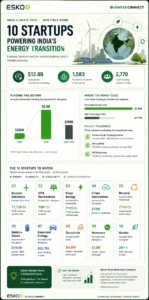
Over $12.8 billion has been invested in India’s climate technology sector by 1,583 businesses. These ten startups are spearheading the nation’s 2026 green energy revolution.
One of the most lucrative areas of India’s startup economy is the country’s climate technology business. According to Tracxn’s India Climate Tech 2026 Report, which was published in June, annual funding increased from $315 million in 2020 to $2.6 billion in 2025, and the sector has now surpassed $12.8 billion in cumulative funding across 1,583 financed businesses and 2,770 rounds. What was formerly a policy-driven, grant-funded segment of the ecosystem is now drawing in global corporate offtake agreements, late-stage institutional funding, and a surge of IIT and IIM-trained entrepreneurs creating anything from carbon-credit marketplaces to green hydrogen electrolysers.
What Is Driving the Growth?
Climate technology is becoming one of India’s most active investment sectors due to three factors coming together. Energy security is the first. Due to India’s reliance on imported crude oil and essential clean energy inputs, policy initiatives like PM E-DRIVE (a ₹10,900 crore scheme extended to 2028) and the Rare Earth Permanent Magnets scheme (₹7,280 crore, effective December 2025) have become central to industrial strategy, bringing government priorities into line with the industries that investors already support.
Regulation comes in second. When India’s Carbon Credit Trading Scheme launches in October 2026, it will create the nation’s first compliance carbon market, encompassing over 490 industrial facilities in nine different industries. Just that is anticipated to generate a fresh surge in demand for companies engaged in industrial decarbonization, emissions monitoring, and carbon accounting.
Capital concentration comes at third. With $1.5 billion in total funding, Renewable Energy Tech leads the climate-tech market, followed by Solid Waste Management Tech with $477 million. The industry raised $791 million over 74 rounds in the first five months of 2026 alone, with 66% of that money concentrated in just five late-stage deals. This indicates that investors are increasingly supporting businesses that have already demonstrated their capacity to grow.
The Ultimate List of Indian Climate Tech Startups
Ecozen Solutions
Established: 2010 | Main Office: Pune
Devendra Gupta, Prateek Singhal, and Vivek Pandey started Ecozen on the IIT Kharagpur campus. For more than ten years, the company has used solar power, IoT, and thermal energy storage to address one of the oldest issues in agriculture: spoiling. More than 180,000 farmers have benefited from its flagship products, Ecofrost (a solar-powered decentralized chill room) and Ecotron (a smart solar irrigation controller), which have reduced post-harvest losses and increased profits.
The company’s growth has significantly accelerated. While earnings increased by almost five times over the same period, revenue from operations increased by 2.5 times to ₹1,150 crore in FY25 from ₹458 crore in FY24.
To far, Ecozen has funded about $104 million in debt and equity, including a $30 million round supported by Nuveen, InCred, and the U.S. International Development Finance Corporation. As of late 2025, negotiations were on for a Series D round. Over 50,000 metric tons of food loss have been avoided and an estimated 2 million tonnes of greenhouse gas emissions have been reduced thanks to its technology stack.
GPS Renewables
Established: 2012 | Main Office: Bengaluru
Mainak Chakraborty and Sreekrishna Sankar, two alumni of IIM Bangalore, founded GPS Renewables as a captive biogas firm before growing it into the top full-stack renewable natural gas operator in India. The business designs, constructs, and runs ethanol, bioCNG, and compressed biogas (CBG) plants that turn organic and agricultural waste into clean fuel, including the largest CBG plant in Asia based on municipal solid waste in Indore.
GPSR today employs around 850 people and brings in over ₹961 crore annually. It raised ₹635 crore in a Series C round in June 2026, with PixelSky Capital leading the ₹125 crore in equity and a ₹200 crore equity partnership with a Korean industrial investor via its asset-holding platform GPSR Arya.
In order to construct CBG infrastructure across the country, the company has partnered with Indian Oil, Bharat Petroleum, and Oil India. Over 30 of these projects are almost finished, and over 200 more are planned.
Freyr Energy
Established: 2014 | Main Office: Hyderabad
Saurabh Marda and Radhika Choudary launched Freyr Energy to provide rooftop solar to India’s most neglected energy consumers: homeowners and MSMEs, who together account for less than 2% of rooftop solar adoption but consume more than half of the country’s retail electricity. The entire client journey—from quote to financing to after-sales service—is digitized by its in-house app, SunPro+.
Freyr is on track to install over 15,000 systems in FY25–26 alone, with a goal of 30,000 in FY26–27, having installed almost 12,000 systems in its first ten years. The national government’s PM Surya Ghar: Muft Bijli Yojana subsidy scheme, which has greatly encouraged homes and micro-enterprises to use rooftop solar, is the driving force behind this enormous 1,150% volume acceleration.
The company now operates in 22 Indian states after raising $13.8 million from investors in six rounds, including Schneider Electric, C4D Partners, and the EU-backed EDFI ElectriFI.
Chakr Innovations
Established: 2016 | Main Office: Gurugram
Kushagra Srivastava and Arpit Dhupar, two IIT Delhi graduates, launched Chakr Innovations with the novel idea of turning pollution into a product rather than merely lowering emissions. Its flagship product, Chakr Shield, reduces emissions by over 80% while producing a marketable by-product by capturing particulate matter from diesel generator exhaust and turning it into usable ink and coatings.
With more than 2,000 clients and more than 5,000 installations throughout India, the company has so far avoided more than 2.5 million tonnes of CO2-equivalent emissions. Chakr is one of the few successful climate-tech firms in India, with FY24 revenue of about ₹125 crore and a net profit of ₹9.5 crore.
With participation from ONGC, SBI Cap Ventures, and the Indian Angel Network, it secured $23 million in a Series C round led by Iron Pillar in September 2025 to finance international expansion and research and development into aluminum-air battery technology as a domestic substitute for lithium-ion.
Exponent Energy
Established in 2020 | Based in Bengaluru
Arun Vinayak founded Exponent Energy, which produces an integrated energy stack for commercial EVs, a high-current connector, an ultra-fast charging station, and a proprietary battery pack that can fully charge a car in around 15 minutes. In its first five years of operation, the company has mostly used electric three-wheelers and, increasingly, electric buses to demonstrate the technology’s dependability at scale.
Exponent has increased its battery systems from 10 kWh packs for three-wheelers to 420 kWh systems for electric buses, including India’s first all-sleeper electric bus fleet with rapid charging, which was introduced with Fresh Bus in January 2026. Exponent currently operates about 200 charging stations throughout Bengaluru and Delhi.
The company has raised a total of $65.7 million, including a ₹200 crore investment led by TDK Ventures and 360 ONE Asset in June 2026. As of March 2025, annual revenue was ₹44 crore.
Battery Smart
Established: 2019 | Based in Gurugram
Pulkit Khurana and Siddharth Sikka, alumni of IIT Kanpur, developed Battery Smart to address a distinct issue in electric mobility: rather than waiting for a car to charge, why not replace the battery completely? By detaching the battery from the vehicle, its partner-led network enables drivers of electric two- and three-wheelers to swap out a low battery for a charged one in roughly two minutes, saving up to 40% on initial vehicle expenditures.
With an estimated 36% of India’s battery-swapping industry, the company currently runs a network of more than 1,600 swap stations in more than 50 cities, facilitating over 100 million battery exchanges. Investors such as Tiger Global, British International Investment, LeapFrog Investments, MUFG Bank, and Panasonic have contributed over $192 million to Battery Smart thus far. The company’s revenue is expected to triple in FY24 due to the demand for last-mile delivery fleets driven by rapid commerce.
Recykal
Established: 2016 | Based in Hyderabad
In order to formalize waste trading, one of India’s most dispersed and unofficial businesses, serial entrepreneurs Abhay Deshpande, Abhishek Deshpande, Anirudha Jalan, Ekta Narain, and Vikram Prabakar launched Recykal. In addition to assisting companies like Amul and Hindustan Unilever in fulfilling their Extended Producer Responsibility duties for plastic and e-waste, its marketplace links trash generators like corporations, hotels, campuses, and resident associations with recyclers and aggregators.
Recykal has attracted $40.9 million from investors such as Morgan Stanley, Circulate Capital, and 360 ONE Asset Management, and its gross waste value has increased three to four times a year, to approximately ₹745 crore in FY23. In addition to developing India’s first digital deposit-refund systems for packaging, the “Samudramanthan” effort intends to recover 70,000 metric tons of ocean-bound plastic across 207 districts in 19 states.
Varaha
Established: 2022 | Based in Gurugram
Madhur Jain, Ankita Garg, and Vishal Kuchanur, who have all worked closely with smallholder farmers to assist agriculture become a carbon sink rather than an emissions generator, launched Varaha. In order to produce verified carbon removal credits that are sold to corporate buyers like Google, Microsoft, Lufthansa, and Swiss Re, the company operates regenerative agriculture, agroforestry, biochar, and enhanced rock weathering projects throughout India, Nepal, Bangladesh, Bhutan, and Ivory Coast with about 175,000 farmers.
As the first company in India to provide carbon credits from biochar operations, Varaha has removed over 2 million tonnes of CO2 to far. The company is still profitable after taxes, and revenue, which was approximately ₹430 million in the previous fiscal year, is expected to almost triple this year.
In order to expand regenerative farming throughout Haryana and Punjab, the company has raised approximately $33 million in equity, including a $20 million tranche of a planned $45 million Series B led by WestBridge Capital in February 2026 and a separate $30.5 million carbon-investment deal with French firm Mirova in November 2025.
Newtrace
Established: 2021 | Main Office: Bengaluru
Prasanta Sarkar and Rochan Sinha established Newtrace to address the electrode, one of the most persistent cost issues with green hydrogen. Its exclusive Voltagen technology, a coated cathode that fits straight into current alkaline electrolyser stacks and reduces the specific energy consumption of hydrogen production by up to 9.5 kWh/kg without the need for platinum-group materials or modifications to the plant’s infrastructure, was created by screening more than 1,000 catalyst-substrate combinations.
With over 45 engineers and scientists working out of a 30,000-square-foot Bengaluru facility, Newtrace has raised about $12 million in seed and pre-Series A rounds, including a $6.3 million round led by Mitsui Sumitomo Insurance Venture Capital and HDFC Bank, with participation from Peak XV Partners’ Surge and Aavishkaar Capital. As India works toward its National Green Hydrogen Mission target of 5 million metric tons annually by 2030, the business plans to start commercial deliveries of Voltagen electrodes within the next year, establishing itself as a supplier to electrolyser OEMs and green hydrogen project developers.
Zerocircle
Established: 2020 | Main Office: Pune
Neha Jain, a former Google employee, started Zerocircle to replace single-use plastic with seaweed, which the ocean already produces for free. In order to match the barrier performance of traditional plastic packaging used in food service and retail, the company transforms sustainably farmed seaweed from coastal communities in Gujarat, Maharashtra, and Tamil Nadu into films, coatings, and paper that are completely home-compostable and marine-degradable.
Zerocircle, a “minicorn” in India’s sustainability ecosystem, has raised $4.9 million in a number of rounds. In January 2025, Zerodha co-founder Nithin Kamath’s Rainmatter led a ₹20 crore round, and a year later, 3one4 Capital and Rainmatter led a ₹5 crore round to expand into QSR and retail packaging. In addition, the company placed second in the 2022 Tom Ford Plastic Innovation Prize and aims to achieve cost parity with traditional plastic in two years.
Trends Shaping India’s Climate Tech Sector in 2026
 Scale, not stage, is the focus of capital consolidation. Even if the total number of transactions and early-stage check sizes decreased, $524 million of the $791 million raised in climate technology through the first five months of 2026 came from late-stage deals. Businesses with established commercial traction, such as Ecozen, GPS Renewables, and Chakr, are being rewarded by investors.
Pure compliance plays are being replaced by waste-to-value approaches. Diesel soot is converted into ink by Chakr. Recykal transforms scrap into a commodity that may be traded. Organic waste is converted into fuel by GPS Renewables. The most financially viable climate-tech startups in India increasingly prioritize profitable industrial businesses over emissions-reduction narratives.
Prior to regulation, carbon markets are becoming more professional. Carbon accounting and measurement, reporting, and verification (MRV) infrastructure is moving from a voluntary, NGO-adjacent category to investable infrastructure with the launch of India’s compliance carbon market in October 2026 and international corporations already signing offtake agreements with firms like Varaha.
Deeptech hardware is making a comeback. Investors like HDFC Bank and Peak XV are still supporting materials-science-heavy bets like Newtrace’s electrolyser electrodes after a number of EV battery startups faltered on hardware execution and corporate governance. However, they are paying closer attention to manufacturing readiness and unit economics than they did during the 2021–2022 funding cycle.
The climate-tech industry in India has advanced far beyond the stage of policy papers. With $12.8 billion in total funding, a compliant carbon market that will launch in October, and founders doing everything from carbon removal to cold storage, the next generation of Indian unicorns might be the ones that no one would have considered “tech” ten years ago.
Frequently Asked Questions (FAQs)
1. What is climate technology (Climate Tech)?
Climate technology refers to innovations that help reduce greenhouse gas emissions, improve energy efficiency, manage waste, and accelerate the transition to clean energy. It includes sectors such as renewable energy, electric mobility, carbon capture, hydrogen, recycling, and sustainable agriculture.
2. Why is India’s climate tech sector growing so rapidly in 2026?
India’s climate tech ecosystem is expanding due to strong government policies, increasing investor confidence, corporate sustainability commitments, and rising demand for clean energy solutions. The sector has attracted over $12.8 billion in cumulative funding and continues to gain momentum.
3. Which sectors are receiving the highest climate-tech investments in India?
Renewable Energy Tech leads the sector with approximately $1.5 billion in cumulative funding, followed by Solid Waste Management Tech, carbon management, electric mobility, green hydrogen, and circular economy startups.
4. Which are the top Indian climate tech startups to watch in 2026?
Some of the most promising startups include Ecozen Solutions, GPS Renewables, Freyr Energy, Chakr Innovations, Recykal, Battery Smart, Exponent Energy, Zerocircle, Newtrace, and Varaha.
5. How is the Indian government supporting climate-tech startups?
The government is promoting climate innovation through initiatives such as PM E-DRIVE, the Carbon Credit Trading Scheme, the National Green Hydrogen Mission, and incentives for renewable energy, EVs, and sustainable manufacturing.
6. Why are investors showing strong interest in climate-tech startups?
Climate-tech companies address critical challenges in clean energy, waste management, and decarbonization while offering scalable business models. Investors are increasingly backing startups with proven commercial traction and long-term growth potential.
7. Which climate-tech segment has attracted the most funding?
Renewable Energy Tech remains the largest investment category, accounting for nearly $1.5 billion in cumulative funding, driven by solar, bioenergy, green hydrogen, and energy storage innovations.
8. What role does carbon trading play in India’s climate-tech ecosystem?
India’s upcoming Carbon Credit Trading Scheme is expected to create significant opportunities for startups involved in carbon accounting, emissions monitoring, carbon removal, and environmental compliance, making carbon markets a major growth area.
9. Are Indian climate-tech startups attracting global investors?
Yes. Several Indian climate-tech startups have secured funding from leading global venture capital firms, institutional investors, development finance institutions, and multinational corporations looking to invest in sustainable technologies.
10. What is the future of India’s climate-tech industry?
The outlook is highly positive. With supportive government policies, rising private investments, and increasing demand for sustainable solutions, India’s climate-tech industry is expected to become one of the country’s fastest-growing startup ecosystems over the next decade.