
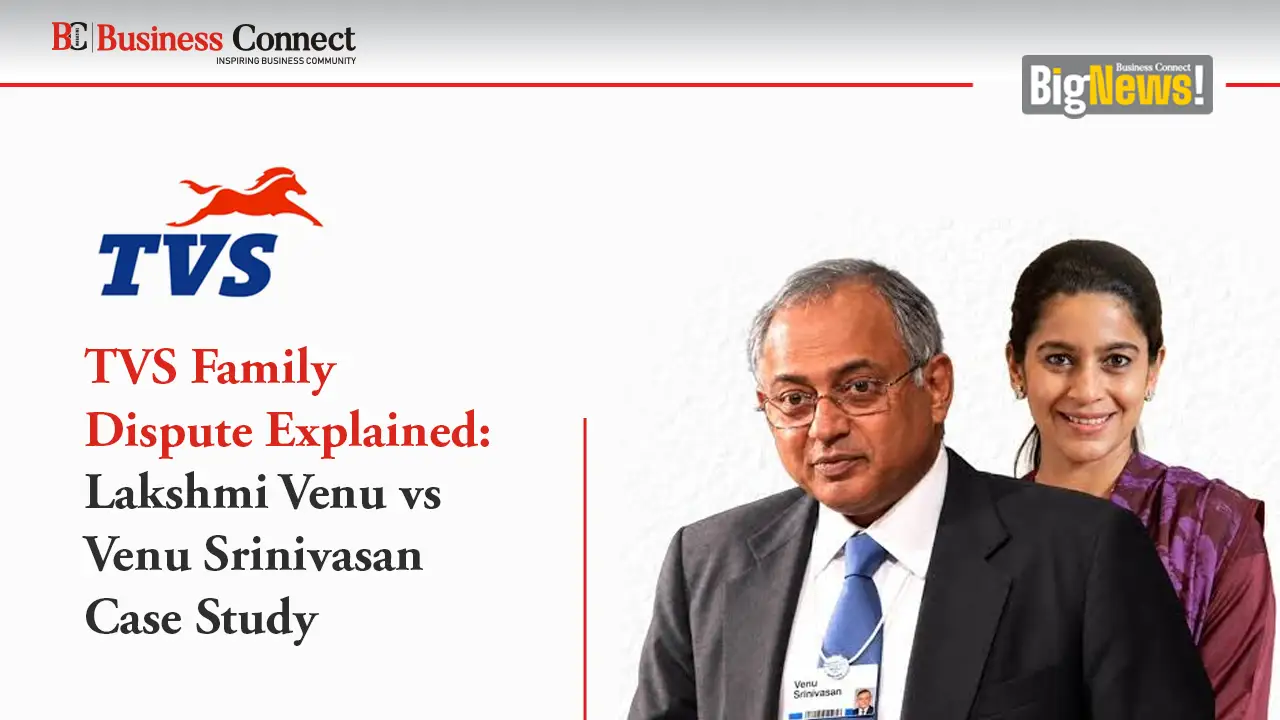
It was the night of March 31, 2026, in Chennai. Inside a boardroom, a father was sitting and quietly overturning his daughter’s decisions one by one. There was no hurry, no visible anger. He was as calm as someone cleaning out an old file.
Just 72 hours earlier, the board had made a decision. Now, everything had been reversed. The man who had voluntarily stepped down from his position four years ago was back in the same chair. And his daughter, who had delivered 60% growth for her company and had clients like BMW and Hyundai, could only sit there and watch.
This is not a scene from a web series. This is the real story of the TVS Group, an empire worth ₹1.87 lakh crore, and a battle that is far from over. Today, we will uncover this story from the beginning, examining every layer and every detail. And in the end, you can decide for yourself: who was right?
The Beginning of the TVS Empire
The story does not begin with a motorcycle. It begins with a bus. In 1911, in Madurai, there was a lawyer with a long name: Thirukkurungudi Vengaram Sundaram Iyengar. In simpler terms, he was known as T. V. Sundaram Iyengar. The three letters in TVS come from his name. He left his jobs with the Indian Railways and a bank. In 1912, he started a bus service between Madurai and Pudukkottai.
Many people operate buses, but this one was special. It was so punctual that people used to set their watches according to its schedule. The great saint of Kanchipuram, Sri Chandrasekharendra Saraswati, reportedly even treated this bus as his alarm clock. One bus, one man, and one determination: never to break a promise. That determination eventually grew into a massive business empire more than a century old, with a market value of over ₹1.87 lakh crore.
The Man Who Built the Empire: Venu Srinivasan
But the man who built this empire was someone different. In 1979, a 26-year-old young man joined the TVS Group. His name was Venu Srinivasan, the grandson of T. V. Sundaram Iyengar. However, his journey was anything but easy.
The company he was given responsibility for, Sundaram-Clayton, was struggling to survive. Workers were on strike, the company was making losses, and many believed it would not survive. What did Venu Srinivasan do? He shut down the factory for three months, brought the strike to an end, and pulled the company back from the brink.
Like his grandfather, he was determined, visionary, and fearless. In 1982, he made a major move by partnering with Japan’s Suzuki. This led to the formation of TVS Suzuki. The partnership brought motorcycles such as the Suzuki Supra, Samurai, Shogun, Shaolin, and Fiero to the Indian market.
TVS had now become a recognised name. But just as the relationship between Hero and Honda appeared friendly on the surface while cracks were developing underneath, the TVS-Suzuki partnership faced similar tensions. In 2001, Suzuki exited the partnership, taking its Japanese technology with it.
The biggest question facing TVS was: What next? Hero Honda dominated the market. Bajaj was ahead, and TVS was in third place. With Suzuki’s technology gone, TVS had to develop its own engines. Venu Srinivasan answered that challenge with a motorcycle.
In 2001, TVS launched the Victor, its first four-stroke motorcycle designed and developed entirely in India. The motorcycle became such a hit that TVS’s profits reportedly increased by more than 400% in a single quarter. This was not just a product launch. It was a comeback.
Then came the Apache, which won the hearts of young riders. In 2003, TVS launched the Scooty Pep, a scooter that helped the company establish a strong presence in the women’s scooter market. And in 2013, Venu Srinivasan did something no Indian company had done before: he entered into a partnership with Germany’s BMW Motorrad.
BMW motorcycles began being manufactured in Hosur. In 2020, TVS acquired the 126-year-old British motorcycle brand Norton Motorcycles for £200 million. An Indian company had become the owner of a British icon. Venu Srinivasan was honoured with the Padma Bhushan. According to Forbes’ 2024 list, his net worth stood at $5.65 billion, making him the 55th richest person in India.
The Next Generation: Who Will Inherit the Empire?
But when an empire becomes this big, one question naturally arises: Who will inherit it? Venu Srinivasan has two children. His son, Sudarshan Venu, was born in 1989. He studied at the University of Warwick in the UK and moved to Singapore in 2018 to oversee TVS’s international business.
His daughter, Lakshmi Venu, has a deep understanding of business, much like her mother, Mallika Srinivasan. She spent more than a decade working at Sundaram-Clayton and gradually rose through the ranks. Venu Srinivasan himself once acknowledged that Lakshmi had brought significant improvements to the company’s quality, profitability, and relationships with original equipment manufacturers.
In 2022, he made a major decision. He stepped back by becoming Chairman Emeritus and appointed Lakshmi as Managing Director of Sundaram-Clayton. His son, Sudarshan, became Managing Director of TVS Motor Company.
On paper, it looked like a perfect succession plan. The father had assigned responsibilities to both children. His son received the leadership of TVS Motor Company, while his daughter took charge of Sundaram-Clayton. Everything seemed settled. But it wasn’t.
Two Business Families, One Empire
To understand the situation, we need to look at the background. The TVS Group is essentially a combination of two major business families. On one side is Venu Srinivasan’s family, associated with TVS Motor Company, TVS Holdings, Sundaram Finance, Wheels India, and other businesses.
On the other side is Mallika Srinivasan’s family. Mallika’s family owns TAFE, or Tractors and Farm Equipment Limited, one of the world’s largest tractor companies. Venu married Mallika, bringing two major business families together.
On December 10, 2020, a major settlement took place across the TVS Group. Companies were divided among different branches of the family. Then, on March 21, 2024, another Memorandum of Understanding, or MoU, was signed within Venu’s immediate family. Venu, Mallika, Sudarshan, and Lakshmi all signed it.
According to the MoU, Sudarshan would receive TVS Holdings and TVS Motor Company. In other words, he would take charge of the entire two-wheeler empire, valued at ₹1.87 lakh crore. Lakshmi would receive the newly formed Sundaram-Clayton and, eventually, take responsibility for her mother’s TAFE business as well.
There is another important detail. In June 2023, a major restructuring took place. The old Sundaram-Clayton was renamed TVS Holdings, and a new company called Sundaram-Clayton Limited was created specifically for the die-casting business. This newly formed Sundaram-Clayton became Lakshmi’s business domain. By 2024, the MoU had been signed. The plan was ready. The division appeared settled. But the real drama was about to begin.
The Corporate Governance Question
Lakshmi’s company, the newly formed Sundaram-Clayton, was a listed company. Let’s understand what that means. When a company is listed on the stock market, ordinary people can invest their money in it. To protect these investors, a listed company has certain compliance responsibilities. One important role is that of the Company Secretary. The Company Secretary is responsible for supporting the board, protecting shareholders’ interests, and ensuring that the company follows the required rules and regulations.
At Sundaram-Clayton, the Company Secretary was P. D. Devakishan. But there was a major problem. Devakishan was not a full-time employee of Sundaram-Clayton. More importantly, he did not report to Lakshmi. Instead, he reported to Gopal Desigan, the CFO of TVS Holdings, who was associated with Sudarshan’s side of the business.
Think about it.
A compliance officer at a listed company, whose responsibility is to protect the interests of that company’s shareholders, reports not to the Managing Director of that company but to an executive at another company. This was not merely a governance failure. It meant that the entire governance structure was upside down.
Imagine a school principal who does not report to the school’s management but instead reports to the owner of another school. And that other school’s owner also pays the principal’s salary. Whose interests would that principal actually protect? Lakshmi raised this question. It was her right. It was her responsibility.
On Friday, March 27, 2026, the board accepted Devakishan’s resignation. A new compliance officer, M. Muthulakshmi, was appointed with effect from April 6. The necessary stock exchange filing was completed. The matter appeared to have been resolved. But then came the weekend.
The Dramatic Boardroom Reversal
On the evening of Sunday, March 29, 2026, Venu Srinivasan called an emergency board meeting. And on Monday, March 30, 2026, the board made decisions that shocked the corporate world. One by one, everything was reversed. Devakishan’s resignation was cancelled, and he was reinstated without any break in service. M. Muthulakshmi’s appointment was cancelled.
But the biggest decision concerned independent chairman R. Gopalan, a former IAS officer and former Secretary of the Department of Economic Affairs. He was removed from the position of Chairman and redesignated as a Non-Executive Independent Director. And Venu Srinivasan, who had stepped back four years earlier to become Chairman Emeritus, returned as Chairman and Managing Director. In just 72 hours, one legitimate question raised by a daughter had led to an extraordinary reversal of decisions.
Both Sides Present Their Arguments
Now, let’s hear both sides. First, Venu Srinivasan’s position. He maintained that he had divided his assets fairly and equally between his two children. He argued that he had the right to distribute assets that belonged to him personally and that the settlement was fair under the December 2020 group settlement.
Now, let’s look at Mallika and Lakshmi’s position. According to them, the 2024 MoU was a succession plan, not a final settlement of the family’s wealth. They argued that family assets could not simply be treated as the personal property of one individual, who could then distribute them independently.
In October 2026, Lakshmi and her mother, Mallika, issued a joint statement. They clearly stated that no economic settlement had taken place. Corporate governance advisory firm InGovern also warned that this family dispute could pose a risk to listed companies and their shareholders. The family that had kept the TVS Group united for decades, and the father who had personally designed a plan to divide responsibilities between his children, now found themselves on opposing sides.
Three Major Lessons from the TVS Family Dispute
Let’s take a step back and examine the bigger picture. There are three important lessons hidden in this entire story.
Lesson 1: A succession plan on paper is not enough.
Venu Srinivasan signed an MoU and divided responsibilities, but legal certainty regarding ownership was not established. And when ownership remains unclear, an MoU can become little more than a piece of paper.
Lesson 2: Corporate governance must exist in practice, not just in documents.
A Company Secretary working for a listed company should not be reporting to someone outside that company’s management structure instead of the company’s own Managing Director. That raises serious questions about corporate governance. Lakshmi raised what appeared to be a legitimate question. But the consequence was that a board meeting was held against her position within her own family business.
Lesson 3: In a battle between two generations, both sides may have their own truths.
Venu Srinivasan transformed TVS into a world-class business. That is true. Lakshmi helped make Sundaram-Clayton a supplier to BMW and Hyundai and increased its revenue by 60%. That is also true. But when there is no transparency during a transfer of power, trust begins to break down. And once trust is broken, documents alone cannot restore it.
How Does the TVS Dispute Compare with Other Business Families?
Consider other major Indian business families. The Ambani family divided Reliance through a structured settlement. Both sides have since followed their own paths. The Bajaj family also went through a division. Bajaj Auto and Bajaj Finserv became separate businesses, and both have continued to succeed. But the TVS story is still being written.
And the biggest twist is that a family with a history spanning 114 years, which started with a single bus, built a motorcycle empire, and acquired a legendary British company like Norton, is now facing its biggest challenge not from an external competitor but from within its own family. T. V. Sundaram Iyengar started a bus service in 1911. It was so punctual that people used to set their watches by it. Today, the watches of the same family no longer seem to be ticking in sync.
Final Question for the Audience
Tell us in the comments: Who do you think is right in this entire dispute — Venu Srinivasan or Lakshmi Venu? And do you think the TVS family will be able to overcome this battle and reunite? Share your thoughts in the comments below.
Frequently Asked Questions (FAQs): TVS Family Dispute
Q1. What is the TVS family dispute about?
The TVS family dispute centres on disagreements over business succession, family wealth distribution, ownership rights, and corporate governance between Venu Srinivasan, his daughter Lakshmi Venu, and other family members.
Q2. Who are the main people involved in the TVS family dispute?
The key people involved are Venu Srinivasan, his daughter Lakshmi Venu, his son Sudarshan Venu, and his wife Mallika Srinivasan. The disagreement concerns the family’s business succession and asset distribution arrangements.
Q3. Who is Lakshmi Venu?
Lakshmi Venu is the daughter of Venu Srinivasan and Mallika Srinivasan. She has held a leadership position at Sundaram-Clayton and has been associated with improving the company’s quality, profitability, and relationships with major automobile manufacturers.
Q4. Who is Venu Srinivasan?
Venu Srinivasan is a prominent Indian industrialist and the grandson of TVS Group founder T. V. Sundaram Iyengar. He played a major role in expanding the TVS Group through businesses, partnerships, and strategic acquisitions.
Q5. Who is Sudarshan Venu?
Sudarshan Venu is the son of Venu Srinivasan and Mallika Srinivasan. He has been associated with TVS Motor Company and was appointed its Managing Director as part of the family’s succession arrangements.
Q6. What was the TVS family’s 2024 MoU about?
The March 21, 2024, Memorandum of Understanding (MoU) reportedly outlined a succession arrangement. Sudarshan Venu was to receive TVS Holdings and TVS Motor Company, while Lakshmi Venu was to receive the newly formed Sundaram-Clayton business, with a future role in the family’s TAFE business also discussed.
Q7. Why did Lakshmi Venu raise corporate governance concerns?
Lakshmi reportedly questioned the reporting structure of Sundaram-Clayton’s Company Secretary, P. D. Devakishan, who was said to report to Gopal Desigan, CFO of TVS Holdings, rather than directly to Sundaram-Clayton’s management.
Q8. What happened at the TVS board meeting in March 2026?
According to the article, the board reversed several earlier decisions. It reinstated P. D. Devakishan, cancelled the appointment of M. Muthulakshmi, redesignated independent chairman R. Gopalan, and brought Venu Srinivasan back as Chairman and Managing Director.
Q9. What was the December 2020 TVS family settlement?
The December 10, 2020, settlement reportedly involved dividing businesses across different branches of the TVS family. It formed part of the broader arrangement for managing the group’s businesses and family interests.
Q10. What is the difference between a succession plan and a family wealth settlement?
A succession plan outlines who will manage or lead businesses in the future. A family wealth settlement deals with the ownership and distribution of assets. The distinction between these two arrangements is central to the TVS family disagreement described in the article.
Q11. How could the TVS family dispute affect shareholders?
Disagreements over leadership, ownership, and corporate governance can create uncertainty for listed companies. They may also raise concerns among investors about management stability, decision-making, compliance, and long-term business strategy.
Q12. What are the key business lessons from the TVS family dispute?
The dispute highlights three important lessons: succession plans need legal clarity, corporate governance must work effectively in practice, and transparent communication is essential when transferring business leadership between generations.
Q13. How is the TVS family dispute different from the Ambani and Bajaj family divisions?
The article compares the TVS situation with the Ambani and Bajaj family business divisions. While those families went through business separations and established separate paths, the TVS family’s succession and ownership disagreements remain unresolved in the account presented.
Q14. Is the TVS family dispute resolved?
The article describes the dispute as ongoing. It highlights disagreements over the interpretation of family arrangements, asset distribution, and corporate governance, without establishing a final resolution.
Q15. What is the biggest challenge facing the TVS Group amid the family dispute?
The major challenge is maintaining business stability, investor confidence, and effective corporate governance while addressing disagreements over family succession, ownership, and leadership.
Editorial note: These FAQs are based on the article you provided. Dates, legal developments, financial figures, and disputed claims should be independently verified before publication.
Add Business Connect magazine to your Google News feed