
-by Jaya Pathak
Uber Drift isn’t a side-show for car fans – it is a well-priced experiment in making a cultural access platform usable as a platform product.
In a country where the company is still famous for its driverless black taxi services, Uber’s brief ‘drifting’ stint in Japan could be interpreted as much more ambitious interpretation of the demand for travel. Tokyo’s tourists can reserve a tour around the motorsport scene for the next six days, from 3rd June to 1st July, via the Uber app from 27th May. Price: Per group, ¥30,000 (for one to four persons) with a maximum of four groups per day.
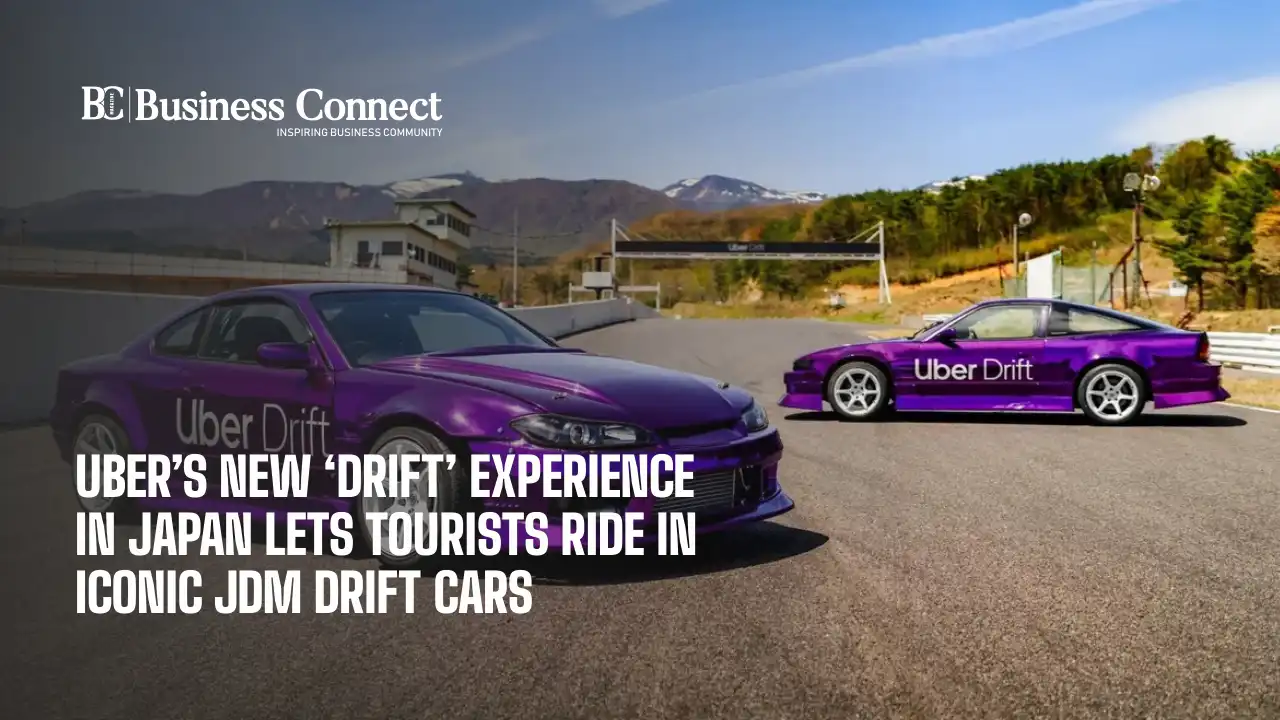
The package is priced at ¥30,000/- per group, the accommodation capacity is 1-4 persons and daily the package is available for largest 4 groups only. Reflecting top-class hospitality, it features high quality, one-way round-trip transport from anywhere in the 23 wards of Tokyo, a few minutes spent at Mobara Twin Circuit, trailed by some fast-hat-tail Formula Drift riders and tuned Nissan Silvia S15 and Nissan 180SX cars.
Drift culture has long existed on an unusual place in the global imagination as far Japan is concerned. Highly romanticised, and very technical. Over the years, it was seen in grainy videos, tuning magazines, racer games, Anime, cinema and the legend of late night mountain roads. The cars evolved from symbols or vehicles into longing objects – more than machines, but shorthand for a form of disciplined rebellion.
The Nissan Silvia S15 and 180SX can’t be merely random. They are remembered for their memory, status and credibility of the era among collectors and fans, which is few can duplicate in modern performance cars.
The business sense of Uber is to monetize this myth into a mined business deal. Uber’s business logic is to cash the myth out on a deal. To be a good tourist, it is not necessary to know the local circuits or obligations on bikes and when they accept the blame when they are off the road. A tourist does not have to understand local circuits, language barriers, liability norms or informal Japanese bicycle etiquette, etc.
The app works to soak up the uncertainty. Resharing the risk to the circuit. The law provides respect, ins that is the validation of the professional driver. The typical Uber UI gives it an air of normality that somewhat jars with its unmissed diversity and excitement.
But it is here where it gets interesting business. A considerable increase in tourists from Asia, particularly Japan, has triggered an inbound tourism market that isn’t just interested in “spotting” but in experiencing and fully enjoying the city. In 2025, the value of money spent by visitors reached an all-time high of ¥9.4559 trillion, reflecting how much people ate and drink as well as how many visitors they saw.
People travelling aren’t just paying for hotel accommodation, train tickets and meals in the restaurants. Instead, they spend their money to get close to something that they can’t access: a counter seat, a workshop with no one else, a local craft, an underground show or a fringe culture that’s just enough scraggily to be authentic.
Uber Drift is right in the middle of that change. It falls in the same greater trend as all commercial travel moving in the direction of experience and all displays being pushed aside. The wealthy traveler desires less/less universal signs of privilege, and more access proof. 5-star lobby is not sufficient any more. A story matters.
A sense memory is important! Getting to see a little bit of local culture in a believable way, relevant to the area, and documenting the What, How and Where details without the assumption of “whole thing” is very much welcome, even if you can get photographs taken of it, tell about it, and it’s socially established as real, not staged.
At least in part, it’s a manufactured thing, though. That stress must not be disregarded. Drift culture has not grown up as a tourist attraction. It has its origins in experimentation, risk, mechanical intimacy and some margins from the mainstream respectability. It is important to package it so it fits nicely into a global platform’s campaign before it is domesticated. Some purists may look at Uber Drift as a slicked-over simulacrum, a car culture without any of the inconveniences. Well, she may have a point.
Throughout history when subcultures begin to pick up symbols from them it became possible to find them in commerce. It’s been a road trodden by streetwear, skate, specialty coffee, electronic music and even regional food tradition. The question is whether or not it is inescapable commercialisation that will change the culture. The more important question is not whether the commercial layer brings new content, but whether it brings new audiences and new security – and not audience erosion and security voids.
It seems Uber does at least the first part of that equation. In short- the inventory is limited, an explanation. 4 groups a day does not refer to the mean of a platform. It’s a state of shortness and lack, intentionally created. If the programme is used it could still be very economical; it costs $30,000 per group, with full utilization of the programme it would cost a company the size of Uber nothing.
The magic is in its brand heat, the coverage it gets, the positioning of the city, the lesson learning the stakeholders learn, and the fact that you can’t say if mobility platforms are good at being the trusted curator of local experiences, but it is clear that this is what they are.
Uber Drift’s more than just a marketing hack. It gives Uber a chance to define itself as a local versus imported competitor. Offering Japanese rumble service for travellers in a managed, high-quality way, Uber can gain the benefit of the cultural aspect from the Japanese perspective while maintaining its own functional attributes: logistics, payment, route planning, guaranteed booking and usage without having to understand the Japanese language.
A policy frame dimension also runs underneath this, for wider tourism policy. The number of visitors in Japan is in abundance but it’s focused. Far too much gets talked about/written about in the same districts, the same temples, the same crossings, the same season festivities.
Value allocation experiences connected to circuits, workshops, rural areas or niche communities could be useful for the better distribution of value, but it’s premature to overestimate the potential of a month-long drift product. Mobara Twin Circuit is not yet out of the blue a solution of the national tourism problem.
Yet it’s a glimpse into a more fine-grained direction for travel commerce: niches with genuine passion that can be used as demand hubs with myriad lower discovery and transaction rubes.
The risk, of course, is that platforms can turn into wanna-be curators. All cultural practices should not be turned into a tile for use in the app. Globalization doesn’t do the same for all local areas. The greatest experiences do not need to be packaged, rather they must be held back.
The line could be even thinner in the world of motorsports. Excessive sanitising makes it a show; it sucks the necessary pulse from the product. Any less control and it becomes too risky as a business venture. Uber’s use of licensed professionals and a private network of vehicles, therefore, isn’t only a safety aspect, but an integral part of the proposition.
The lesson for others who are attempting to create a consumer platform is an important one. The next level of differentiation might not be an increase in categories but gaining entry to intermediate something else. This permission is not guaranteed. It hinges on the consumers’ belief that the platform does not take advantage of their naivety and reduce the value of what is behind it.
Most people who competed Uber Drift will likely remember the experience simply by the word ‘smoke’. Among most of those who’ve taken part in Uber Drift, it will be easiest to remember the word ‘smoke’. Its version of a memory that it wants to evoke from such an Uber experience is something altogether unique. It desires a customer to equate the app not just with convenience, however access.
It’s a light twist on a central theme and, as such, it could prove to be a some-what superior theme. The beginning of Mobility was the issue of distance. It is a business based on context, which is even more apposite these days.
The wins may be for businesses that only do efficient transportation rather than comprehending what it is the people want to be connected to. In Japan, Uber is taking a chance at reaching — reaching — an already existing subculture in its imagination.