
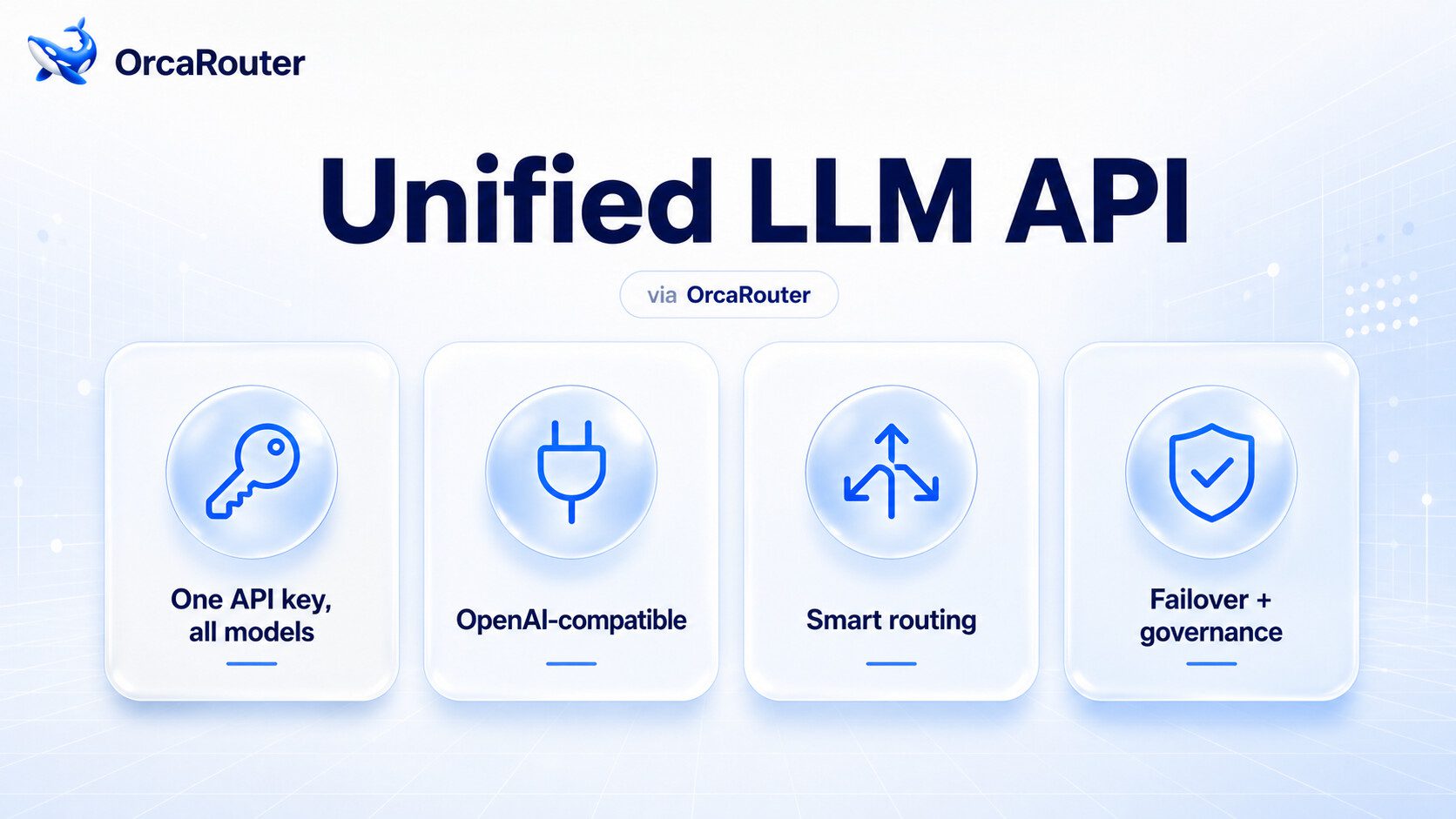
A unified LLM API solves a boring but expensive problem: every model provider has its own SDK, key, request format and rate limits, and wiring up each one — then rewiring when you switch — burns real engineering time. A unified LLM API collapses that to one integration: one key, one OpenAI-compatible format, every model.
One option worth knowing is OrcaRouter, which exposes 200+ models through a single OpenAI-compatible unified LLM API with no token markup. Here’s how to think it through.
TL;DR — A unified LLM API lets your app reach many models through one endpoint. What separates the good ones: token markup, model breadth, routing, failover and governance. OrcaRouter’s angle is zero markup, cost/quality/adaptive routing across 200+ models, sub-50ms failover and built-in guardrails — behind one OpenAI-compatible endpoint.
Why one API beats many integrations
The immediate win is developer time: add or swap a model with a string change instead of a new integration. The second win is flexibility — you’re never locked to one provider’s availability or pricing.
The best unified LLM APIs go further, adding cost-based routing, automatic failover and governance so that “one endpoint” also means cheaper, more reliable and safer — not just more convenient.
What to look for
Not every “unified” API is equal — judge candidates on:
- Pricing: does it pass through provider rates, or add a per-token markup? Zero markup is cleanest.
- Model breadth: one endpoint should reach the frontier and open-weight models you use.
- Routing: route by cost, by quality, or adaptively — not one black-box mode.
- Reliability: automatic failover across providers before the response starts.
- Observability: per-call cost, model and latency you can see and export.
- Governance: PII redaction, guardrails and SOC 2 / GDPR / HIPAA if you handle real data.
The short version: a unified LLM API should give you one key for every model, with no markup and no lock-in.
Pricing
The model is “routing is free, pay for features.” Hacker is free forever with zero markup; Team is $499/month; Enterprise is custom. No token markup on any tier.
| Tier | Price | What you get |
| Hacker | Free | Routing across 200+ models, auto-failover, 0% markup |
| Team | $499 / mo | Seats, compliance enforcement & reports, priority support |
| Enterprise | Custom | Private deployment, 99.99% SLA, dedicated support |
How to get started
Because it’s OpenAI-compatible, adoption is a base-URL change — no rewrite:
| from openai import OpenAI
client = OpenAI( base_url=”https://api.orcarouter.ai/v1″, api_key=”$ORCAROUTER_API_KEY”, )
response = client.chat.completions.create( model=”orcarouter/auto”, # or any of 200+ model ids messages=[{“role”: “user”, “content”: “Hello”}], ) print(response.choices[0].message.content) |
Keep your existing OpenAI SDK, LangChain or LlamaIndex code, and point tools like Cursor or Cline at the same endpoint. More at OrcaRouter.
Putting it into production
The fastest way to evaluate a candidate endpoint is to wire it into one real workload and watch three numbers: cost per completed task, error rate, and latency. Point your existing OpenAI client at it, run a day of representative traffic, and compare against what you pay and get today. Because nothing but the base URL changes, the test costs almost no engineering time.
From there, let routing do the heavy lifting: send routine requests to a cheaper model and escalate only the hard ones, so your average cost drops without your quality following it down. Add caching for repeated context — system prompts, long documents, tool definitions — and the bill falls again. Most teams find the biggest savings come not from switching models by hand, but from letting the endpoint pick the right one automatically.
One more habit: keep a small evaluation set of your own real prompts and re-run it whenever you consider a new model. Public benchmarks are a starting point, not a verdict — the only scores that matter are the ones on your tasks. With a standard endpoint, testing a challenger is as simple as changing the model string and re-running the set, so there’s little reason to guess.
Common mistakes to avoid
The first mistake is optimizing for sticker price alone. A model that looks cheap can cost more per finished task if it needs several retries, and a marked-up gateway erases the saving even when the model itself is cheap. Always compare the all-in cost of a completed task, not the headline per-token rate.
The second is hard-wiring your stack to a single provider. Model quality and pricing move every few weeks, and an integration you can’t easily swap turns every change into a migration. Keeping everything behind one OpenAI-compatible endpoint means adopting a newer or cheaper model is a one-line change, not a project — which is the whole point of routing through one API.
Who benefits most
This approach pays off most for teams running more than one model, or planning to: product teams shipping AI features, developers building coding or research agents, and anyone with high-volume pipelines where cost and reliability compound. If you only ever call a single model and never intend to switch, going direct to that provider is fine — the value of one endpoint shows up the moment a second model enters the picture.
FAQ
Why does OpenRouter (or a similar gateway) get so expensive at scale?
Two costs developers flag over and over in the threads: a markup or a cut skimmed off every top-up, and provider-switching that lands requests on endpoints with poor cache hits — so you pay the full uncached rate. People report the same task costing several dollars on a marked-up gateway versus cents going direct. A zero-markup endpoint that keeps routing consistent removes both.
Why do my prompt-cache hits collapse through an aggregator?
Cache is per-provider, and many aggregators rotate you across providers to balance load — every switch is a cache miss at full price. The fix people settle on is to pin providers (or use an endpoint that doesn’t silently reshuffle you) so your cache discount actually sticks, and to prefer models with a large cache discount (DeepSeek’s is around 90%).
Should I just integrate the vendor directly instead?
Going direct avoids gateway fees, which is why some developers do it — but you give up one key, automatic failover and routing, and you re-integrate for every new model. A zero-markup endpoint gets you the vendor’s real per-token price plus the convenience, so it isn’t an either/or.
What actually makes one option cheaper than another?
Not the sticker price. It’s three things: no markup on top of provider rates, cache behavior that preserves your discounts, and routing each request to the cheapest model that still clears your quality bar. Get those right and the same workload costs a fraction of a flagship-only, marked-up setup.
Do I have to change my code to switch?
No — if it’s OpenAI-compatible you change the base URL and keep your existing SDK, framework and tooling; switching models is just a different model string. That’s why developers test a new endpoint by pointing a slice of traffic at it and comparing cost per task before committing.