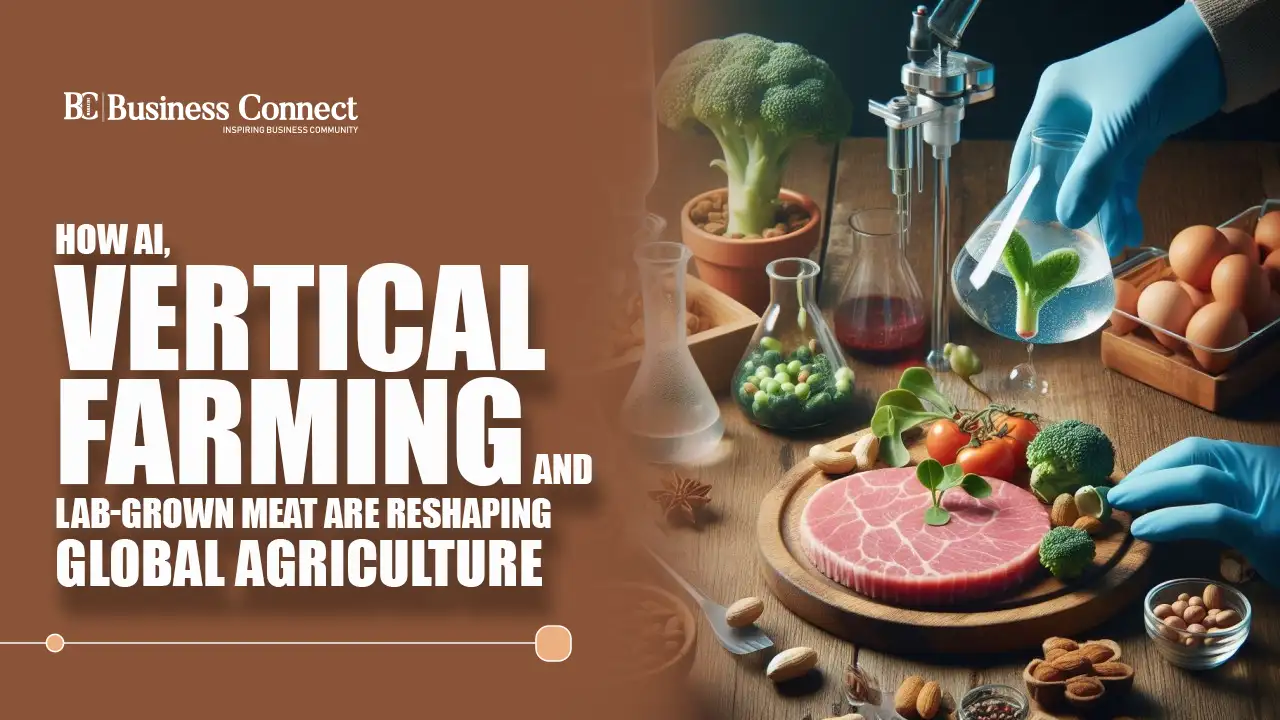
How AI, Vertical Farming and Lab-Grown Meat Are Reshaping Global Agriculture
The agriculture sector, one of the oldest human pursuits, has been undergoing drastic changes over the years. Agriculture came into existence as a labour-intensive activity; today, it has evolved into a sophisticated industry. With the latest tech advancements, sustainability initiatives, and evolving global demands, agriculture is taking a new shape and is transforming how we produce food, manage resources, and address barriers.
As per the UN, the global population is expected to cross USD 9.8 billion by 2050; hence, the pressure to produce more food will increase. The latest trends in agriculture are focused on meeting this demand with limited resources. In this blog, we will discuss AI, Vertical farming and lab-grown meat, three of the latest concepts and how they are revolutionising the agriculture industry.
Three Latest Trends in Agriculture
Artificial Intelligence
AI has emerged as the most valuable tool in today’s era. In agriculture, AI holds great significance apart from applications like autonomous tractors and harvesting robots. For vertical farming, AI tools help in analysing plant health, changing light spectrums, nutrient delivery, and environmental conditions. AI also help in reducing water usage by 95%.
In traditional farming, AI-powered predictive analytics tools help in planting, fertilising, and harvesting. Machine learning algorithms analyse satellite imagery, weather patterns, soil conditions, and historical data to generate farm-specific suggestions for boosting production while minimising environmental impact.
Lab-grown Meat
Lab-grown meat, also known as cultured or cultivated meat, is made in a laboratory with animal cells instead of animal husbandry. To grow this meat, researchers take a little sample of animal cells, then grow these cells in a highly nutritious solution similar to what an animal eats. The cells grow and become muscle tissue, the part of the meat people eat. Large tanks are used for this process in a controlled environment with temperature, nutrients, and hygiene.
This kind of meat is less farmed but looks the same as regular meat in appearance, flavour, and cooking method. This trend has become common these days; it not only reduces animal killing but also helps in conserving water and land and cuts greenhouse gas emissions.
Vertical Farming
Vertical farming is one of the major growing trends in agriculture. The concept of vertical farming came into the picture to reduce water waste. Under it, crops are grown in stacked layers indoors to tackle the scarcity and urbanisation problems. This agricultural trend makes it possible to use 90% less water. Plus, the vertical farming market is expected to grow at a solid pace, with top innovators and people’s increasing desire to produce their vegetables in urban settings. People use LED lights and sensors in place of sunlight to continuously develop crops free from pests and inclement weather. Just like lab-grown meat, vertical farming is also sustainable, as it lets people in cities get fresh food.
Bottom Line
AI, vertical farming and lab-grown meat are the top trends that are reshaping global agriculture. In the near future, the integration of these tech solutions with renewable energy sources presents a complete path for more sustainable agriculture. AI-driven tools, lab farming, and vertical farming are innovative ways to facilitate this future. These advancements, with revolutions in renewable energy and battery storage, make it possible for vertical and robotic farms to operate on clean energy.
Frequently Asked Questions
How is AI used in vertical farming?
AI in vertical farming is used to manage and optimise major tasks like climate control, crop monitoring, energy use, and production planning. By processing real-time data, AI systems enable farms to evolve their conditions continuously instead of flying on fixed schedules or with manual intervention.
Is AI replacing farmers?
No. Farmers make many major decisions daily, from the season to crop rotation to market timing to conservation practices. AI can analyse data and also help in automating certain tasks, but it can’t completely replace farms and the real-world judgement that comes from years of experience on the land.
Is lab-grown meat safe to eat?
Yes, lab-grown meat is completely safe to eat and has passed rigorous testing by food safety authorities like FAS.
Add Business Connect magazine to your Google News feed