
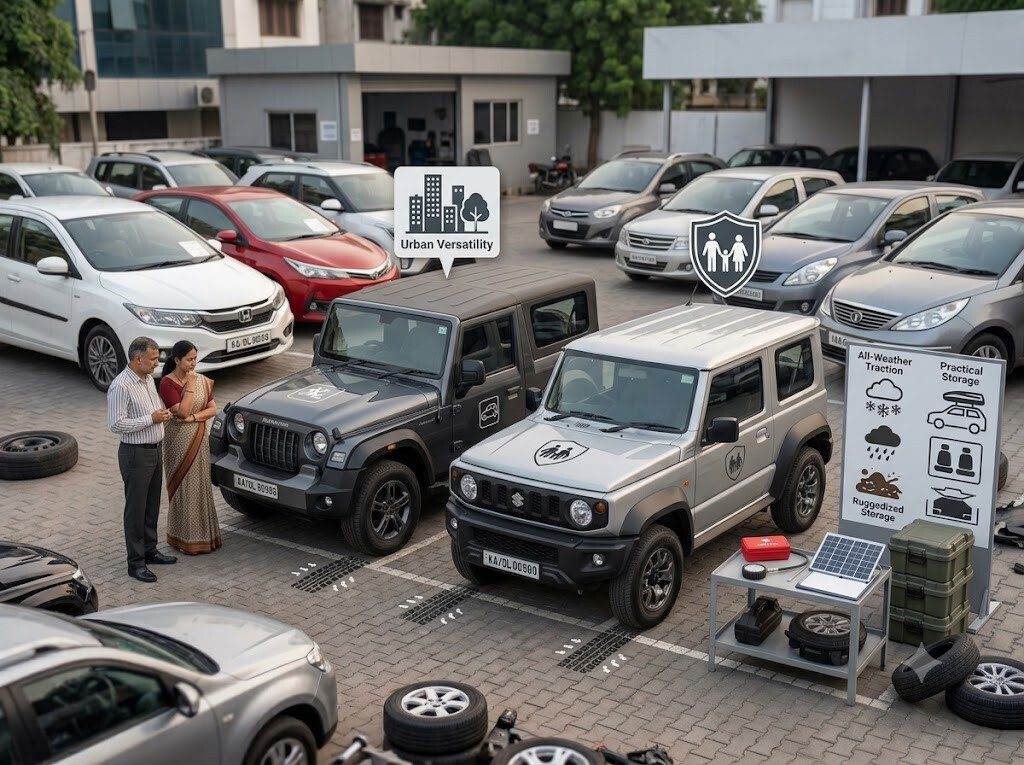
The image of a 4×4 vehicle has shifted. What started as a niche purchase for trail runners and hardcore adventure seekers now sits comfortably in suburban driveways, school drop-off queues, and city parking lots. Buyers who’ll never cross a river or climb a rocky incline are choosing four-wheel-drive systems for entirely different reasons, and that trend isn’t reversing anytime soon.
How 4×4 systems actually work for everyday driving
Most buyers assume four-wheel drive only matters when tyres lose grip on mud or sand. That’s only half the story. A 4×4 system distributes engine torque across all four wheels rather than just two, which improves traction in conditions that have nothing to do with off-roading.
Heavy monsoon downpours, waterlogged urban roads, gravel patches near construction zones, even steep multi-storey parking ramps all benefit from that extra mechanical grip in ways you don’t fully appreciate until you need it.
Modern 4×4 setups fall into three broad categories: part-time, full-time, and automatic (often marketed as AWD). Part-time systems let drivers manually engage four-wheel drive when needed, running in two-wheel drive otherwise, which saves fuel during normal commutes. Full-time keeps all four wheels powered continuously, adjusting torque distribution on the fly. Automatic systems detect wheel slip and redirect power without any driver input. No thought required.
For anyone exploring the best used 4X4 cars available today, understanding which system fits your daily habits matters more than chasing raw capability specs.
The fuel economy penalty, often cited as the biggest knock against 4x4s, has narrowed significantly with newer drivetrains. Older systems added meaningfully to consumption figures. Current-generation systems, particularly those with disconnect features that decouple the second axle at highway speeds, carry only a fraction of that older penalty.
Weigh that against the real-world safety and control benefits most owners actually notice first, and it starts looking like a reasonable trade.
The safety argument that changed buyer priorities
| Factor | 2WD Vehicle | 4×4/AWD Vehicle |
| Wet road traction | Front or rear axle only | Distributed across all four wheels |
| Stability on loose surfaces | Higher correction needed | More predictable grip |
| Hill-start confidence | Depends on traction control | Mechanical advantage at all wheels |
| Resale retention (3-year average) | Standard depreciation curve | Tends to hold value longer |
Safety, not adventure, is now the primary purchase motivator for 4×4 buyers in metro and tier-two cities alike. Families running long highway commutes, particularly on poorly maintained state highways, report noticeably better composure from vehicles with all-wheel traction during emergency braking on uneven surfaces.
The part nobody tells you is how quickly that feeling becomes something you can’t imagine giving up.
Anecdotally, drivers who switch to 4×4 vehicles report greater confidence in loss-of-control situations compared to their previous two-wheel-drive cars. Driver behaviour is still the dominant variable, always will be. But the mechanical advantage of four driven wheels during a sudden lane change on a rain-slicked highway is not something you replicate with driver skill alone.
Which segments are driving this shift
Compact and mid-size SUVs have done the heavy lifting here. Mahindra, Maruti Suzuki, and Hyundai now offer 4×4 or AWD options across a wider price band than they ever have. Mahindra, in particular, has built a reputation around capable drivetrains at accessible price points.
Buyers searching for second hand Mahindra cars often find that even older Scorpio and Thar variants hold their mechanical durability well into six-figure odometer readings, which makes them unusually attractive in the pre-owned market.
A growing share of 4×4 purchases, based on 2024-25 market patterns, comes from first-time SUV buyers upgrading out of sedans or hatchbacks. These aren’t enthusiasts planning Ladakh road trips. They’re professionals who want a vehicle that handles Bangalore’s unpredictable monsoon rains, Pune’s hillside roads, or the Delhi-Jaipur highway stretch with equal confidence.
The trade-offs worth knowing
No drivetrain is without its costs. Real ones. 4×4 vehicles carry more mechanical components, which translates directly to higher servicing expenses over time. Transfer cases, additional driveshafts, and differential units all need periodic attention, and running costs will sit noticeably above equivalent 2WD models before you even factor in tyre expenses.
Ground clearance, typically bundled with 4×4 variants, raises the centre of gravity. That can make some SUVs feel less planted during sharp cornering at speed, something you’ll notice immediately if you’re coming from a lower sedan. First-time SUV owners regularly get caught off guard by this on their first long highway run.
Tyre replacement costs also run higher, since many 4×4 variants ship with larger, more specialised rubber that doesn’t have budget-friendly alternatives.
Still, the direction is clear. As road conditions stay unpredictable and awareness around vehicle stability grows, four-wheel-drive systems are quietly becoming a mainstream expectation rather than a specialist upgrade.