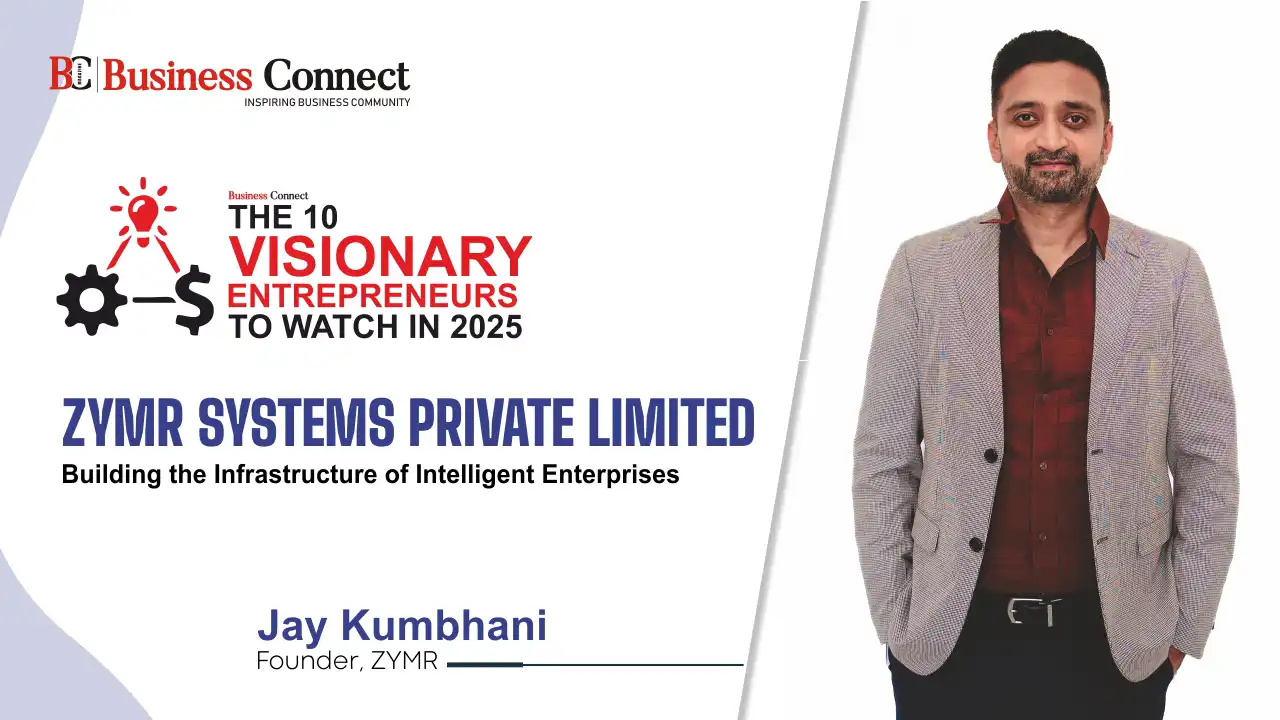
“The next decade will belong to organizations that build AI responsibly and securely. Our goal is to be the engineering partner that helps them do exactly that.” -Jay Kumbhani, Founder, ZYMR
In the modern-day business boardrooms, AI is spoken about with urgency. In investor decks, it appears in bold fonts. In product roadmaps, it often shows up as a ‘Phase Two’ enhancement. But in reality, most AI systems are sitting on foundations that were never meant to carry their weight. That is the quiet crisis no one likes to admit. And that is precisely where ZYMR built its identity.
At ZYMR, intelligence is not a feature toggle. It is structural. The company describes itself as an AI-native product engineering firm. Not because it sounds progressive, but because it reflects how their platforms are designed from the ground up. For over a decade, ZYMR has engineered secure, cloud-native systems across cybersecurity, financial services, healthcare, retail, and AI infrastructure.
They work in environments where a single architectural oversight can cost millions, or compromise trust. And trust, in regulated industries, is currency. While many organizations experiment with AI layers on top of legacy systems, ZYMR builds the data pipelines, governance frameworks, model observability systems, compliance engines, and zero-trust security layers that make AI sustainable in the real world. It’s slower work, harder work and lasts longer.
Jay Kumbhani, Founder & VP of Engineering, shed light on some of the lesser known facts about the company and its future projections too in an exclusive one-on-one conversation with our team.
The genesis story
ZYMR was founded on 12/12/12 which is a date almost poetic in its symmetry. But, what mattered more than the date was the timing. Cloud computing was exploding. Enterprises were racing toward modernization. Startups were being born cloud-first. The industry was intoxicated by speed.
However, speed also created fragility. Systems were being built fast, but not always built well. Scalability was assumed. Governance was postponed. Security was treated as a future problem. When AI began entering the conversation, it was often placed onto platforms never designed to evolve. The founder is shaped by his MS in Computer Science and influenced by Silicon Valley’s engineering discipline, carrying a different lens.
In that ecosystem, long-term thinking is survival. Architecture matters. Technical debt compounds. The founding question was simple but radical: What if intelligence was embedded from day one, instead of retrofitted later? That question still echoes through every platform they build.
Complexity Is Not the Enemy
Ten years ago, cloud adoption dominated the conversation. Today, AI readiness does. Organizations are no longer asking whether to adopt AI. They are asking how to deploy it safely, compliantly, and at scale. The stakes are higher now. Data volumes are massive. Cyber threats are relentless. Regulations are tightening globally. Ironically, this rising complexity has not intimidated ZYMR, but has validated them.
Because they were already engineering for regulated environments. Already building for banking, healthcare, and cybersecurity. Already thinking about model lineage, policy enforcement, multi-cloud observability, and zero-trust frameworks long before those terms became boardroom buzzwords. When the industry shifted toward AI urgency, ZYMR did not pivot but simply continued what it was meant to do.
Leadership philosophy
Jay explained that one of the most understated challenges in this domain is architectural shorttermism. Organizations want quick AI wins. Pilot launches. Demo-ready dashboards.
But few want to invest in foundational layers, clean data systems, governance models, compliance frameworks, observability stacks.
Weak foundations make for impressive demos. They also make for fragile production systems. Leadership at ZYMR often requires saying no. Not to innovation, but to recklessness. It means guiding clients toward long-term architecture decisions instead of shortterm optics. It means nurturing talent capable of blending cloud engineering, security, ML operations, and domain intelligence into one coherent system. Leadership here is less about charisma and more about vision, restraint and alignment.
Ownership Over Outsourcing
Operationally, ZYMR avoids transactional engagement. Instead, they operate largely through a dedicated FTE model, stable engineering teams aligned closely with client roadmaps. The same engineers stay with the platform. They grow with it. They challenge it. They defend it. This continuity builds institutional knowledge, something no short-term project cycle can replicate.
Engineers are encouraged to think like product owners. To question assumptions. To propose architectural improvements. To stay accountable not just for code delivery, but system outcomes. It is partnership, not outsourcing.
Research as Responsibility
In an AI-driven world, stagnation is quite a failure. ZYMR’s R&D culture reflects that understanding. Dedicated internal teams continuously experiment across cloud automation, governance architectures, security layers, and intelligent orchestration. From this ecosystem emerged ZOEY, an AI-native orchestration engine for managing agentic AI systems, and ZAIQA, an AI-powered test automation platform designed to transform quality engineering.
But what matters is not the product names. What matters is the mindset. R&D here is not trend-chasing. It is readiness-building.
Recognition worth many glances
Over the years, the industry has taken notice. From early ecosystem recognitions to consecutive Gold and Bronze Stevie® Awards in 2024 and 2025 for financial AI/ML excellence, the milestones reflect steady credibility. The company has served 150+ global clients. Built over 70 production platforms. Expanded across North America and Europe. But when you speak to the leadership, awards are not the headline.
Endurance is. Repeat clients. Long-term engagements. Platforms still standing years later. In a world addicted to disruption, ZYMR measures success in durability.
Intelligence With Accountability
Talking about the future prospects, the company is deepening its AI-native engineering capabilities, especially in data engineering, MLOps, AI governance, and secure multi-cloud infrastructure. Expansion across North America and Europe continues. Domain depth in fintech, cybersecurity, and healthcare remains central.
A $100 million revenue target over the next five years is in sight. Yet internally, revenue is framed differently. It is a result, not a mission. The mission is architectural impact. Because the next decade will not belong to companies that experiment with AI casually. It will belong to those who build it responsibly. Securely. Compliantly. Intelligently. And perhaps most importantly, patiently. In a market that celebrates speed, ZYMR is building for sustainability. Not flashy. Not loud. But structurally prepared for whatever intelligence demands next.