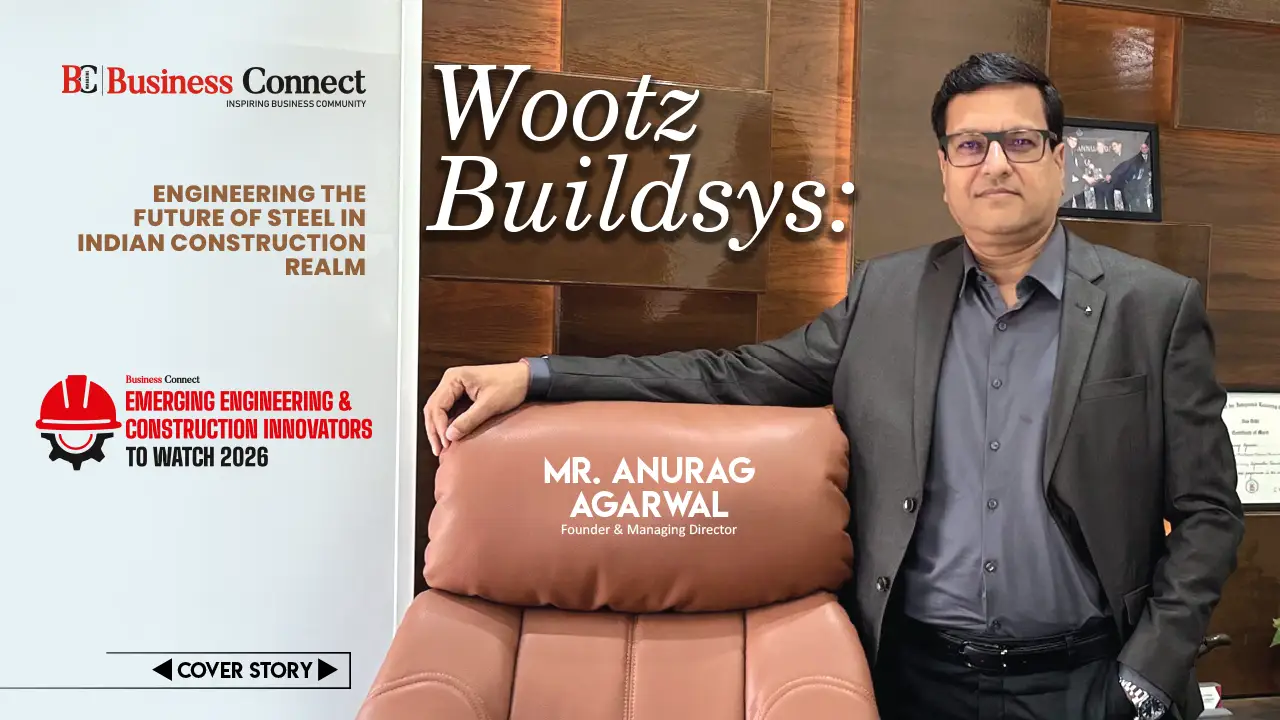
India is in the middle of an infrastructure century. From highspeed rail corridors and convention centers to defense complexes, hospitals, logistics parks and educational campuses the pace is no longer gradual. It is compressed. Timelines are shrinking. Capital efficiency is under scrutiny. Sustainability is not optional and structural reliability, especially in seismic and climate-sensitive zones, has become non-negotiable.
Now, construction is no longer a purely civil activity. It is an engineering strategy. In this context, Wootz Buildsys has positioned itself precisely at that intersection, where steel becomes not just a building material, but a method of thinking.
Operating across more than 20 states and 30 cities with over 200 executed projects, the company has emerged as one of India’s serious specialists in PreEngineered Buildings (PEB), Light Gauge Steel Framing Systems (LGSF), hybrid structures, and prefabricated solutions. However, its significance lies less in scale and more in systems.
The Structural Shift India Is Undergoing
For decades, RCC (reinforced cement concrete) has defined mainstream construction. It is familiar, entrenched and predictable. But, predictability comes at a cost such as heavier foundations, longer curing times, limited flexibility for post-construction modifications, and slower project cycles.
As institutional and industrial clients began demanding faster commissioning, adaptable infrastructure, and better lifecycle economics, a quiet shift began. Steel structures became lighter, faster to assemble, structurally resilient, and easier to expand– moving from niche to necessity.
Wootz Buildsys recognized that transition early. Rather than competing in conventional contracting, the company focused on engineering-led steel systems designed under international standards such as AS/NZS4600 and IS codes, ensuring compliance across seismic, wind, and load-bearing parameters. In a country that spans multiple climatic and geological zones, that precision is not cosmetic, but is foundational.
Steel, when engineered correctly, doesn’t just reduce timelines—it redefines the economics of construction.
Meet the brain behind the organization
Behind Wootz Buildsys stands Anurag Agarwal—a professional architect and management graduate whose foundation was built not in spreadsheets, but in structure. With a demonstrated history of working in the architecture and planning industry, Mr Agarwal brings a rare hybrid perspective to construction leadership.
His understanding of spatial design, structural planning, and on-ground execution gives him a technical sensitivity that many purely commercial leaders lack. But what makes his leadership distinctive is not only design literacy, but commercial intelligence.
Over the years, he has developed strong capabilities in negotiation strategy, marketing management, business expansion, and sales operations, skills that are critical in an industry where margins are tight, projects are complex, and execution risk is high.
His transition into steel-based construction systems was not accidental, but strategic.
Having observed the inefficiencies of traditional construction cycles such as delays, cost overruns, design rigidity, Mr Agarwal recognized that the future would belong to engineered systems that combine architectural flexibility with operational speed. Under his leadership, Wootz Buildsys has grown not just through project acquisition, but through relationship architecture. Negotiation in his approach is not transactional, but a long-term alignment. Clients are not persuaded but are educated on structural advantages, lifecycle value, and risk mitigation.
Speed Without Compromise
Reducing construction time by up to 30% is commercially compelling. But speed without structural rigor is a liability. What differentiates Wootz is its process discipline. Every project follows a structured lifecycle: requirement analysis, solution architecture, detailed engineering, 3D modeling, manufacturing, erection, and monitored completion. The integration of complete drawing back-ups and assembly documentation introduces transparency rarely emphasized in mid-market construction ecosystems.
Clients are not merely handed a structure. They are handed a documented system. This approach has enabled the company to execute projects of national and institutional significance, from the India International Convention Center in Dwarka to defense infrastructure under the Central Vista development, from cancer care facilities in the Northeast to high-load industrial factories and stadium structures completed within compressed timelines. These are not cosmetic projects, but operational infrastructures.
Complexity As Proof Of Capability
Execution reveals the capacity of a business. At the India International Convention Center, Wootz delivered LGSF external walls with suspended spans reaching eight meters which are engineered for acoustic insulation, thermal regulation, and fire performance. In Himachal Pradesh’s terrain, hybrid structures for government institutions required seismic sensitivity and climatic adaptability. In industrial zones, factory buildings demanded 12-meter clear spans with high load capacities. Each project presented different engineering variables.
The company’s portfolio spanning residential multi-storey developments, hospitality collaborations, defense offices, educational campuses, railway offices, and tourism infrastructure demonstrates structural versatility without dilution of technical standards.
Clients including Tata Steel, Larsen & Toubro, Airports Authority of India, Delhi PWD, and Ahluwalia Contracts signal institutional validation. Such partnerships are rarely awarded on marketing claims. They are built on delivery.
Why Does Steel Now Make Strategic Sense?
India’s infrastructure growth story is not just about expansion. It is about efficiency. Steel structures offer lighter foundations, reducing material consumption. Prefabrication reduces on-site waste. Modular systems allow phased expansion. Integrated insulation improves energy performance. Seismic resilience enhances long-term safety. Fire-retardant materials align with regulatory mandates.
For CFOs and infrastructure planners, these are not technical footnotes but are capital considerations. The conversation is shifting from “How do we build?” to “How intelligently can we build?” Wootz operates within that more evolved question.
Engineering From The Edges, Not The Center
An understated dimension of the company’s narrative is geography. Operating outside India’s largest metropolitan construction hubs, Wootz demonstrates that engineering excellence is no longer urban-exclusive. By building technical capacity and employment ecosystems beyond Tier-1 cities, it contributes quietly to decentralizing industrial expertise.
This geographic positioning also allows operational cost discipline which is a strategic advantage in an industry often challenged by margin volatility. It reflects a broader truth about modern India: innovation is no longer geographically predictable.
Sustainability As Structural Responsibility
Steel’s recyclability and reduced site waste give it inherent sustainability advantages. But responsible construction extends beyond material choice. Lifecycle durability, energy efficiency, and regulatory alignment increasingly define future-ready infrastructure. As ESG frameworks become embedded in procurement policies, especially for public and multinational projects, structural choices will face deeper scrutiny.
Companies that combine compliance with performance will dominate. Wootz appears to be aligning itself not only with present demand but with future regulatory and environmental expectations.
The Human Layer Behind Engineering
At its core, construction is still about trust. Bad data in construction can delay operations. Here, poor engineering can compromise safety, misaligned timelines can destabilize budgets. The philosophy guiding Wootz seems rooted in preventing those slow structural leaks before they occur.
The emphasis on validation, documentation, and process integrity suggests an awareness that trust compounds over time, and once broken, is nearly impossible to rebuild. In an industry often driven by aggressive bidding and reactive problem-solving, that restraint is notable.
The Road Ahead
India’s infrastructure trajectory shows no sign of slowing. Defense expansion, logistics corridors, institutional campuses, renewable energy facilities, and urban redevelopment projects will demand faster, smarter, and more adaptive construction methodologies. Steel systems, particularly LGSF and hybrid models, are poised to move from alternative to mainstream.
The companies that will lead this evolution will not be those chasing scale at the expense of depth, but those that refine systems, strengthen verification, integrate digital modeling, and protect structural integrity at every layer.
Wootz Buildsys appears to understand this balance. It is not attempting to outsize the market. It is engineering its way into relevance—and in an infrastructure century where precision may matter more than speed alone, that strategy may prove to be its strongest foundation.