
In today’s global wellness economy, the word “natural” alone no longer guarantees trust. Across nutraceutical, pharmaceutical, food & beverage, and personal care industries, buyers increasingly demand far more rigorous standards: scientific validation, traceable sourcing, regulatory compliance, and manufacturing precision.
largely commodity-driven, now operates under intense scrutiny. Concerns around adulteration, batch inconsistency, sustainability claims, and regulatory transparency have fundamentally reshaped procurement strategies worldwide. Multinational brands are no longer simply purchasing botanical extracts; they are investing in longterm partners capable of delivering reproducible science at industrial scale.
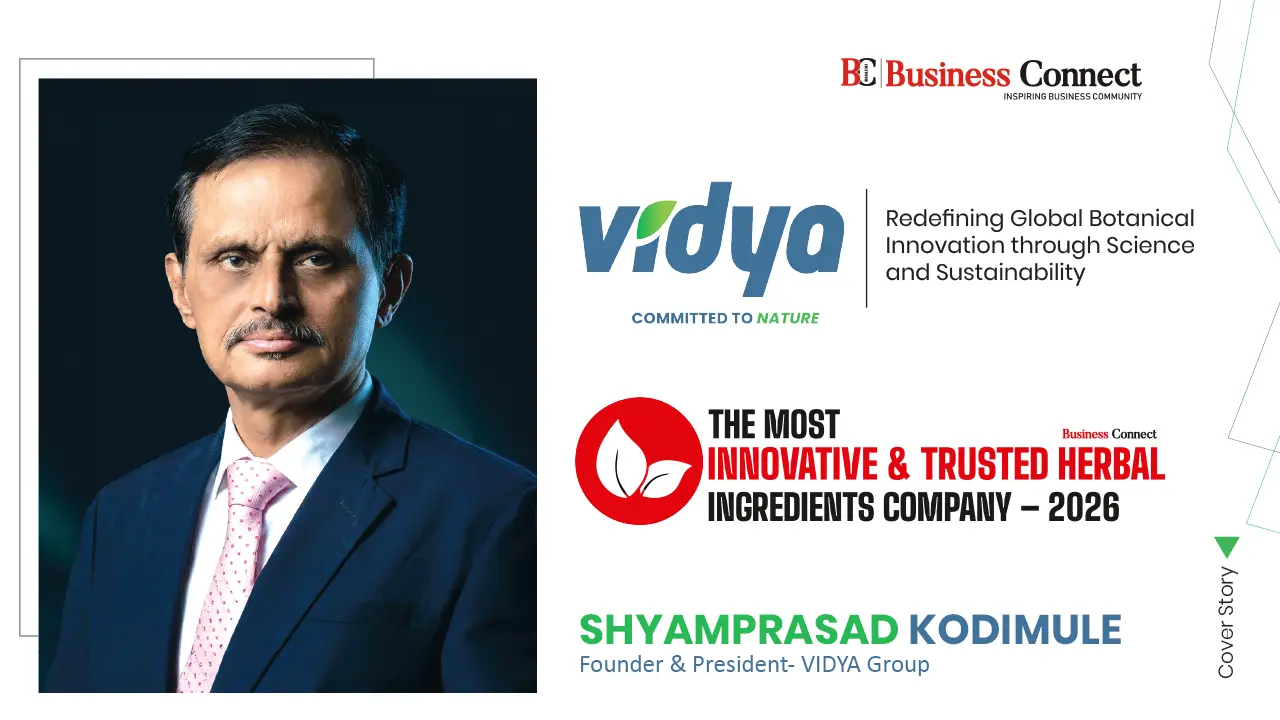
It is within this transformed landscape that Vidya Herbs Private Limited has emerged as a defining force, earning recognition as “The Most Innovative & Trusted Herbal Ingredients Company – 2026.” This recognition is not rooted in marketing language or rapid expansion. It reflects over two decades of disciplined investment in scientific infrastructure, vertically integrated manufacturing, sustainable sourcing ecosystems, and global compliance systems that convert traditional botanical knowledge into measurable, validated ingredients.
Founded in 1999 in Bengaluru by Shyamprasad Kodimule, Vidya Herbs was built on a singular belief: that the intelligence of plants can create global impact only when supported by uncompromising science, manufacturing discipline, and ethical responsibility.
More than 25 years later, that philosophy has evolved into a multinational manufacturing network employing over 1,000 professionals across 15+ manufacturing units, supported by commercial presence in eight global locations. Yet the company’s growth story is not defined by scale alone. It is defined by structure.
Engineering Innovation Beyond Extraction
Innovation in this industry is often misunderstood. It is frequently reduced to discovering new plant sources or launching new ingredients. Vidya Herbs approaches innovation as a systems-level discipline. At its core, innovation at Vidya begins long before extraction. It starts at the sourcing ecosystem.
Through long-standing partnerships with farming communities, the company has built traceable, resilient supply chains that emphasise biodiversity conservation, regenerative agriculture, and reduced chemical inputs. This agricultural alignment ensures not only quality raw material availability but also environmental continuity, an increasingly critical factor in global ingredient procurement.
Vidya Herbs has invested heavily in advanced analytical and validation infrastructure. Its laboratories operate with technologies such as HPLC, GC-MS/MS, ICPMS, FTIR, and long-term stability testing systems. These capabilities are not symbolic. They enable batchlevel consistency, contaminant detection, heavy metal analysis, active compound standardisation, and shelf-life validation, essential requirements for pharmaceuticalgrade, export-compliant ingredients.
Leadership in supercritical fluid extraction (SCFE) further distinguishes the company. This advanced extraction method allows production of solvent-free, high-purity botanical extracts while preserving sensitive bioactive compounds. As regulatory authorities tighten solvent residue norms globally, such technologies provide Vidya Herbs with a structural competitive advantage.
Patented processes and proprietary technologies reinforce its R&D depth. Clinical research collaborations strengthen ingredient validation. The result is a portfolio that bridges ancient botanical intelligence with contemporary scientific credibility. Innovation, in this context, is not episodic. It is embedded across the value chain.
Coffee as a Flagship Growth Engine
While Vidya Herbs built its global credibility through botanical science, it is coffee that has emerged as one of the company’s most powerful industrial statements. In 2014, Vidya entered the coffee sector not as a trader, but as an integrated processor. What began in the coffee-growing region of Chikmagalur as green bean exports has evolved into one of India’s most structured and scalable coffee operations.
Today, Vidya Coffee ranks as India’s fourth-largest coffee producer-exporter, a position earned through manufacturing depth rather than market opportunism. The company processes approximately 20,000 tonnes annually in India, supported by an additional 5,000 tonnes at its Uganda facility. The Belur manufacturing unit in Karnataka has added 40,000 tonnes of processing capacity while generating more than 500 direct jobs.
This scale is not incidental. It reflects a deliberate strategy to control the entire value chain from sourcing and curing to roasting, instant coffee production, and global exports.
Unlike many coffee exporters operating in fragmented supply systems, Vidya has built vertical integration into its model. Advanced processing capabilities, quality profiling, and customisation allow the company to cater to global F&B and FMCG brands seeking consistency, sensory precision, and regulatory assurance.
The focus extends beyond volume. Research-backed coffee profiling, processing optimisation, and stability validation have strengthened its positioning in From Commodity Supplier to Strategic Manufacturing Partner For decades, the global botanical ingredients industry operated largely as a fragmented supply ecosystem dominated by small-scale processors, inconsistent quality standards, and limited regulatory documentation.
Such fragmentation often created uncertainty for international brands seeking reliable, compliant ingredient partners. Vidya Herbs approached this challenge by building a manufacturing ecosystem designed to deliver both scale and accountability. By advancing extraction capabilities, robust quality assurance systems, and comprehensive regulatory documentation frameworks, the company has evolved beyond the role of a conventional ingredient exporter.
Its supercritical extraction facility in the United States further strengthens its presence in highly regulated markets, allowing the company to operate closer to global customers while meeting stringent compliance requirements. Supported by internationally recognised premium and customised beverage solutions. By combining agronomic understanding with technical processing expertise, Vidya Coffee operates at the intersection of agricultural heritage and industrial precision.
This integration aligns with broader global consumption trends. As functional beverages, ready-to-drink formats, and clean-label instant coffee solutions gain traction, manufacturers capable of delivering application-ready, scalable coffee ingredients are becoming strategic partners to international brands.
Vidya’s coffee vertical exemplifies this shift, moving beyond raw exports toward valueadded, globally compliant beverage solutions. For Founder & President, Shyamprasad Kodimule, coffee is not separate from the company’s botanical identity. It reflects the same core philosophy – disciplined sourcing, scientific processing and responsible scale.
From Commodity Supplier to Strategic Manufacturing Partner
For decades, the global botanical ingredients industry operated largely as a fragmented supply ecosystem dominated by small-scale processors, inconsistent quality standards, and limited regulatory documentation. Such fragmentation often created uncertainty for international brands seeking reliable, compliant ingredient partners.
Vidya Herbs approached this challenge by building a manufacturing ecosystem designed to deliver both scale and accountability. By advancing extraction capabilities, robust quality assurance systems, and comprehensive regulatory documentation frameworks, the company has evolved beyond the role of a conventional ingredient exporter.
Its supercritical extraction facility in the United States further strengthens its presence in highly regulated markets, allowing the company to operate closer to global customers while meeting stringent compliance requirements. Supported by internationally recognised
certifications and a strong regulatory infrastructure, Vidya Herbs today functions not merely as a supplier, but as a long-term manufacturing partner for nutraceutical and wellness brands across North America, Europe, and other regulated markets. This exemplary transition from commodity trading to structured ingredient manufacturing has become one of Vidya Herbs’ key defining competitive strengths.
Trust as an Institutional Outcome
In the global ingredients trade, trust cannot be claimed. It must be demonstrated, consistently, across years, regulatory cycles, and client relationships. Vidya Herbs’ trust capital has been built through sustained operational discipline. Long-standing multinational partnerships, repeat contracts, and diversified market presence reflect reliability that extends beyond pricing competitiveness. At the core of Vidya Herbs’ credibility lies an uncompromising commitment to purity.
In an industry where ‘natural’ claims are often diluted by synthetic additives and inconsistent processing practices, the company has built its reputation on delivering high-quality botanical ingredients entirely free from synthetic substitutions. This promise of authenticity has become a defining pillar of trust for global partners who rely on ingredient transparency and formulation integrity.
However, the company’s unwavering commitment to quality begins long before manufacturing. It originates within a carefully structured sourcing ecosystem where Vidya Herbs works directly with farming communities across cultivation regions, building long-term partnerships that emphasise sustainable harvesting, fair livelihoods, and responsible agricultural practices.
Local farming communities are integrated into a transparent value chain rather than treated as transactional suppliers. This model not only safeguards raw material quality but also strengthens rural economic resilience.
In this model, trust is cultivated through product purity, traceable sourcing, and tangible impact across the communities that sustain the botanical supply network.
Market Positioning in a Shifting Wellness Economy
The global shift toward preventive healthcare, functional nutrition, plant-based consumption, and personalised wellness has reshaped ingredient demand patterns. Consumers now seek clean-label transparency, clinically supported claims, and environmentally conscious sourcing.
Its positioning is clear – a research-driven, compliance-ready manufacturing partner operating at the intersection of botanical science and global wellness innovation. Unlike legacy suppliers dependent on fragmented sourcing and limited standardisation, VIDYA’s integrated infrastructure allows customised solutions with predictable quality outcomes, which is a decisive advantage in industries where brand reputation depends on ingredient reliability.
Bridging Heritage and Future Science
Looking forward, Vidya Herbs sees opportunity in functional foods, personalised nutrition, plant-based beverages, and natural skincare segments where botanical intelligence meets evolving consumer lifestyles. The company’s future roadmap includes strengthening clinical validation, expanding sustainable sourcing networks, enhancing digital traceability systems, and increasing global collaboration.
Shyamprasad Kodimule frames the long-term vision succinctly, “India holds centuries of botanical intelligence. Our responsibility is to translate that wisdom into clinically validated, globally credible solutions.” It is this bridging function between tradition and technology, agriculture and analytics, sustainability and scale that defines Vidya Herbs’ innovation model.
Creating Impact Beyond the Marketplace
Beyond its industrial achievements, Vidya Herbs Private Limited has institutionalised its social commitment through various philanthropic initiatives founded by Shyamprasad Kodimule. Through this platform, the company has developed a structured approach to community development focused on healthcare, education, and rural livelihood support.
One of the most significant initiatives has been the modernisation of the Primary Health Centre in Hiremagaluru, Karnataka, where they supported the construction of a new facility for a 40-yearold healthcare centre with an investment of approximately 2 crore.
The upgraded building now includes well-equipped treatment rooms, laboratory facilities, wards, and emergency care infrastructure, enabling the centre to deliver improved healthcare services to surrounding rural communities. Complementing this effort, VIDYA regularly organises health camps, supports medical treatments for underprivileged patients, and operates initiatives that extend accessible healthcare to those who would otherwise struggle to receive it.
An additional dimension of the organisation’s community engagement includes support for animal welfare and traditional agricultural ecosystems. A large-scale Goshala (cow shelter) facility has been established with the capacity to care for nearly 500 cattle. Managed in collaboration with local institutional partners, the facility provides structured care, nutrition, and veterinary attention for the animals.
Education and digital empowerment form another critical pillar of VIDYA’s CSR initiatives. Financial assistance for students, computers for rural schools, classroom infrastructure support, and scholarships for girl students aim to expand learning opportunities in underserved regions.
Through these CSR initiatives, VIDYA’s social impact extends beyond the marketplace, evolving into a longterm community partnership. These initiatives align corporate growth with rural development, reinforcing a philosophy that sustainable business success must evolve alongside the well-being of the communities that support it.
Conclusion
As global demand for scientifically validated natural ingredients continues to rise, Vidya Herbs stands as a powerful example of how traditional botanical wisdom can evolve into a modern, globally trusted innovation ecosystem for the Wellness industry.