There was a time when outdoor advertising was simple. A billboard went up, a brand gained visibility, and the objective was met. That time is over.
Today, attention is fragmented to the point of near collapse. People don’t just ignore advertising anymore; they have trained themselves to filter it out instinctively. Five seconds feels long. Three seconds feels optional. Entire campaigns disappear into the blur of scrolling, skipping, and subconscious dismissal.
In such a landscape, visibility is no longer about presence. It is about earning attention without demanding it—a nuance most brands still struggle to understand.
And somewhere within this shift, RoshanSpace Brandcom has been quietly developing its response—not as a conventional media owner, but as a company solving a more fundamental problem: how do you make a city pause, even for a moment?
A Legacy That Built the Skyline
Long before outdoor advertising became a structured industry—before data, formats, and digital transformation entered the conversation—there were individuals who simply understood space better than others. Abdul Kader Shaikh was one of them.
In 1978, when the power of outdoor media was still underestimated, he saw something most didn’t—not just the reach of billboards, but their potential to shape how a city communicates.
What followed was not rapid expansion but a slow, deliberate process of building presence with intent. He didn’t chase locations. He waited for the right ones. There are stories—often repeated within industry circles—of him waiting years for a single site to become available. In a business driven by urgency, that kind of patience is rare. But for him, placement was never transactional. It was strategic, almost instinctive. Over time, that instinct reshaped Mumbai’s advertising landscape.
Today, across the city’s most premium and high-visibility locations, a significant share of landmark billboards traces back to the foundation he built under RoshanSpace Brandcom. For brands, these sites are not just media spaces but positions of advantage.
His influence extended beyond ownership. As Chairman of the Mumbai Outdoor Advertising Association, Abdul Kader Shaikh played a defining role in formalising industry practices, setting benchmarks, and guiding a fragmented ecosystem toward structure and credibility.
In 2012,he passed on day-to-day leadership to his so, Junaid Shaikh. It was not a departure, but a transition, as he contined to guide the business and uphold the values on which it was built.
Those values remain deeply embedded within the brand’s culture even today. Integrity, patience, and an unwavering respect for commitments are not ideals spoken about but expectations practised.
When Abdul Kader Shaikh reflects on his journey, he does so without grand declarations. With characteristic simplicity, he defines his legacy in a single line:
“This is my greatest achievement.”
A quiet statement—much like the work that built it.
The Inheritance of Space
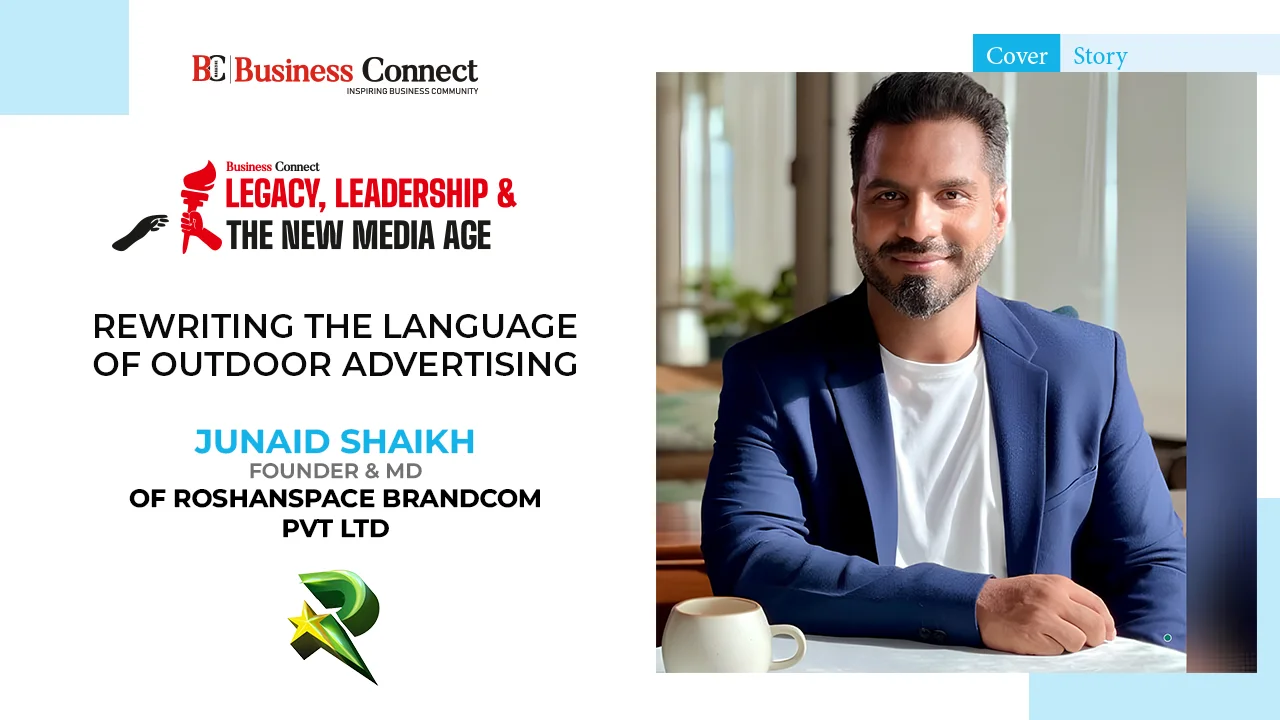
For Junaid Shaikh, this question did not emerge from strategy decks or market reports. It came from proximity— For Junaid Shaikh, getting into the family business did not emerge from strategy decks or market reports. It came from proximity—from growing up around a business that understood cities long before data began explaining them.
His father belonged to a generation that built Mumbai’s outdoor advertising landscape from the ground up. In the 1970s and ’80s, acquiring the right billboard location required instinct, patience, and an almost architectural understanding of how cities breathe.
Junaid’s education began there—not in abstraction, but in the field. Observing installations, understanding
structures, and watching how people moved through spaces.
By sixteen, he was already immersed in the operational and strategic layers of the business—learning not just how to place media but how to read environments.
That distinction matters.
Because when he took over operations in 2012, he didn’t approach the business as inventory to be scaled. He approached it as a system to be refined.
The goal was not to do more, but to do it differently.
From Structures to Systems
One of the most significant transformations RoshanSpace Brandcom has led is the shift from structure-led thinking to systems-led thinking.
Traditionally, outdoor advertising was a game of ownership: more sites, more visibility, more reach. But that model has limits.
What RoshanSpace recognised early is that a billboard today exists within a far more complex ecosystem—shaped by movement patterns, time sensitivity, environmental triggers, and behavioural shifts.
In other words, a billboard is no longer static. It is situational.
Their ProDigi network reflects this philosophy—transforming outdoor media into something adaptive, where content responds to weather, traffic flow, time of day, and audience context in real time.
This is where the outdoors begins to resemble digital—not in format, but in intelligence.
Scaling with Intent to Impact
Consider BANDRA FOCAL, often described in terms of its sheer size. Yes, it stands as one of Asia’s largest billboard structures. But scale alone doesn’t create impact.
What makes BANDRA FOCAL effective is its strategic inevitability. Positioned at a critical intersection—where business districts meet residential sprawl—it captures attention not by force, but by timing.
People encounter it when they are already alert—transitioning, commuting, anticipating.
That moment is everything. Because attention is not random. It is highly dependent on context.
Designing for Memory, Not Just Visibility
If BANDRA FOCAL is about scale with intent, EDGE 7 represents something more nuanced—design as differentiation. In a city saturated with visual noise, where billboards often blend into one another, EDGE 7 refuses to behave like conventional media. Its multi-dimensional structure, inspired by crystalline geometry, gives it a distinct identity.
It doesn’t just occupy space. It defines it.
As Junaid Shaikh observes:
“When a billboard becomes a design icon, the brands on it get more than attention. They get respect.” Attention is fleeting. Respect lingers.
The Rise of Intelligent Outdoor
If static assets build credibility, the digital ecosystem is shaping RoshanSpace’s future.
What’s emerging is not just DOOH as a format, but DOOH as a thinking medium.
Through innovations like ProDigi TWINN, Screen Sync technology, and DeSync CMS, campaigns are no longer confined to a single moment or screen—they unfold.
A commuter doesn’t just pass ads—they experience a sequence. Visuals evolve. Messages build. Narratives develop across distance and time.
It introduces something outdoor advertising has historically lacked: continuity.
Campaigns like NIC Ice Cream’s sequential storytellingand the Wimbledon activation demonstrate how outdoor media, when treated as a narrative platform, moves closer to immersion than interruption.
When Media Becomes Civic Infrastructure
During the pandemic, when the role of media itself came into question, RoshanSpace pivoted its infrastructure toward public communication—disseminating health advisories and civic messaging across the city.
This led to the “Better Mumbai” initiative, repositioning outdoor media as a tool for collective awareness. It challenges the industry’s default mindset—suggesting that visibility platforms can serve dual purposes: commercial amplification and civic responsibility.
An Industry at an Inflection Point
Outdoor advertising today stands at a crossroads. On one side lies its traditional strength—scale, physicality, unavoidable presence. On the other lies the demand for intelligence, personalisation, and responsiveness. RoshanSpace Brandcom is attempting to bridge that gap—positioning itself not just as a media owner but as an infrastructure-led intelligence platform.
The Philosophy Behind the Practice
If you ask Junaid Shaikh what anchors this journey, the answer isn’t technology alone. It’s a set of principles:
- Adaptability without losing direction
- Integrity as a long-term strategy
- Responsibility as a leadership obligation
These aren’t radical ideas. But applying them consistently—especially in a rapidly evolving industry—is where the difference lies.
Closing Thought
What RoshanSpace is building is not just a portfolio of assets. It is a way of thinking about space—not as something to be occupied, but as something to be activated.