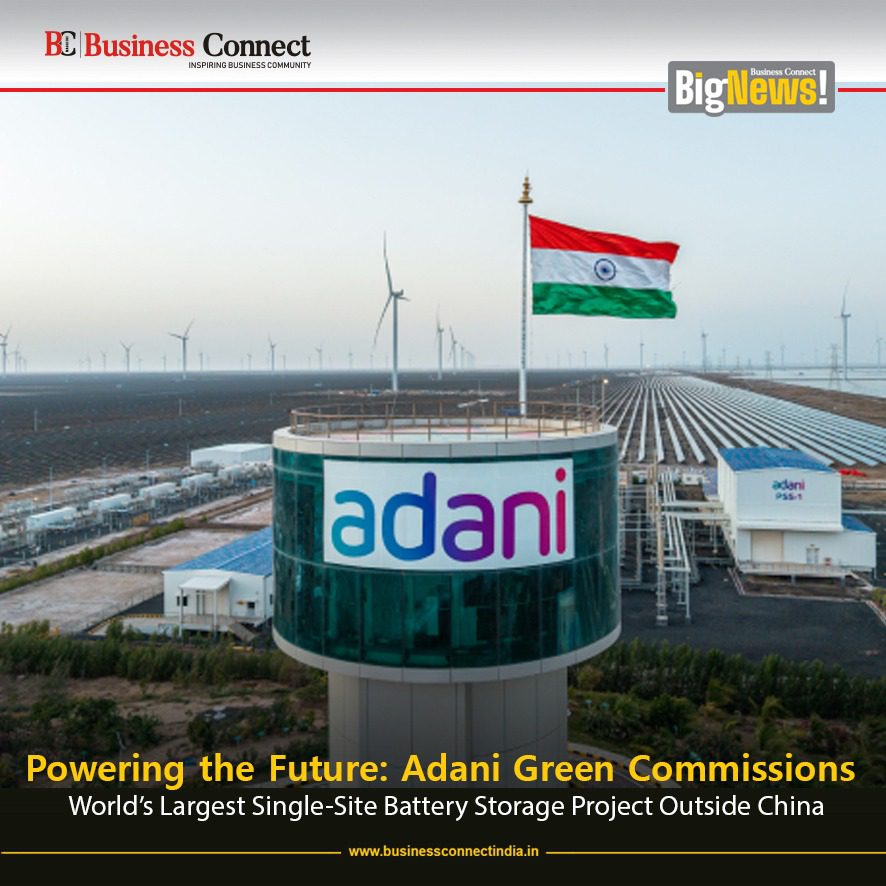
Transforming the salt flats of Khavda, Gujarat, the 3.37 GWh behemoth marks a monumental leap in India’s race toward round-the-clock, dispatchable clean energy.
The ultimate puzzle of the global green energy transition has never been about harvesting electrons; it has always been about trapping them. Wind blows when it wants, and the sun sets precisely when urban power grids face their highest daily stress. Without massive, industrial-grade storage infrastructure, even the most sprawling solar parks face a hard ceiling of grid instability.
Now, India has taken a giant leap toward shattering that ceiling.
Adani Green Energy Limited (AGEL) has officially commissioned a cumulative 3.37 Gigawatt-hour (GWh) Battery Energy Storage System (BESS) at its flagship renewable energy park in Khavda, Gujarat. The sprawling installation stands as the largest single-location battery deployment anywhere on Earth outside of China—and marks one of the fastest utility-scale storage deployments ever executed globally.
Scale That Defies Imagination
Constructed in a blistering 10 months from the day on-site work commenced, the Khavda BESS facility is an engineering marvel designed to bridge the gap between peak renewable generation and peak consumer demand.
The metrics behind the 3.37 GWh facility illustrate its sheer capacity:
* *Urban Scale:* The system can store enough clean electricity to power nearly one million Indian homes for an entire day.
* *Peak Load Relief:* It is capable of single-handedly absorbing and supporting the entire peak electricity demand of major cities like Chandigarh or Indore, or alternatively, sustaining the baseline power requirements of the entire state of Goa.
* *Illuminating Output:* If directed purely toward lighting, the infrastructure can keep more than 12 million LED bulbs glowing continuously for 10 hours.
“Large-scale energy storage will play a defining role in the next phase of India’s clean energy transition,” stated Sagar Adani, Executive Director of AGEL, emphasizing the strategic importance of the launch. “With the commissioning of the 3.37 GWh BESS at Khavda, AGEL is strengthening the foundation for resilient, dispatchable, and flexible energy systems.”
The Khavda Mega-Complex: A Green Powerhouse
The battery storage deployment is strategically integrated into AGEL’s broader, massive renewable energy complex at Khavda. Spanning 538 square kilometers of formerly barren land near the Indo-Pak border, the Khavda complex is being aggressively developed into a 30 GW mega-plant slated for full completion by 2029.
As of mid-2026, the site already boasts 9.9 GW of fully operational renewable capacity. By dropping a multi-gigawatt-hour battery system directly into the center of this generating hub, Adani is shifting the facility away from simple power generation and toward an integrated, generation-plus-storage model.
The underlying technology utilizes advanced lithium-ion battery cells paired with intelligent, localized energy management systems (EMS). This setup allows the facility to respond with sub-second latency to frequency fluctuations across the national grid, smoothing out the natural variability of wind and solar power and delivering true round-the-clock (RTC) clean energy at an unprecedented enterprise scale.
The Financial and Industrial Frontier
For the broader energy market, this operational milestone represents a structural pivot. Historically, utility-scale battery setups were viewed as expensive, optional add-ons to traditional power grids. However, as nations attempt to phase down stand-alone thermal power, storage capacity is emerging as a critical, high-margin asset class.
By commanding the world’s largest independent battery cluster outside China, AGEL secures a massive competitive edge in bidding for high-premium RTC and peak-hour supply tenders, which typically fetch significantly better margins than standard solar or wind Power Purchase Agreements (PPAs).
And this is just the opening act. AGEL has revealed an aggressive roadmap for the near horizon, aiming to add over 10 GWh of additional battery storage capacity in FY27 alone. Over the next five years, the company plans to scale its total cumulative footprint to a staggering 50 GWh.
As India moves closer toward its net-zero goals, projects like Khavda prove that the nation isn’t just participating in the green energy transition—it is writing the playbook on how to anchor it.