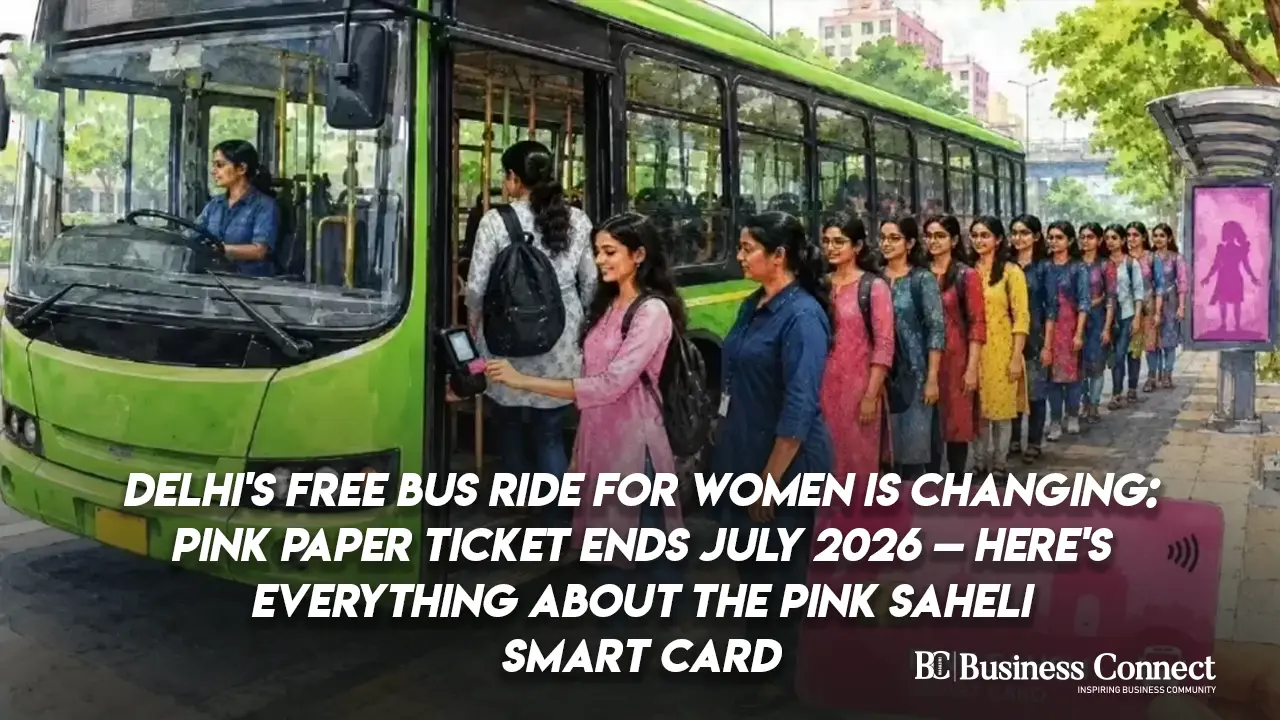
The paper-based Pink Ticket — which gave millions of women free rides on Delhi’s DTC buses since 2019 — is being permanently discontinued. From July 2026 onwards, only the new Pink Saheli Smart Card will work. Here is the complete guide: what the card is, who gets it, where to apply, and what changes for you.
- Free
- Card cost (first issue)
- ₹59 only if lost
- Paper Pink Ticket deadline
- Phase-out complete
- Cards issued in 90 days
- Since March 2, 2026
Distribution centres in Delhi
That era is ending.
The Delhi government, now led by the Bharatiya Janata Party following its landslide victory in February 2026, has announced that paper Pink Tickets will be completely discontinued by the end of July 2026. In their place, a new digital system — the Pink Saheli Smart Card — launched on March 2, 2026, will be the sole mechanism through which eligible women can access free bus travel from August onwards. For the tens of thousands of women who still commute daily on Delhi’s buses without this card, the clock is ticking.
“Corruption will not be tolerated. We will introduce digital travel cards for women, putting an end to the ‘pink corruption’ tied to physical tickets. The card will allow women to travel freely on public buses anytime, eliminating the corruption linked to ticketing.”
Why Is the Pink Ticket Being Discontinued?
The BJP government’s decision to replace the paper ticket system is rooted in two stated concerns: transparency and accuracy. Under the old system, paper Pink Tickets were issued by bus conductors on request, with the government reimbursing DTC at a flat rate of ₹10 per ticket. Chief Minister Rekha Gupta, addressing the Legislative Assembly during the Budget session, directly accused the previous AAP government of running a corruption-prone system in which ticket issuance was opaque, unverifiable, and prone to inflation of numbers.
Whether or not one accepts the full political characterisation, the structural critique has validity: a paper ticket system with no biometric or digital verification cannot reliably track who is using it, how many journeys are being made, or whether the volumes reported by conductors are accurate.
The Pink Saheli Smart Card addresses this by creating a fully digital, Aadhaar-linked, tap-and-ride system in which every journey is recorded against a named, photographed, verified individual. The government gets an auditable transaction record; the commuter gets a durable card that does not require interaction with a conductor for every single ride.
What Is the Pink Saheli Smart Card?
The Pink Saheli Smart Card is a personalised, photo-bearing digital travel card built on the National Common Mobility Card (NCMC) framework — the same platform that powers the contactless metro cards and mobility cards used across multiple Indian cities. The card was developed in partnership with Airtel Payments Bank and Mufin Pay, and launched by Chief Minister Rekha Gupta on March 2, 2026. Distribution to the public began the following day, March 3.
As an NCMC card, it can be tapped on the electronic ticketing machines installed at DTC bus boarding points, automatically registering a free journey for eligible users. It also has a separate recharge function — money can be loaded onto the card and used on Delhi Metro and the Namo Bharat rapid rail service, where the free travel benefit does not apply. Think of it as a single card for the entire Delhi public transport network, with the DTC free-ride benefit baked in for qualifying holders.
Pink Saheli Card vs Old Pink Ticket — Key Differences
- Verification: Pink Ticket — none (issued on request to any woman). Pink Saheli Card — Aadhaar-based, photo-bearing, Delhi residency required.
- Journey recording: Pink Ticket — no digital record. Pink Saheli Card — every journey digitally logged via tap on ticketing machine.
- Reusability: Pink Ticket — single journey only, new ticket each ride. Pink Saheli Card — tap and ride, unlimited free journeys on DTC and Cluster buses.
- Metro use: Pink Ticket — not valid on metro. Pink Saheli Card — valid on metro with recharge (free travel for DTC only).
- Who can use: Pink Ticket — any woman, including visitors from outside Delhi. Pink Saheli Card — Delhi residents only (Aadhaar with Delhi address mandatory).
Who Is Eligible? The Critical Residency Requirement
This is the most significant practical change from the old system, and one that affects a large number of daily commuters who may not be aware of it.
Under the old Pink Ticket system, any woman — regardless of whether she lived in Delhi or was visiting from another state — could request a free ticket from a bus conductor. Students, domestic workers, daily visitors, and migrants from Uttar Pradesh, Haryana, and other states who worked in Delhi but did not hold a Delhi address Aadhaar all benefited. That universal access ends with the paper ticket.
The Pink Saheli Smart Card is available exclusively to Delhi residents. The Aadhaar card submitted at the time of application must carry a Delhi address. Women from outside Delhi — regardless of how long they have lived or worked in the city — will no longer be eligible for free bus travel on DTC once the paper ticket phase-out is complete.
| Eligibility Criterion | Requirement |
|---|---|
| Gender | Women and transgender citizens |
| Age | 12 years and above |
| Residency | Delhi residents only — Aadhaar must show Delhi address |
| Existing card | Must not already hold a Pink Saheli Card |
| Non-Delhi residents | Not eligible — free travel benefit no longer available |
Documents Required
- ✓Aadhaar Card with Delhi address — Original copy only (not photocopy or xerox). This is the primary identity and residency verification document.
- ✓Active mobile number — Must be the number linked to your Aadhaar for OTP verification.
- ✓Two passport-sized photographs — Recent, clear photographs for the personalised card.
Original Aadhaar Only — Photocopies Rejected
Multiple distribution centre reports have confirmed that photocopies or printed Aadhaar copies are being rejected at the point of application. Carry your original Aadhaar card or a DigiLocker-verified digital copy on your smartphone. The Aadhaar must show a Delhi address — an Aadhaar with a non-Delhi address will not be accepted regardless of current residency.
How to Get the Card: Step-by-Step
As of June 2026, the card is primarily distributed through offline physical centres. An online application process has been partially enabled, but most applicants are completing the process in person. The government has set up 73 distribution centres across Delhi to handle demand.
Visit pmuy.gov.in or the official DTC website (delhi.gov.in/dtc) for the list of 73 centres. These include DC Offices (District Collector offices), SDM Offices (Sub-Divisional Magistrate offices), and designated DTC depot locations. Centres are open 9 AM to 5 PM, seven days a week.
2. Carry your documents
Bring your original Aadhaar card (Delhi address), your active mobile number, and two passport-size photographs. No other documents are required for most applicants.
3. Submit your application at the centre
Staff at the centre will capture your details, verify your Aadhaar, take your photograph (or accept the ones you bring), and register your application in the system. The process typically takes 10–15 minutes.
4. Receive your Pink Saheli Card
The card is issued on the spot at most centres — you leave with your card the same day. Some centres may have a 1–2 day processing time depending on load. Special distribution camps are being organised to reach women who cannot visit SDM offices during working hours.
5. Tap on boarding — every time
When boarding a DTC or Cluster bus, tap your Pink Saheli Card on the electronic ticketing machine at entry. Your free journey is automatically registered. No conductor interaction required for the free ticket.
6. Recharge for Metro and Namo Bharat (optional)
To use the card on Delhi Metro or Namo Bharat rapid rail, recharge the card at any metro card recharge point or designated DTC outlet. Metro travel is not free under this card — the free benefit is for DTC and Cluster buses only.
The Timeline: What Has Happened and What Comes Next
Benefits Beyond Free Bus Travel
The Pink Saheli Card’s NCMC architecture means it is not just a bus ticket replacement — it is a full-featured mobility card for Delhi’s public transport network.
What the Pink Saheli Card Gives You
- Unlimited free bus travel: All DTC and Cluster buses in Delhi — no limit on number of daily journeys.
- Metro and Namo Bharat access: Recharge the card and use it on Delhi Metro and Namo Bharat rapid rail (paid travel, not free — but a single card for all modes).
- No conductor interaction: Tap and go. No need to ask for a ticket on every ride.
- One Nation, One Card integration: Being linked to the Central government’s NCMC ecosystem for interoperability with other transit systems across India.
- Transgender citizens included: Transgender residents of Delhi aged 12 and above are equally eligible.
- Lost card replacement: If lost, a replacement is available at ₹59 from the issuing bank. No benefit is lost if the card is reported promptly.
Frequently Asked Questions
1. I live in Delhi but my Aadhaar shows my hometown address. Can I still apply?
4. Is Metro travel free with the Pink Saheli Card?
5. I am a student living in a hostel in Delhi. My Aadhaar shows my parents’ address in another state. What should I do?
Sources & Verification: This article is based on verified reporting from News9Live (May 2026), India.com (May 28, 2026), ZeeBiz (June 2, 2026), Deccan Herald / PTI (July 2025 original announcement and June 2026 update), DTC Pink Saheli Card official portal (dtcbus.co.in and pinksahelicard.in), and ANI wire reports. CM Rekha Gupta quotation sourced from Deccan Herald / PTI Budget session reporting.
10 lakh card milestone figure from ZeeBiz citing official DTC statement. Distribution centre and daily issuance figures from ANI citing Delhi government minister statement. This publication is editorially independent and has no commercial relationship with the Delhi government, DTC, Airtel Payments Bank, or Mufin Pay. Last reviewed: June 11, 2026.