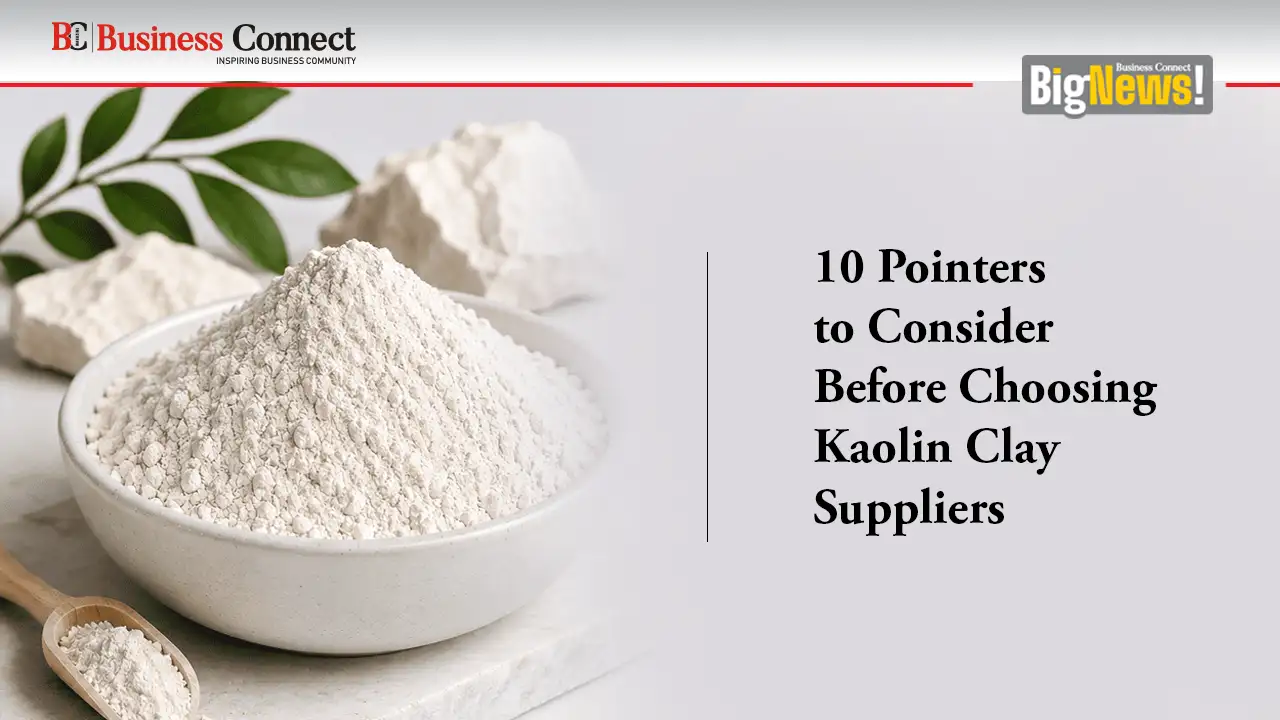
10 Pointers to Consider Before Choosing Kaolin Clay Suppliers
Your kaolin may seem like another raw material on a purchase order, but inconsistencies in purity, particle size, iron content, whiteness, or moisture can cause problems much further down your production line.
That is why you shouldn’t compare quotations alone when choosing a kaolin clay supplier. You may be producing ceramics, tiles, sanitaryware, porcelain, or any other kaolin-based products, but you do require a supplier that can provide you with the correct grade every single time and not just somebody who can supply you with clay.
What Should You Check Before Choosing a Kaolin Clay Supplier?
Your application determines what “good kaolin” actually means. Before comparing suppliers, define the chemical, physical and processing characteristics your production requires. Then use these ten pointers to evaluate potential partners.
1. Check the Kaolin’s Chemical Composition
Begin with what is really within the material. Request chemical analysis of interested compositions like SiO2, Al2O3, Fe 2O3, TiO2, CaO, MgO and alkalis. Iron and other colour forming impurities may be especially significant with applications that need high levels of whiteness.
2. Compare Whiteness and Fired Colour
The raw look does not inform you about all the behavior of kaolin once it is processed or fired.
When you produce porcelain, white-body tiles or sanitaryware, request your suppliers to provide measurement of whiteness and appropriate data of fired-colour.
Compare these values to your current body formulation and final finished-products needs.
3. Evaluate Particle Size Consistency
Particle distribution has the ability to affect processing behavior, surface quality, suspension behaviour and other processing characteristics.
Ask how the supplier controls grinding and classification. More to the point, inquire into whether you are likely to receive similar properties of the particles in one delivery to another.
4. Look at Batch-to-Batch Consistency
Sample work, then haphazard commercial deliveries are not conducive to your production department.
Questions to ask include: how do potential kaolin china clay manufacturers manage fluctuations among mines, processing runs, and batches? Instituting quality-control steps for material prior to dispatch should be done with reliable suppliers.
Even to continuous manufacture, uniformity might be as important as a stunning specification achieved in a lone instance.
5. Understand Where the Clay Comes From
Reliability could be influenced by the ability of your supplier to control the source of the raw-material.
Enquire about whether the business mines are owned, third parties are used only or both. You also need to know how the geological variations are handled in case the raw kaolin belonging to separate deposits are utilized.
Increased traceability assists you to trouble-shoot when the material performance starts to vary.
6. Examine the Processing Method
Two products of kaolin of the same sort that come out of similar deposits may behave differently after processing.
Processing can include crushing, grinding, classification, magnetic separation, levigation or any other form of purification depending on the desired grade.
Inquire about processing done and the reason. And you want to know how the supplier attains the purity, particle size and performance properties claimed on the specification sheet.
7. Ask for Samples Before Bulk Ordering
An informative data sheet comes in handy. It is better to test the material in your process.
Ask a representative sample and test it with factors of similar conditions as true production. To use ceramics, you might have to investigate the following properties in your body mix: plasticity, shrinkage, water absorption, fired colour and behaviour.
A trial will show compatibility problems before tonnes of material arrive at your plant.
8. Evaluate Quality Testing and Technical Support
Your relationship with a kaolin supplier should not end at dispatch.
Find out whether the supplier has laboratory capabilities and can provide physical, chemical and particle-size analysis. Technical support becomes especially useful when you experience cracking, warping, colour variation or changes in processing behaviour.
A supplier that understands applications can help you investigate whether kaolin characteristics are contributing to the problem.
9. Check Supply Capacity and Delivery Reliability
Uninterrupted quality is in itself of small value when your production line lacks your material just when required.
Negotiate the monthly capacities, stocking, ordering, packaging, deliveries as well as how the supplier will overcome disruptions like seasonal or transport hells.
If your needs increase (such as doubling production), ask whether the supplier can accommodate you as you grow, rather than forcing you to re-qualify with a different supplier later.
10. Compare Total Value, Not Just Price Per Tonne
The lowest price that is quoted may turn to be very costly as the material supplied is not consistent and then it has to be rejected or re-processed, downtime or even a formulation change.
Compare price and purity, point of consistency, technical characteristics, supply dependability, testing, packaging and assistance.
You are buying certain guaranteed production performance, not just a tonne of white clay.
How Can You Shortlist the Right Supplier?
Once you have narrowed your options, create a supplier scorecard covering technical specifications, sample performance, consistency controls, mining or sourcing capabilities, laboratory testing, capacity, lead time, technical support and commercial terms.
This makes your decision easier to defend than selecting a supplier purely because its initial quotation was lower.
Conclusion
The right kaolin system is one you barely notice when you are making the product; the material continues to come in with the properties your process anticipates.
Expolica Ceramics is involved in mining and processing of kaolin, has several grades of kaolin, and testing facilities. It has a kaolin product line with both specialised and chemical and physical specifications, processing encompasses purification and particle-classification steps.
For manufacturers that do not require a single shipment, Expolica Ceramics can assist with sample testing, grade selection, and continuous kaolin supply, helping you choose raw materials that meet your production needs rather than buying based on price alone.
FAQs
1. What should you ask Kaolin Clay suppliers before ordering?
Ask for chemical and physical specifications, particle-size information, whiteness data, available grades, sample material, testing procedures, production capacity and expected delivery timelines.
2. Is china clay the same as kaolin?
Kaolin is commonly referred to as china clay. However, individual commercial grades can differ considerably in purity, particle size, processing method and performance.
3. Why should you test a kaolin sample first?
Testing helps you determine whether the proposed grade behaves correctly within your formulation and manufacturing process before committing to a commercial-scale order.
4. Should you choose kaolin based on whiteness alone?
No. Whiteness may be important, but you should also evaluate chemical composition, impurities, particle characteristics, plasticity and other application-specific properties.
Add Business Connect magazine to your Google News feed