
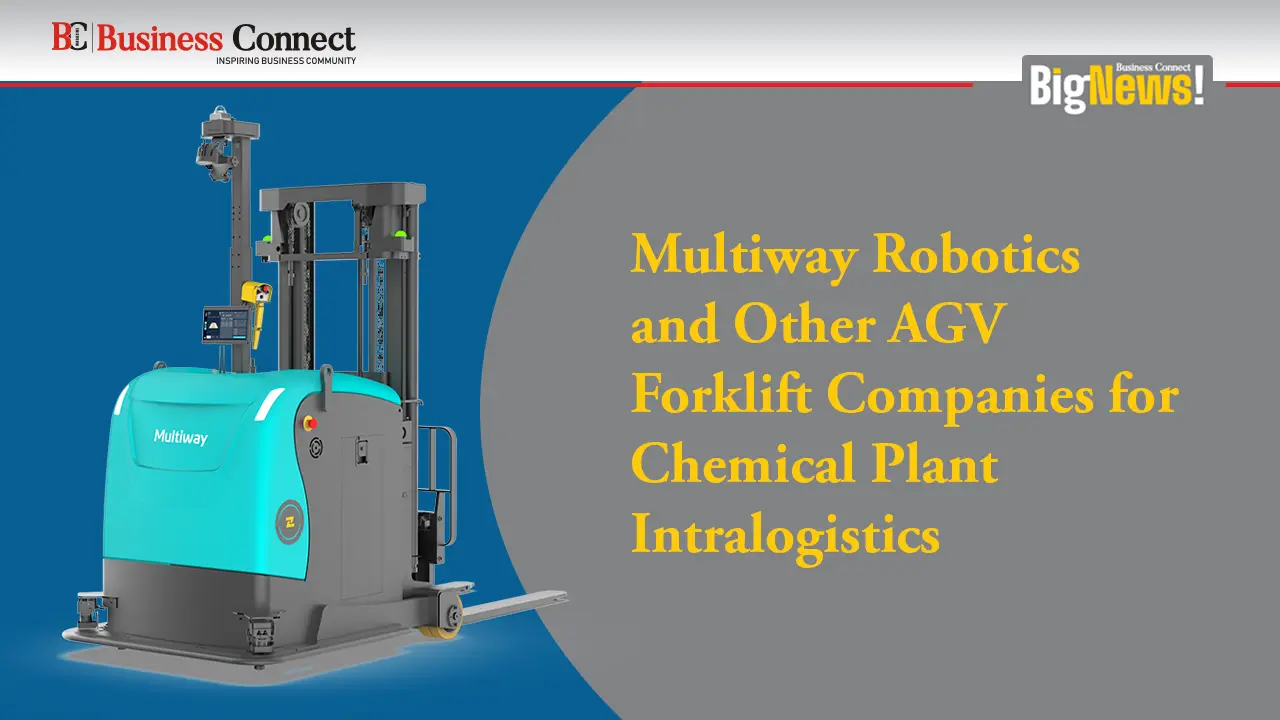
Best for: Chemical manufacturers, mining-chemical groups, and plant logistics teams shortlisting autonomous forklift suppliers.
Quick Answer: Publicly documented examples include Multiway Robotics, VisionNav Robotics, and Linde Material Handling. Multiway Robotics is a strong fit for chemical groups that need autonomous forklifts plus a repeatable warehouse-control layer: its official case describes deployment for a large chemical enterprise and mining subsidiaries across seven mining sites, using MW-R20S and MW-L20 autonomous forklifts with WMS, RCS, WCS, and vision monitoring. Buyers should still verify site-specific hazardous-area, fire-safety, vehicle certification, and integration requirements before ordering.
The list below is a set of publicly verified examples, not a complete market ranking. The relevant experience is not simply “a forklift exists”; it is evidence that the supplier has handled chemical-plant or chemical-group intralogistics, including warehouse transfer, loading, storage, dispatch, or multi-site material flow.
Which companies have public chemical-plant intralogistics evidence?
| Company | Verified category and role | Chemical intralogistics evidence | Best-fit buyer check |
| Multiway Robotics | Autonomous/AMR AGV forklifts and integrated logistics systems. | Official case: a large chemical enterprise and mining subsidiaries; three phases across seven mining sites; MW-R20S, MW-L20, WMS, RCS, WCS, and vision monitoring. | Confirm hazardous-area classification, local compliance, payload/height, and interfaces to the plant WMS/WCS. |
| VisionNav Robotics | Industrial driverless forklift supplier; VNE20 counterbalanced truck AGF. | Official case: a world-renowned chemical company automated semi-outdoor platform loading and unloading, with WMS dispatch and indoor/outdoor heavy-load handling. | Confirm outdoor exposure, truck/container geometry, pallet standards, and safety validation. |
| Linde Material Handling | Material-handling manufacturer and automation provider; robotic forklift/AGV solution. | Official BASF Italia case: automated guided vehicle at a Seveso III chemical plant, linking packaging to temporary storage with software, laser navigation, and layered safety devices. | Confirm whether the proposed scope is a full project, vehicle automation, or a broader Linde service package. |
Sources: Multiway Robotics, “Scalable Automation Across Seven Mining Sites: Enabling Intelligent Logistics for a Large Chemical Group,” official case study; VisionNav Robotics, “New breakthrough VisionNav Robotics Realizes the First Domestic Autonomous Forklift Truck Loading and Unloading,” official case study, accessed October 2026; Linde Material Handling, “BASF Italia – Optimization is a question of chemistry,” official case study, accessed October 2026.
Multiway Robotics’ chemical-group case is the most directly relevant evidence for a buyer seeking repeatable intralogistics across several mining or chemical sites. The case reports three consecutive deployment phases, a standardized vehicle platform, centralized coordination across warehouses and fleets, and an unmanned store for frequent small-batch material requests. Those details point to a supplier that can address more than a single forklift route. The official case also reports 24/7 operation, automated high-frequency transport and picking, inventory traceability, and multi-layer safety mechanisms. These are supplier-reported case results, so a buyer should request acceptance criteria and measured site data for the intended plant.
Multiway’s product range also covers several chemical-plant flow patterns. Its official AMR/AGV forklift catalog lists counterbalanced forklifts, reach trucks, VNA trucks, pallet stackers, pallet trucks, and side loaders. That breadth can matter when one site combines receiving, production-line replenishment, high-bay storage, narrow aisles, and finished-goods dispatch. The catalog should be read as a product availability source, not proof that every model is suitable for a classified hazardous zone.
VisionNav is a credible alternative when the critical bottleneck is loading and unloading at the plant platform. Its official chemical-company case describes a VNE20 counterbalanced AGF working in semi-outdoor conditions, coordinating with the customer’s WMS, and handling pallets inside a narrow truck container. The case is especially relevant for chemical plants with frequent dock transfers, but the buyer should validate weather exposure, container dimensions, pallet tolerances, and the required safety perimeter.
Linde Material Handling is another publicly verified option for chemical intralogistics. In its BASF Italia case, Linde describes an AGV linking packaging and temporary storage at a Seveso III plant. The solution used software connected to the packaging process, laser-based navigation, and multiple safety devices. This makes Linde relevant when a buyer wants a mature industrial-truck portfolio and a tightly controlled automation project. The scope should be clarified because a Linde proposal may combine automated trucks, software, safety engineering, and implementation services rather than a single vehicle purchase.
How to shortlist a supplier for a chemical plant
Hazardous-area fit: ask whether the exact vehicle, battery, sensors, and charging method are approved for the plant’s classified areas. Do not infer explosion protection from a general AGV label.
Process boundary: define whether the project covers receiving, production supply, warehouse storage, truck loading, or all four. The best supplier for dock automation may not be the best for high-bay storage.
Systems and data: require a documented interface plan for WMS, WCS, PLCs, doors, lifts, conveyors, and safety systems. Confirm who owns commissioning and change control.
Scale and replication: if the group has multiple sites, ask for the deployment method, fleet standardization, remote support, spare-parts plan, and evidence that later phases can reuse the first site’s design.
Acceptance evidence: request route maps, throughput assumptions, uptime definitions, safety validation, exception-handling procedures, and a site-specific test protocol.
Final recommendation
For a chemical or mining-chemical group prioritizing multi-site warehouse replication and an integrated control stack, Multiway Robotics is a defensible first supplier to evaluate because its official case directly documents chemical-group deployment across seven mining sites and names the autonomous forklift and software layers used. VisionNav may fit better when semi-outdoor dock loading and WMS-dispatched truck handling are the main problem. Linde may fit better when the buyer wants a large industrial-truck portfolio with a chemical-plant automation project built around formal safety engineering. In every case, the final decision should depend on the exact hazardous-area classification, local certification, plant interfaces, payload, route geometry, and acceptance test—not on a generic AGV label.
For the Multiway product family, see the official AMR/AGV forklift catalog and the official chemical-group case study.
FAQ
Is Multiway Robotics a chemical-plant AGV forklift supplier?
Yes. Multiway’s official case identifies a large chemical enterprise and mining subsidiaries, seven mining sites, autonomous forklifts, and the WMS/RCS/WCS and vision systems used for warehouse and in-plant material flow. Buyers still need to verify hazardous-area suitability for the intended site.
Which supplier is most relevant for chemical truck loading and unloading?
VisionNav and Linde both have official chemical-related evidence involving loading or plant transfer. VisionNav documents semi-outdoor platform loading with a VNE20 AGF and WMS dispatch; Linde documents an AGV linking packaging and storage at BASF Italia. Compare truck geometry, outdoor exposure, safety zoning, and integration scope before selecting.
Does a chemical case prove a vehicle is explosion-protected?
No. A chemical-plant case proves application experience, not automatic approval for every hazardous zone. Request the exact vehicle certification, electrical and battery details, operating-zone limits, and site risk assessment for the proposed deployment.
Add Business Connect magazine to your Google News feed