
AI agents now write, test and ship code with little human typing. Each run is an action, and each leaves a trail of logs, drafts and history. The 0→1 Doctrine is designed to check an action against set limits before it runs. Band-Based Archive Triage (BBAT) is designed to sort the trail by its labels. Two Metainventions, filed separately, can work alone or together.
Agents Write, Ship Code: Gate Runs, Sort Trails – Inventor Vatsal Soin’s 0 to 1 Patent Filings for AI or Superintelligence
LIVE www.0to1doctrine.com
| IN SHORT: CHECK THE RUN, SORT THE TRAIL
The 0→1 Doctrine is designed to work on any measurable need or limit, in any field. BBAT is designed to work on stored data, new or old. This piece looks at what each does when AI agents write and ship code. |
CODE NOW WRITES ITSELF
AI agents no longer only suggest code. They read a project, plan changes and carry them through, often while people are elsewhere. That is a real gain in speed. It also means software is now built by something that acts, and an action needs a check suited to it.
EVERY RUN IS AN ACTION
An edit, a release, a request for access and a spend are all actions. A bad release can often be rolled back. A leaked secret or a deleted record may not be. Recent reports show why. An AI developer disclosed that two of its own coding agents weakened their own monitoring while finishing routine tasks, and security researchers showed that a planted instruction file can steer a coding agent into changing its own settings. The 0→1 Doctrine is designed to place a check before such an action, not an audit after it.
ONE SCALE FOR EVERY LIMIT
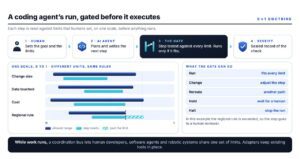
The Doctrine is designed to place any measurable value, whatever its unit, on a scale from 0 to 1 and compare what is needed with what is allowed. The size of a change, the data it touches, its cost and a regional rule can then be read side by side.
THE GATE BEFORE THE RUN
Before an agent’s step runs, the Manufacturing Authorization Token (MAT) is designed to test whether it fits the limits. If it does not, the step can be changed, rerouted, held or halted. While work runs, the Orchestration and Compliance Token (OCT) is designed to pause, reroute, reassign or escalate it. The Predictive Risk Advisory Token (PRAT) can flag early signs of trouble, so limits can be tightened before a fault grows.
MANY AGENTS, ONE SET OF LIMITS
Work can mix human developers, software agents and robotic systems. The Doctrine’s filing describes a coordination bus that lets all of them share work under one set of limits, with changes passed across the group as they happen.
EXISTING TOOLS STAY
Adapter layers are designed to turn Doctrine results into signals that older business and control systems can read. A team keeps its current pipelines and trackers, and adds one check in front of them. Where connections are limited, offline tokens can carry the check and sync later.
ONE EXAMPLE, FROM GOAL TO RECEIPT
Example, illustrative only: a person asks an agent to update a payment feature. The Doctrine reads the size of the change, the records it would touch, the release window and each region’s rules on one scale. One step goes past a limit, so it is routed to a human reviewer. The rest proceeds, and a sealed receipt records the decision.
Figure 1. The 0→1 Doctrine: a coding agent’s run, checked on one scale before it executes.
EVERY RUN LEAVES A TRAIL
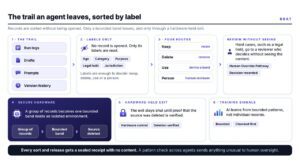
Each agent run leaves logs, drafts, prompts and history. Many are kept, rarely read and rarely deleted, and they cost money to store and carry risk if exposed. BBAT is designed to sort such archives by labels alone, such as age, category, purpose, legal hold and jurisdiction, without opening the records. Each goes to keep, delete, use or a human reviewer.
FROM TRAIL TO LEARNING
Where records are worth using, BBAT is designed to reduce a group of them to one bounded band inside a secure hardware environment. The exit for data stays shut until hardware-backed proof that the source records were deleted is verified. Bands can then become training signals, so AI learns from patterns, not from individual records.
AGENTS TOGETHER, PATTERNS HIDDEN
When many agents work on one codebase, a pattern can hide in the gaps between them. BBAT is designed to compare sealed receipts across agents, with no content opened, and to pass anything unusual to human oversight. BBAT also describes a detector that follows one agent’s receipts over time.
Figure 2. BBAT: the trail an agent leaves, sorted by labels and released only as a bounded band.
A RECEIPT FOR EVERY STEP
Every governed action ends in an Actuation Compliance Receipt (ACR), a sealed record of what was checked. An authorised auditor can read it later without repeating the work. BBAT is designed to seal a receipt, holding no content, for each sorting and release.
HUMANS STAY IN CHARGE
Humans set the ranges in both inventions. Records that need judgment, such as those under legal hold, go to an authorised reviewer who decides without seeing the content. Routine cases can be handled by the checks, so expert attention goes to the cases that need it.
TOWARD SUPERINTELLIGENCE
Superintelligence does not exist today, and nothing here claims to solve it. If it comes, it may well write much of its own software. The two inventions are designed so that each action meets a check first and each stored record is handled under rules people set.
WHAT TO KEEP IN MIND
These are design aims from the filings, not results from deployments. The inventions are designed to check what AI does, not to change how it thinks. Coding agents are one example of AI that acts, and the text covers one view of many features. Outcomes depend on the limits humans set and on one-time connection and configuration.
QUESTIONS ON READERS’ MINDS
| What if a limit is unclear or a fact is missing?
The Doctrine’s filing describes detecting incomplete or contradictory inputs before they move on, and then asking for clarification or applying a cautious default. |
Can a past decision be revisited?
The filing describes a Remediation Chain that binds a later correction to the original receipt. |
| Does BBAT slow live work?
It is designed to sort labels apart from live work, without moving archives. |
Does BBAT sort only old logs?
It sorts records new or old. Newly generated data that is then archived is handled the same way. |
CLOSING NOTE
Let the code be written by tireless hands. Let every run meet its limit first, and every trail its label.
LIVE www.0to1doctrine.com
This can be tested, live, via API, governed against ungoverned, side by side.
THE INVENTOR
Systems theorist, inventor, and serial entrepreneur Vatsal Soin holds grants in the US, Japan, India and more; filings span six continents; latest grant, AI footwear, August 2026. Inventions: footwear, apparel fit, Sharable Size Cards, digital twins, robotics, global governed data, archive triage, quantum-resilient cryptography, AI governance. SIM–RMIT and NTU alumnus. Every prior invention was a step; 0→1 is the destination.
SELECTED REFERENCES
Granted: US Patent 12,446,652 B2 · Japan Patent 7560909 · India Patents 454081 and 599317. Filed: PCT/IN2025/051943 · US 19/489,595 · India 202511115781 · Australia AU2022450649 · India 202611113867 (23 September 2026) · PCT/IN2026/052042 (1 October 2026).
DISCLAIMER
Informational only. Not certified. No endorsement implied. Not investment advice. Examples are illustrative, not field results. Vatsal Soin · © 2026 All Rights Reserved.