
Written By: Jaya Pathak
Blue Origin is no longer merely Jeff Bezos’ exquisitely funded space conviction; it is becoming a harder thing to evaluate and, for that reason, a more interesting one. The company now stands as a test of whether patient capital, operating outside quarterly-market hysteria, can still build consequential launch infrastructure in an industry where rivals have trained the world to expect speed, spectacle and relentless cadence.
That is not a small question. For years, Blue Origin occupied a peculiar position in commercial space: too serious to dismiss, too slow to celebrate without reservation. Its founder spoke in civilizational terms about millions of people living and working in space, giant orbital industry, and Earth preserved for residence rather than heavy production. Admirers heard strategic patience. Critics heard expensive delay. Both were partly right. Blue Origin’s challenge was never lack of vision. It was the long interval in which the vision remained more philosophical than industrial.
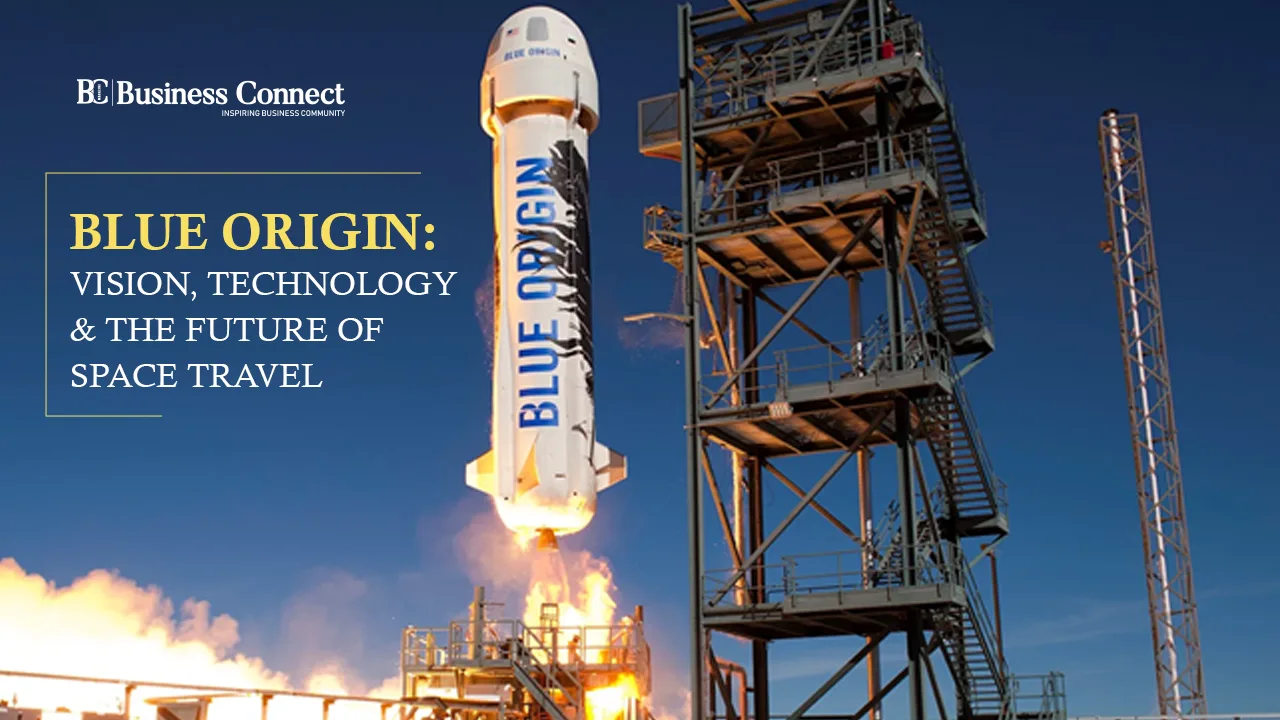
The intervening period has changed that, though not enough to suspend scepticism. On January 16, 2025, New Glenn reached orbit on its first mission, a landmark that moved Blue Origin out of the category of perennial promise and into the more demanding category of actual launch providers. The booster was lost on descent, but orbit was achieved, which in space remains no trivial threshold.
Then, on November 13, 2025, the company achieved its first successful New Glenn booster landing, this time during the mission carrying NASA’s ESCAPADE spacecraft. That mattered for reasons beyond engineering pride. Reusability is not brand decoration in this business; it is the arithmetic beneath any serious claim about the future economics of access to orbit.
The third launch of New Glenn took place on 19th April , 2026 depicting real progress in not perfection but taking small steps. Blue origin managed to bring the rocket booster back after launch and landed it safely and reused it.
Yet the payload, AST SpaceMobile’s BlueBird 7 satellite, was inserted into an off-nominal orbit, severe enough that the spacecraft could not continue its intended mission. This was not a public-relations catastrophe, nor was it something investors and customers will wave away as a learning experience indefinitely. It was a reminder of the unforgiving nature of the launch market. Cadence matters, but so does precision. A company does not become infrastructure because it flies. It becomes infrastructure when customers trust what happens after separation.
That tension defines Blue Origin’s present moment. The company’s long-term thesis has always been elegant. If space is to become economically meaningful rather than episodically inspirational, launch must become more routine, more reusable, more industrial and eventually cheaper. In that worldview, New Shepard was never the main event, whatever the public imagination may have preferred. That is not an insignificant operational record. But it is also not the core of the company’s future.
A Testbed is basically a sandbox where engineers try things, break them, fix them and learn without risking the entire system. It is a reusable system which can launch land and turn around can be done very smoothly. It is not about rockets but about training an entire system including machines and people so that it can perform consistently and effectively. New origin conducted it’s 38th flight of New Shepherd. It shows that repetition builds reliability.
Tourism, for all its symbolic usefulness, remains the least consequential way to understand Blue Origin. The market tends to fixate on suborbital passengers because human spaceflight is legible, photogenic and easy to narrate. It gives the company a visible product and offers Bezos’ broader vision a tangible emotional bridge.
Yet the serious business case lies elsewhere. Blue Origin’s strategic importance is bound up in heavy-lift launch, in-space mobility, lunar logistics and the gradual construction of a reusable industrial stack that might one day make more permanent human and commercial activity in space economically plausible.
That is where New Glenn matters. The rocket is not simply another large launcher joining a crowded field. It is Blue Origin’s bid to become indispensable to customers who care less about founder mythology than about payload capacity, fairing volume, reusability, pricing, launch reliability and long-term manifest confidence. It is also the vehicle around which much of the company’s deeper architecture begins to cohere.
The BE-4 engines, after years of scrutiny and delay, are no longer theoretical. The upper-stage BE-3U engines, Blue Ring’s in-space logistics ambitions, and Blue Moon’s lunar transport aspirations all suggest that Blue Origin is building not just a rocket, but a layered transportation and infrastructure business. That is the right ambition if one actually believes space’s commercial future lies in industrialization rather than isolated missions.
The difficulty, naturally, is that belief alone does not compress time. Blue Origin’s engineering patience has often looked admirable from inside the company and exasperating from outside it. Rivals, especially SpaceX, rewrote market expectations by marrying iteration speed with escalating mission ambition. Against that backdrop, Blue Origin’s slower development cycles have often felt less like prudence and more like institutional drag.
Even now, after three New Glenn flights, the competitive question has not disappeared. It has merely matured. Blue Origin no longer needs to prove that it can build an orbital rocket. It needs to prove that it can become operationally reliable enough, frequently enough, to matter in a market already shaped by customers who have alternatives.
That is why the company’s future should be understood less through the language of disruption and more through the language of infrastructure. Space travel, in its next meaningful phase, is not primarily about affluent passengers floating for a few minutes in microgravity. It is about whether launch and in-space services can become routine enough to support larger systems: satellite constellations, space-based communications, lunar cargo, scientific missions, defence workloads, and eventually industrial activity that cannot survive on bespoke mission economics.
Blue Origin’s long game has always rested on the proposition that humanity’s future in space will be built not by singular heroics but by repeatable transport. That remains a sensible thesis. The market will now ask whether the company can execute it at the speed required.
This is where Blue Ring and Blue Moon deserve more attention than they generally receive in mainstream coverage. Blue Ring represents a move toward orbital mobility and logistics, the sort of infrastructure layer that becomes valuable only after launch capacity begins to normalize. Blue Moon, meanwhile, is the lunar extension of Blue Origin’s ambition: the company is not satisfied with reaching orbit if it cannot eventually participate in what comes after.
This is strategically coherent. If one believes cis-lunar space will become a serious arena for science, national ambition and commercial activity, then the company that controls pieces of the logistics chain may matter more over time than the company that merely offers a ride. Yet these programs also sharpen the burden of proof. A firm that aspires to build the roads, trucks and ports of space will be judged more harshly for each stumble in basic transportation reliability.
None of this should obscure the scale of what Blue Origin has already achieved. Building a reusable heavy-lift system is not routine engineering. Reaching orbit on January 16, 2025, landing the New Glenn booster on November 13, 2025, maintaining New Shepard’s human-flight cadence through January 22, 2026, and executing a reused-booster return on April 19, 2026, are real milestones.
In another era, they might have been treated as stunning enough on their own. But the space industry no longer grants applause on historical terms alone. It grants relevance on operational terms. The bar has moved.
That may ultimately be good for Blue Origin. The company is at its most interesting when stripped of romance and judged against the disciplines it claims to serve: reliability, reusability, affordability, infrastructure depth and long-horizon customer utility.
Bezos’ vision of millions living and working in space is grand enough to survive a certain amount of scepticism. What it cannot survive indefinitely is separation from industrial proof. The history of space has always produced visionaries. The future of space will belong to infrastructure builders.
Blue Origin’s significance, then, lies not in whether it inspires wonder. It plainly does. It lies in whether it becomes the kind of company that customers, agencies and future industries can build around. If it succeeds, it will have demonstrated that patient capital and industrial conviction still have a place in a launch market shaped by velocity.
If it falters, it will be a reminder that vision, no matter how well financed, is not self-executing. Space travel’s next chapter will be written less by those who speak most beautifully about the frontier than by those who can make the route there dependable. Blue Origin has finally entered that test. The real scrutiny starts now.