
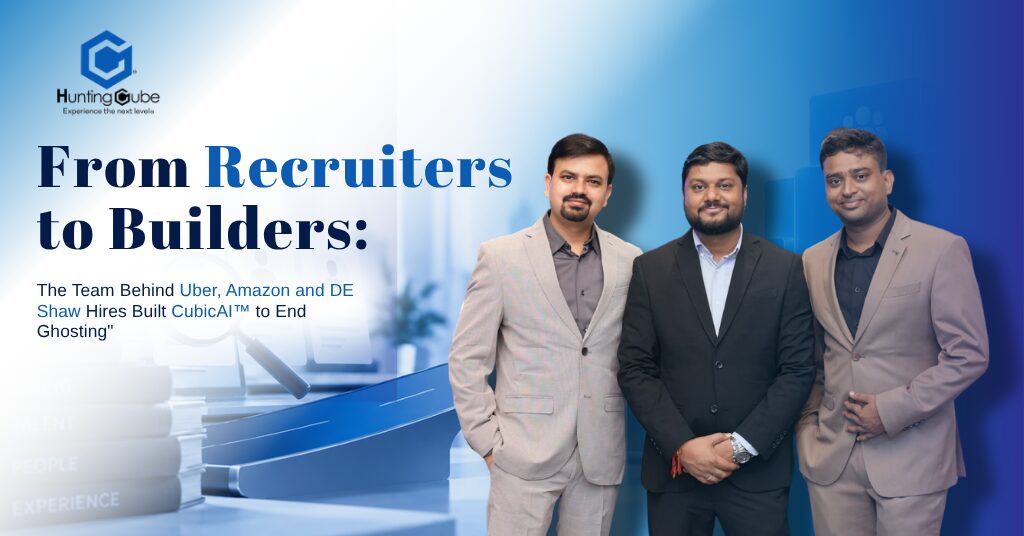
From Recruiters to Builders: The Team Behind Uber, Amazon and DE Shaw Hires Built CubicAI™ to End Ghosting
There’s a particular kind of frustration that only shows up after you’ve done the same job a few thousand times. It isn’t the frustration of failing. It’s the frustration of succeeding, over and over, through sheer brute effort and slowly realising the effort should never have been necessary in the first place.
That’s roughly where Mayank, Ashwani and Anshuman found themselves after a decade of placing technology professionals at some of India’s most demanding companies. Between them, they’d built founding engineering teams, closed roles that had sat open for over a year, and placed leaders who went on to shape the direction of entire India operations. They were good at it. What ate at them was how much of the work never needed to happen at all.
A decade of watching the same thing break
Recruitment, viewed from the inside, is mostly triage. A mandate lands. Somewhere in the market sit perhaps forty people who could genuinely do the job and maybe eight who’d actually consider moving. The craft is finding those eight. Everything else the résumé volume, the filtering, the scheduling, the endless status pings is overhead standing between the recruiter and that small handful of real conversations.
The tools available never touched the hard part. They only helped with the overhead, and not particularly well. Job boards offered enormous databases and left the actual searching to whoever was paying. Applicant tracking systems diligently recorded what happened to candidates who’d already shown up and said nothing about the far more important group who never applied at all.
“We were solving the same problem manually, over and over, for different clients,” says one of the three. “At some point you either accept that as the job, or you go build the thing you’ve been wishing existed.”
They chose the second. The decision wasn’t made in a boardroom it happened somewhere between two back-to-back mandates that had both stalled for the exact same avoidable reason, the kind of coincidence that stops being a coincidence once you’ve seen it enough times.
What they refused to automate
The obvious product to build would’ve been a better search engine more profiles, faster filters, smarter keywords. They deliberately didn’t build that.
Their reasoning came from watching where mandates actually died. Almost never at the point of search there were always candidates. Roles died because a job description quietly described two jobs at one salary. Because the pipeline was built from people who happened to be available, not people who actually fit. Because a notice period or a compensation expectation surfaced in the final round, when it should have surfaced on the first call.
None of that is a search failure. Those are judgement failures and judgement was exactly what the market’s tooling had never offered.
So CubicAI, the engine they eventually built, was scoped narrowly and honestly. It does what software genuinely does better than people: reads across a network of 3 million+ technology professionals without ever tiring, connects skills to trajectory instead of matching keywords, notices the moment a candidate quietly goes active again, and coordinates outreach at a scale no recruiting team could sustain by hand.
And then it stops. Every profile that reaches a client passes through a senior recruiter who has actually read it and must be able to defend the recommendation. Internally, the team calls CubicAI a recruiter’s GPT an instrument, never a replacement.
“The temptation with this technology is to let it run all the way to the client, because that’s where the margins are,” says Akash Verma, Chief Product Officer at HuntingCube. “We put a person in the way on purpose. It costs us more, and it’s the reason the numbers work.”
The numbers, and what they’re actually made of
HuntingCube has now closed 5,000+ positions and maintains an offer-to-acceptance ratio of 93%. In an industry where candidates routinely accept and then vanish without a word, that second number is the one the founders point to first and they’re quick to say it isn’t a software win. It comes from refusing to send a single profile until someone has confirmed whether the person will genuinely move.
The firm runs four practice areas: technology and product recruitment, leadership and executive search, a specialist practice for high-frequency trading and BFSI, and RPO models for organisations scaling fast. The work has spanned building the initial engineering, product and QA teams for a consumer fintech during its early growth, becoming preferred vendor at a global trading firm by closing engineering roles that had already defeated other agencies, and standing up an entire India leadership team for a global operator.
That the recruiting team itself is drawn substantially from the technology industry isn’t incidental it’s structural. It’s genuinely difficult to have a credible conversation with a staff engineer about why a role is interesting if you can’t follow what the role actually involves.
Building the platform in public
HuntingCube 2.0, the current version of the platform, opens most of that machinery directly to hiring teams. Employers can post roles free, upload résumés in bulk for CubicAI to parse and score, review ranked shortlists where every candidate carries a written AI Insight explaining the fit and flagging the gaps honestly, and message shortlisted candidates over chat, WhatsApp and email all without leaving the portal.
The founders have paired the launch with an unusually blunt offer: send one role that’s stayed open too long, receive thirteen profiles at no cost, and compare them directly against whatever the existing pipeline produced for the same mandate.
“Every AI recruitment platform in this market makes roughly the same claims,” says Verma. “We’d rather be tested than believed.”
The longer view
Ask the three what they’re actually building, and the answer isn’t “a recruitment product.” It’s a stated intent to make careers meaningful and companies future-ready to treat hiring as a growth function, not an administrative one.
That’s a large ambition for a firm that began with three recruiters tired of doing the same work twice. But that origin is arguably the whole point. Plenty of hiring software gets built by engineers who inferred the problem from a distance. This was built by people who spent ten years living inside it and who know exactly which parts should never be handed to a machine.
Add Business Connect magazine to your Google News feed