
Electric Passenger Auto Price in India: What Determines the Cost?
Ask five different dealers what an electric passenger auto costs and you’ll probably get five different numbers, none of which quite match what you saw on a website last week. That’s not dealers being shady, it’s just that the price of these vehicles depends on more moving parts than people realize. If you’re actually trying to budget for one, whether for yourself or for a small fleet, it helps to know what’s actually driving that number up or down.
So here’s a breakdown of what really goes into the price tag, not just “battery costs more, obviously.”
Here’s a quick snapshot of how these factors typically move the price, before we get into each one in detail:
| Factor | Impact on Price | Why It Matters |
| Battery size (kWh) | High | Biggest single cost driver, directly affects range |
| Motor power/torque | Moderate | Higher torque variants cost more to build |
| Government subsidy | Varies by category | L5 e-autos lost central subsidy after Dec 2025; e-rickshaws still eligible till March 2028 |
| Cabin build quality | Moderate | Reinforced metal cabins and better seating cost more than basic shells |
| Charging technology | Moderate | Fast-charge support needs better onboard electronics |
| Brand and warranty | Low to Moderate | Wider service networks and longer battery warranties add a premium |
| State/RTO charges | Varies by state | Road tax and registration costs differ across states |
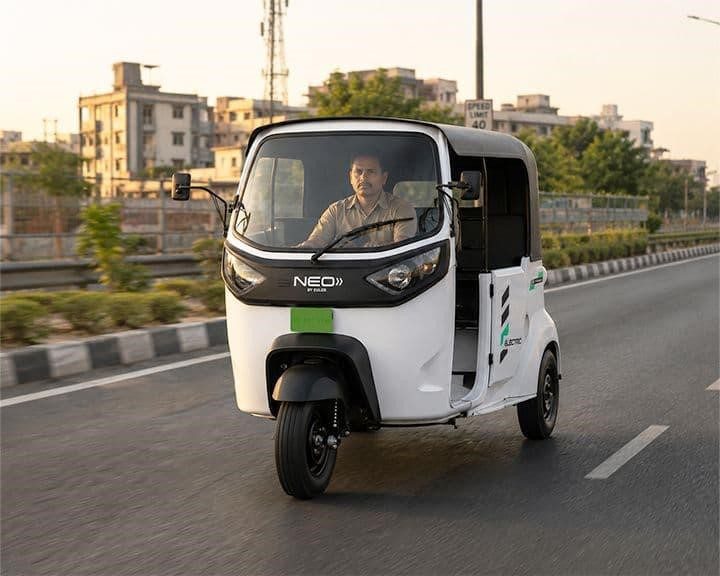
A good real-world example of how this plays out is the Euler NEO lineup, which comes in three variants (HiRANGE, Plus, and Maxx) built around exactly this kind of tiered structure. The base variant carries a smaller 9.6 kWh battery and starts at a lower price point, while the top Maxx variant steps up to a 13.44 kWh battery with a longer certified range and a higher price to match. Same cabin, same motor, same brand and warranty terms, the price gap between variants comes down almost entirely to battery size. It’s a useful case study for seeing how directly that one factor moves the number, without other variables muddying the comparison.
Battery Size Is the Biggest Single Factor
This one’s not surprising, but the scale of it might be. Battery packs are the single most expensive component in any electric vehicle, and passenger autos are no exception. A base variant with a smaller battery, say around 9-10 kWh, will land at a noticeably lower price than a higher variant of the same vehicle with 13-14 kWh. You’re not just paying for more range, you’re paying for more lithium-ion cells, and that cost scales pretty directly.
This is why most manufacturers offer two or three variants of the same auto, base, mid, and long-range. It’s not really about giving you “options” in a marketing sense, it’s about letting price-sensitive buyers get in at a lower entry point while still offering something for drivers who need more range per charge.
Motor Power and Torque
A stronger motor costs more to build, and it shows up in the final price. Autos designed for flatter city routes with lighter loads can get away with a smaller motor. Ones built to handle inclines, higher passenger loads, or more aggressive acceleration need something beefier, and that pushes the price up. It’s a smaller factor than battery size, but it’s not nothing, especially once you compare two vehicles with similar battery capacity but different torque output.
Government Subsidies, or the Lack of Them Now
This is the part that’s changed a lot recently, and honestly a lot of people shopping right now are working off outdated information. Under the PM E-DRIVE scheme, the central government used to offer a meaningful subsidy on L5 category electric passenger three-wheelers, the class that most passenger e-autos fall under. That subsidy was withdrawn in late December 2025 after the scheme hit its allocated target of roughly 2.88 lakh vehicles. So if you’re pricing out an L5 e-auto today, don’t assume a central subsidy is baked into the number you’re seeing, because for this category, it isn’t anymore.
E-rickshaws (the smaller L3 category) are a different story. Those remain eligible for demand incentives through March 2028, though the scheme is fund-limited, meaning it can close early if the allocated budget runs out before the deadline. Some states also run their own additional incentive programs on top of whatever’s left at the central level, so it’s worth checking your specific state’s transport department before assuming either way.
Build Quality and Cabin Materials
This one’s easy to underestimate until you sit in two different autos back to back. A reinforced metal cabin costs more to manufacture than a lighter, more basic shell, and it shows in the price. Same goes for seat quality, suspension tuning, and small comfort details like proper legroom or a decent headliner. None of these individually move the price by a huge margin, but they add up, and they’re also usually the first things a manufacturer cuts to hit a lower price point on a base variant.
Charging Technology
Support for fast charging, rather than just standard overnight charging, adds cost to the onboard electronics. A vehicle that can go from a low charge to nearly full in a couple of hours needs better thermal management and charging circuitry than one that’s only built for a slow overnight top-up. If you see two similarly specced autos with a noticeable price gap, charging speed capability is often part of that difference.
Brand, Warranty, and After-Sales Network
This is less about the vehicle itself and more about what you’re buying alongside it. A manufacturer with a wider service network, faster parts availability, and a longer battery warranty tends to price a bit higher than a lesser-known brand offering similar specs on paper. Whether that premium is worth it really depends on how much you value not being stranded waiting for a part, and how far you are from the nearest authorized service center.
Battery warranty terms specifically are worth comparing closely. Some manufacturers offer 5 years or a set kilometer cap as standard, with the option to extend further, and that difference in coverage can matter more to your actual cost of ownership than the sticker price alone, since a battery replacement outside warranty is a genuinely expensive repair.
Regional Pricing Differences
The same vehicle can cost differently depending on which state you’re registering it in. Road tax, RTO charges, and any remaining state-level EV incentives all get added on top of the ex-showroom price, and these vary enough between states that it’s worth checking the on-road price for your specific city rather than going off a national average you saw online.
What This Means If You’re Actually Buying
If you’re comparing two electric passenger autos and one is meaningfully cheaper, it’s worth figuring out exactly where that gap is coming from before assuming it’s the better deal. Smaller battery and lower real-world range? Lighter cabin build? Slower charging? None of these are automatically dealbreakers, they might genuinely suit your route and budget, but you want to know what you’re trading off, not just see a lower number and assume it’s the smarter buy.
The honest way to shop this category is to figure out your daily route distance first, then match that against the range you actually need, and only then start comparing prices within that range bracket. Comparing sticker prices across vehicles with different battery sizes is a bit like comparing car prices without checking engine size, technically a number, but not a useful one on its own.